




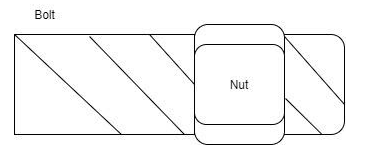
A nut is screwed onto a bolt with $12$ turns per cm and diameter $1.18$ cm. The bolt is lying in a horizontal direction. The nut spins at $216$ r.p.m. Time taken by the nut to cover $1.5$ cm along the bolt is
A) $2$s
B) $3$s
C) $4$s
D) $5$s
Answer
 Verified
580.8k+ views
Hint:A nut screwing in the bolt shows a rotational motion. But with every rotation the nut advances an amount of length through the bolt. So, here you can see a translational motion along with a rotational motion indeed.
Complete step by step answer:
Given:
The nut is screwed onto the bolt with $12$ turns per cm.
The diameter of the nut is $1.18$ cm.
The nut spins at $216$ r.p.m .
To get: The time taken by the nut to cover $1.5$ cm through the bolt.
Step 1:
You can consider the nut and the bolt to be uniform.
Hence, if the nut takes $12$ turns to cover a distance of $1$ cm through the bolt, then you calculate the number of turns required to cover $1.5$ cm.
$N = 12 \times 1.5 = 18$
Step 2:
The nut spins with $216$ r.p.m.
$\therefore $ It takes one minute to complete $216$ turns.
Hence, calculate the time taken by the nut to complete one turn.
$t = \dfrac{1}{{216}}$ minute
$ \Rightarrow t = \dfrac{{60}}{{216}}$ s
Step 3:
So, you get that the nut requires $N = 18$ turns to traverse a distance of $1.5$ cm onto the bolt and it takes $t = \dfrac{{60}}{{216}}$ s to complete one turn.
Hence calculate the time required by the nut to move a distance of $1.5$ cm onto the bolt.
$
T = t \times N \\
\Rightarrow T = \dfrac{{60}}{{216}} \times 18s \\
\Rightarrow T = \dfrac{{60}}{{12}}s \\
\Rightarrow T = 5s \\
$
$\therefore $ The time taken by the screw is $5$ s.
Final Answer:If a nut is screwed onto a bolt with $12$ turns per cm and diameter $1.18$ cm with the bolt lying in horizontal direction and the nut spinning at $216$ r.p.m, then the time taken by the nut to cover $1.5$ cm along the bolt is (D) $5$ s.
Note:The motion is here not only the rotational motion but a transaction is also happening. This type of motion is called helical motion, where the time rate of rotation is your key content. You need to understand that the angular velocity is given in terms of rotation per minute, so the diameter and hence the total travelled path is useless here. Only the distance along the bolt per rotation is what you need to consider because with each turn it will enter to a certain distance along the bolt and this is the only thing you require.
Complete step by step answer:
Given:
The nut is screwed onto the bolt with $12$ turns per cm.
The diameter of the nut is $1.18$ cm.
The nut spins at $216$ r.p.m .
To get: The time taken by the nut to cover $1.5$ cm through the bolt.
Step 1:
You can consider the nut and the bolt to be uniform.
Hence, if the nut takes $12$ turns to cover a distance of $1$ cm through the bolt, then you calculate the number of turns required to cover $1.5$ cm.
$N = 12 \times 1.5 = 18$
Step 2:
The nut spins with $216$ r.p.m.
$\therefore $ It takes one minute to complete $216$ turns.
Hence, calculate the time taken by the nut to complete one turn.
$t = \dfrac{1}{{216}}$ minute
$ \Rightarrow t = \dfrac{{60}}{{216}}$ s
Step 3:
So, you get that the nut requires $N = 18$ turns to traverse a distance of $1.5$ cm onto the bolt and it takes $t = \dfrac{{60}}{{216}}$ s to complete one turn.
Hence calculate the time required by the nut to move a distance of $1.5$ cm onto the bolt.
$
T = t \times N \\
\Rightarrow T = \dfrac{{60}}{{216}} \times 18s \\
\Rightarrow T = \dfrac{{60}}{{12}}s \\
\Rightarrow T = 5s \\
$
$\therefore $ The time taken by the screw is $5$ s.
Final Answer:If a nut is screwed onto a bolt with $12$ turns per cm and diameter $1.18$ cm with the bolt lying in horizontal direction and the nut spinning at $216$ r.p.m, then the time taken by the nut to cover $1.5$ cm along the bolt is (D) $5$ s.
Note:The motion is here not only the rotational motion but a transaction is also happening. This type of motion is called helical motion, where the time rate of rotation is your key content. You need to understand that the angular velocity is given in terms of rotation per minute, so the diameter and hence the total travelled path is useless here. Only the distance along the bolt per rotation is what you need to consider because with each turn it will enter to a certain distance along the bolt and this is the only thing you require.
Recently Updated Pages
Master Class 12 Economics: Engaging Questions & Answers for Success

Master Class 12 Physics: Engaging Questions & Answers for Success
Master Class 12 English: Engaging Questions & Answers for Success
Master Class 12 Social Science: Engaging Questions & Answers for Success
Master Class 12 Maths: Engaging Questions & Answers for Success
Master Class 12 Business Studies: Engaging Questions & Answers for Success
Trending doubts
Which are the Top 10 Largest Countries of the World?
What are the major means of transport Explain each class 12 social science CBSE
Draw a labelled sketch of the human eye class 12 physics CBSE
Differentiate between insitu conservation and exsitu class 12 biology CBSE
Draw a neat and well labeled diagram of TS of ovary class 12 biology CBSE
Give 10 examples of unisexual and bisexual flowers