




A semi-circular ring of radius 0.5m is uniformly charged with the total charge of $1.4 \times 10^{-9}C$. The electric field intensity at the centre of the ring:
$\text{A.} \ 320Vm^{-1}$
$\text{B.} \ 0Vm^{-1}$
$\text{C.} \ 64Vm^{-1}$
$\text{D.} \ 32Vm^{-1}$
Answer
 Verified
528.2k+ views
Hint: Here, it is important to note that the charge is distributed over an object. Hence we cannot directly apply Coulomb's law which is valid for point charge. Hence we need to get the electric field due to any general element and then integrate over the ring to get a net electric field at the centre.
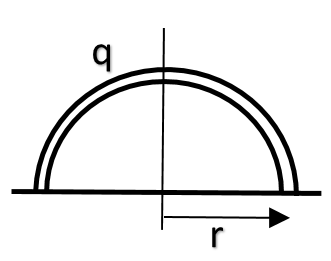
Formula used:
$dE = \dfrac{Kdq}{r^2}$
Complete answer:
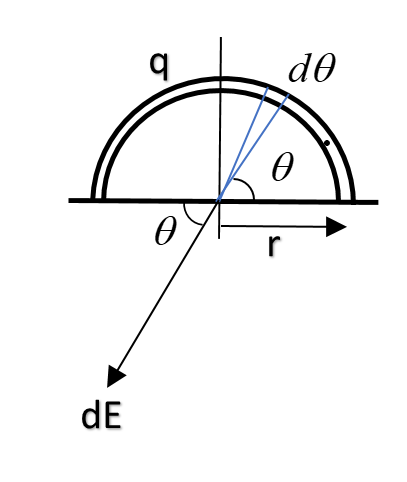
Let us consider an elementary part of the ring at an angle $\theta$ having angular length of $d\theta$. The small charge inside the elementary part will be calculated as follows:
Total circumference = $\pi r$
Total charge distributed = q
Hence the linear charge density = $\dfrac{q}{\pi r}$
Thus the total charge in the element of length $rd\theta$, will be:
$dq = \dfrac{q}{\pi r}rd\theta = \dfrac{qd\theta}{\pi}$
Now, using $dE = \dfrac{Kdq}{r^2}$
The field along –y axis is sin component of dE,
$dE_{y} = dE cos\theta = \dfrac{Kq}{\pi r^2}\times sin\theta d\theta$
Then, $E_{net} = \int dE = \int \dfrac{Kq}{\pi r^2} \times sin\theta d\theta$
[ where $E_{net}$= net field in –y direction]
Or, ${{E}_{net}}=\dfrac{Kq}{\pi {{r}^{2}}}\times \int\limits_{0}^{\pi }{sin\theta {d}}\theta$ [ as K. q and r are constants ]
As the material is present for $\theta = 0 \ to \ \theta = \pi$, hence are the limits.
And $E_{net} = \dfrac{Kq}{\pi r^2} \times (1-(-1)) = \dfrac{2Kq}{\pi r^2}$
Hence we get the net field in my direction.
On putting the values $q=1.4 \times 10^{-9}C$, r=0.5m, we get;
$E_{net} = \dfrac{2\times 9\times 10^9 \times 1.4 \times 10^{-9}}{3.14 \times 0.5^2} = 32 Vm^{-1}$
So, the correct answer is “Option D”.
Note:
Students here should note that we can write $E_{y} = E_{net}$ as due to symmetry, only y component of the field will contribute for the total field and x component will come out to be zero. This can also be easily proven by taking $dE_x = dE_{net} = \dfrac{Kq}{r^2}\times cos\theta$. Also students should understand how to take the limits. If the material were present only in the first quadrant, we might have taken the limits from 0 to $\dfrac{\pi}{2}$ instead of $\pi$.
Formula used:
$dE = \dfrac{Kdq}{r^2}$
Complete answer:
Let us consider an elementary part of the ring at an angle $\theta$ having angular length of $d\theta$. The small charge inside the elementary part will be calculated as follows:
Total circumference = $\pi r$
Total charge distributed = q
Hence the linear charge density = $\dfrac{q}{\pi r}$
Thus the total charge in the element of length $rd\theta$, will be:
$dq = \dfrac{q}{\pi r}rd\theta = \dfrac{qd\theta}{\pi}$
Now, using $dE = \dfrac{Kdq}{r^2}$
The field along –y axis is sin component of dE,
$dE_{y} = dE cos\theta = \dfrac{Kq}{\pi r^2}\times sin\theta d\theta$
Then, $E_{net} = \int dE = \int \dfrac{Kq}{\pi r^2} \times sin\theta d\theta$
[ where $E_{net}$= net field in –y direction]
Or, ${{E}_{net}}=\dfrac{Kq}{\pi {{r}^{2}}}\times \int\limits_{0}^{\pi }{sin\theta {d}}\theta$ [ as K. q and r are constants ]
As the material is present for $\theta = 0 \ to \ \theta = \pi$, hence are the limits.
And $E_{net} = \dfrac{Kq}{\pi r^2} \times (1-(-1)) = \dfrac{2Kq}{\pi r^2}$
Hence we get the net field in my direction.
On putting the values $q=1.4 \times 10^{-9}C$, r=0.5m, we get;
$E_{net} = \dfrac{2\times 9\times 10^9 \times 1.4 \times 10^{-9}}{3.14 \times 0.5^2} = 32 Vm^{-1}$
So, the correct answer is “Option D”.
Note:
Students here should note that we can write $E_{y} = E_{net}$ as due to symmetry, only y component of the field will contribute for the total field and x component will come out to be zero. This can also be easily proven by taking $dE_x = dE_{net} = \dfrac{Kq}{r^2}\times cos\theta$. Also students should understand how to take the limits. If the material were present only in the first quadrant, we might have taken the limits from 0 to $\dfrac{\pi}{2}$ instead of $\pi$.
Recently Updated Pages
Master Class 12 Economics: Engaging Questions & Answers for Success

Master Class 12 Physics: Engaging Questions & Answers for Success
Master Class 12 English: Engaging Questions & Answers for Success
Master Class 12 Social Science: Engaging Questions & Answers for Success
Master Class 12 Maths: Engaging Questions & Answers for Success
Master Class 12 Business Studies: Engaging Questions & Answers for Success
Trending doubts
Which are the Top 10 Largest Countries of the World?
What are the major means of transport Explain each class 12 social science CBSE
Draw a labelled sketch of the human eye class 12 physics CBSE
Why cannot DNA pass through cell membranes class 12 biology CBSE
Differentiate between insitu conservation and exsitu class 12 biology CBSE
Draw a neat and well labeled diagram of TS of ovary class 12 biology CBSE