




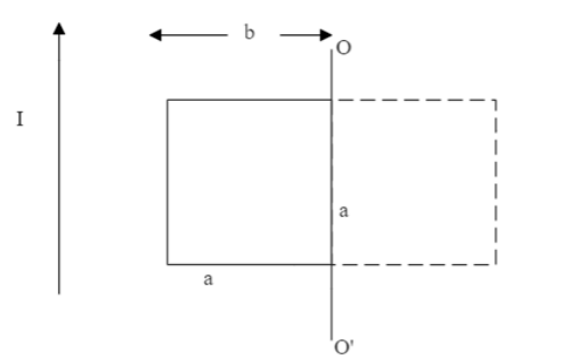
A square wire frame of side $ a $ is placed $ b $ away from a long straight conductor carrying current $ I $ . The frame has resistance $ R $ and self-inductance $ L $ . The frame is rotated by $ 180^\circ $ about $ OO' $ as shown in figure. Find the electric charge flown through the frame.
(A) $ \dfrac{{2{\mu _0}i{a^2}}}{{2\pi Rb}} $
(B) $ \dfrac{{{\mu _0}i}}{{2\pi R}}{\log _e}\dfrac{{b + a}}{{b - a}} $
(C) $ \dfrac{{{\mu _0}ia}}{{2\pi R}}{\log _e}\dfrac{{b + a}}{{b - a}} $
(D) None of these
Answer
 Verified
561.3k+ views
Hint: We know that the faraday's law stated that a changing magnetic field produces an electric field. So charges that are free to move will cause an EMF and a current. Thus the magnetic statement of Faraday’s Law is that EMF induced in a loop is proportional to rate of change in flux.
$ E = iR = \dfrac{{\Delta \phi }}{{\Delta t}} $
We also know that the current in a conductor is nothing but, charge flowing in it per unit time $ i = \dfrac{q}{t} $
We also know that, $ \phi = \int {B.dA} $ .
Formulas used: We will be using the formula $ E = iR = \dfrac{{\Delta \phi }}{{\Delta t}} $ where $ E $ is the EMF induced by current $ i $ , flowing through a conductor with resistance $ R $ and $ \Delta \phi $ is the change in flux of the body, while $ \Delta t $ is the change in time intervals. We will also be using, $ \phi = \int {B.dA} $ where $ B $ is the magnetic field intensity produced due to the flux and $ dA $ is the change in area.
Complete Step by Step Solution
We know that by faraday’s Laws of electromagnetism, $ E = iR = \dfrac{{\Delta \phi }}{{\Delta t}} $ we also know that $ q = it $ , Thus the charge induced on a body can be given by, $ \dfrac{{{Q_{ind}}}}{{\Delta t}}R = \dfrac{{\Delta \phi }}{{\Delta t}} $ .
$ \Rightarrow {Q_{ind}} = \dfrac{{\Delta \phi }}{R} $ .
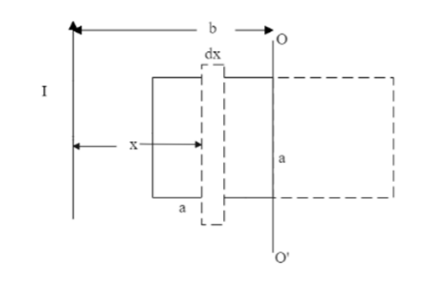
Consider a small strip of width $ dx $ at the distance of $ x $ from the current carrying wire.So let us find the change in flux by finding the final flux and initial flux.
$ d\phi = B.dA $
Integrating the expression to find the initial and final fluxes of the thin strip
$ \int {d\phi } = \int {B.dA} $
We know that $ \int {d\phi } = \phi $ and $ B = \dfrac{{{\mu _0}I}}{{2\pi x}} $ . Also the are of the strip will be $ A = a \times dx $ .
Substituting the values be get,
$ \phi = \int {\dfrac{{{\mu _0}I}}{{2\pi x}} \times adx} $
The limits can be specified to be, $ \left( {b - a} \right) $ to $ b $ .
$ \phi = \dfrac{{{\mu _0}Ia}}{{2\pi }}\int_{b - a}^b {\dfrac{{dx}}{x}} = \dfrac{{{\mu _0}Ia}}{{2\pi }}\left[ {{{\log }_e}b - {{\log }_e}(b - a)} \right] $
$ \Rightarrow \phi = \dfrac{{{\mu _0}Ia}}{{2\pi }}{\log _e}\left( {\dfrac{b}{{b - a}}} \right) $
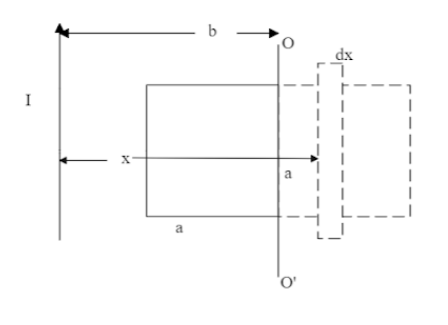
Now, consider the final position to find flux for,
Finding flux using integration,
$ \phi = \int {\dfrac{{{\mu _0}I}}{{2\pi x}} \times adx} $
but the limits will be $ b $ to $ b + a $ .
$ \phi = \dfrac{{{\mu _0}Ia}}{{2\pi }}\int_b^{b + a} {\dfrac{{dx}}{x}} = \dfrac{{{\mu _0}Ia}}{{2\pi }}\left[ {{{\log }_e}(b + a) - {{\log }_e}(b)} \right] $
$ \Rightarrow \phi = \dfrac{{{\mu _0}Ia}}{{2\pi }}{\log _e}\left( {\dfrac{{b + a}}{b}} \right) $
Now we have both the initial and final flux let us find the differences between them, $ \Delta \phi = {\phi _f} - ( - {\phi _i}) = \dfrac{{{\mu _0}Ia}}{{2\pi }}{\log _e}\left( {\dfrac{{b + a}}{b}} \right) - \dfrac{{{\mu _0}Ia}}{{2\pi }}{\log _e}\left( {\dfrac{b}{{b - a}}} \right) $
Since $ \phi = B.dA\cos \theta $ and here $ \theta = 180^\circ $
$ \Delta \phi = \dfrac{{{\mu _0}Ia}}{{2\pi }}{\log _e}\left[ {\left( {\dfrac{{b + a}}{b}} \right) \times \left( {\dfrac{b}{{b - a}}} \right)} \right] $
$ \Rightarrow \Delta \phi = \dfrac{{{\mu _0}Ia}}{{2\pi }}{\log _e}\left( {\dfrac{{b + a}}{{b - a}}} \right) $
Since we know that $ {Q_{ind}} = \dfrac{{\Delta \phi }}{R} $ ,
$ Q = \dfrac{{{\mu _0}Ia}}{{2\pi R}}{\log _e}\left( {\dfrac{{b + a}}{{b - a}}} \right) $
Hence the correct answer is option C.
Note
The problem can also be solved without breaking the limits and taking , solving for, $ \phi = \dfrac{{{\mu _0}Ia}}{{2\pi }}\int_{b - a}^{b + a} {\dfrac{{dx}}{x}} = \dfrac{{{\mu _0}Ia}}{{2\pi }}\left[ {{{\log }_e}(b + a) - {{\log }_e}(b - a)} \right] $
$ \Rightarrow \phi = \dfrac{{{\mu _0}Ia}}{{2\pi }}\left[ {{{\log }_e}(b + a) - {{\log }_e}(b - a)} \right] = \dfrac{{{\mu _0}Ia}}{{2\pi }}{\log _e}\left( {\dfrac{{b + a}}{{b - a}}} \right) $
Thus $ {Q_{ind}} $ will be, $ Q = \dfrac{{{\mu _0}Ia}}{{2\pi R}}{\log _e}\left[ {\dfrac{{b + a}}{{b - a}}} \right] $ .
$ E = iR = \dfrac{{\Delta \phi }}{{\Delta t}} $
We also know that the current in a conductor is nothing but, charge flowing in it per unit time $ i = \dfrac{q}{t} $
We also know that, $ \phi = \int {B.dA} $ .
Formulas used: We will be using the formula $ E = iR = \dfrac{{\Delta \phi }}{{\Delta t}} $ where $ E $ is the EMF induced by current $ i $ , flowing through a conductor with resistance $ R $ and $ \Delta \phi $ is the change in flux of the body, while $ \Delta t $ is the change in time intervals. We will also be using, $ \phi = \int {B.dA} $ where $ B $ is the magnetic field intensity produced due to the flux and $ dA $ is the change in area.
Complete Step by Step Solution
We know that by faraday’s Laws of electromagnetism, $ E = iR = \dfrac{{\Delta \phi }}{{\Delta t}} $ we also know that $ q = it $ , Thus the charge induced on a body can be given by, $ \dfrac{{{Q_{ind}}}}{{\Delta t}}R = \dfrac{{\Delta \phi }}{{\Delta t}} $ .
$ \Rightarrow {Q_{ind}} = \dfrac{{\Delta \phi }}{R} $ .
Consider a small strip of width $ dx $ at the distance of $ x $ from the current carrying wire.So let us find the change in flux by finding the final flux and initial flux.
$ d\phi = B.dA $
Integrating the expression to find the initial and final fluxes of the thin strip
$ \int {d\phi } = \int {B.dA} $
We know that $ \int {d\phi } = \phi $ and $ B = \dfrac{{{\mu _0}I}}{{2\pi x}} $ . Also the are of the strip will be $ A = a \times dx $ .
Substituting the values be get,
$ \phi = \int {\dfrac{{{\mu _0}I}}{{2\pi x}} \times adx} $
The limits can be specified to be, $ \left( {b - a} \right) $ to $ b $ .
$ \phi = \dfrac{{{\mu _0}Ia}}{{2\pi }}\int_{b - a}^b {\dfrac{{dx}}{x}} = \dfrac{{{\mu _0}Ia}}{{2\pi }}\left[ {{{\log }_e}b - {{\log }_e}(b - a)} \right] $
$ \Rightarrow \phi = \dfrac{{{\mu _0}Ia}}{{2\pi }}{\log _e}\left( {\dfrac{b}{{b - a}}} \right) $
Now, consider the final position to find flux for,
Finding flux using integration,
$ \phi = \int {\dfrac{{{\mu _0}I}}{{2\pi x}} \times adx} $
but the limits will be $ b $ to $ b + a $ .
$ \phi = \dfrac{{{\mu _0}Ia}}{{2\pi }}\int_b^{b + a} {\dfrac{{dx}}{x}} = \dfrac{{{\mu _0}Ia}}{{2\pi }}\left[ {{{\log }_e}(b + a) - {{\log }_e}(b)} \right] $
$ \Rightarrow \phi = \dfrac{{{\mu _0}Ia}}{{2\pi }}{\log _e}\left( {\dfrac{{b + a}}{b}} \right) $
Now we have both the initial and final flux let us find the differences between them, $ \Delta \phi = {\phi _f} - ( - {\phi _i}) = \dfrac{{{\mu _0}Ia}}{{2\pi }}{\log _e}\left( {\dfrac{{b + a}}{b}} \right) - \dfrac{{{\mu _0}Ia}}{{2\pi }}{\log _e}\left( {\dfrac{b}{{b - a}}} \right) $
Since $ \phi = B.dA\cos \theta $ and here $ \theta = 180^\circ $
$ \Delta \phi = \dfrac{{{\mu _0}Ia}}{{2\pi }}{\log _e}\left[ {\left( {\dfrac{{b + a}}{b}} \right) \times \left( {\dfrac{b}{{b - a}}} \right)} \right] $
$ \Rightarrow \Delta \phi = \dfrac{{{\mu _0}Ia}}{{2\pi }}{\log _e}\left( {\dfrac{{b + a}}{{b - a}}} \right) $
Since we know that $ {Q_{ind}} = \dfrac{{\Delta \phi }}{R} $ ,
$ Q = \dfrac{{{\mu _0}Ia}}{{2\pi R}}{\log _e}\left( {\dfrac{{b + a}}{{b - a}}} \right) $
Hence the correct answer is option C.
Note
The problem can also be solved without breaking the limits and taking , solving for, $ \phi = \dfrac{{{\mu _0}Ia}}{{2\pi }}\int_{b - a}^{b + a} {\dfrac{{dx}}{x}} = \dfrac{{{\mu _0}Ia}}{{2\pi }}\left[ {{{\log }_e}(b + a) - {{\log }_e}(b - a)} \right] $
$ \Rightarrow \phi = \dfrac{{{\mu _0}Ia}}{{2\pi }}\left[ {{{\log }_e}(b + a) - {{\log }_e}(b - a)} \right] = \dfrac{{{\mu _0}Ia}}{{2\pi }}{\log _e}\left( {\dfrac{{b + a}}{{b - a}}} \right) $
Thus $ {Q_{ind}} $ will be, $ Q = \dfrac{{{\mu _0}Ia}}{{2\pi R}}{\log _e}\left[ {\dfrac{{b + a}}{{b - a}}} \right] $ .
Recently Updated Pages
Master Class 12 Economics: Engaging Questions & Answers for Success

Master Class 12 Physics: Engaging Questions & Answers for Success
Master Class 12 English: Engaging Questions & Answers for Success
Master Class 12 Social Science: Engaging Questions & Answers for Success
Master Class 12 Maths: Engaging Questions & Answers for Success
Master Class 12 Business Studies: Engaging Questions & Answers for Success
Trending doubts
Which are the Top 10 Largest Countries of the World?
What are the major means of transport Explain each class 12 social science CBSE
Draw a labelled sketch of the human eye class 12 physics CBSE
Why cannot DNA pass through cell membranes class 12 biology CBSE
Differentiate between insitu conservation and exsitu class 12 biology CBSE
Draw a neat and well labeled diagram of TS of ovary class 12 biology CBSE