




A thin rod of length \[\dfrac{f}{3}\] is placed along the optical axis of a concave mirror of focal length f such that its image which is real and elongated just touches the rod. Calculate the magnification.
Answer
 Verified
567.6k+ views
Hint: We need to understand the relation between the size of the image, the object distance and the image distance in the given situation to correctly interpret the magnification of the rod. We can easily solve by using the relation between these.
Complete step by step solution:
We are given a thin rod which is kept along the axis of a concave mirror. It is given that the image formed by the rod is real and magnified. From this we can infer that the object is placed between the focal point of the mirror and the center of curvature of the mirror.
Let us assume the length of the image of the thin rod kept along the axis to be of ‘l’ units. We can find the lateral magnification of the using the information given as –
\[\begin{align}
& m=\dfrac{h}{h'} \\
& \Rightarrow m=\dfrac{l}{\dfrac{f}{3}} \\
& \therefore m=\dfrac{3l}{f} \\
\end{align}\]
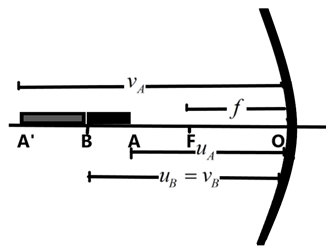
Now, we know that to touch the one end of the object, the object should be kept at the center of curvature extending in the direction of the focal point. We can find the position of the object from this information as –
\[\begin{align}
& {{u}_{A}}=2f-\dfrac{f}{3} \\
& \therefore {{u}_{A}}=\dfrac{5f}{3} \\
\end{align}\]
We can find the image position of the end A of the rod using the mirror formula as –
\[\begin{align}
& \dfrac{1}{f}=\dfrac{1}{{{v}_{A}}}+\dfrac{1}{{{u}_{A}}} \\
& \Rightarrow \dfrac{1}{{{v}_{A}}}=\dfrac{1}{f}-\dfrac{1}{\dfrac{5f}{3}} \\
& \Rightarrow \dfrac{1}{{{v}_{A}}}=\dfrac{5-3}{5f} \\
& \Rightarrow {{v}_{A}}=\dfrac{5f}{2} \\
\end{align}\]
Now, we can see from the figure that the image of the point B which is at the center of curvature will be at B itself.
\[\begin{align}
& \Rightarrow {{u}_{B}}=2f \\
& \therefore {{v}_{B}}=2f \\
\end{align}\]
Now, we can find the size or length of the image of the rod by subtracting the distances of the image distance of the two points from the mirror as –
\[\begin{align}
& l={{v}_{A}}-{{v}_{B}} \\
& \Rightarrow l=\dfrac{5f}{2}-2f \\
& \therefore l=\dfrac{f}{2} \\
\end{align}\]
Now, we can find the magnification as –
\[\begin{align}
& m=\dfrac{3l}{f} \\
& \Rightarrow m=\dfrac{3\dfrac{f}{2}}{f} \\
& \therefore m=\dfrac{3}{2}=1.5 \\
\end{align}\]
Therefore, the magnification of the image of the rod is one and half times the object.
Note:
We could have found the magnification of the image initially by finding the ratio of the image distance from point A to the object distance from point A. But, in some cases where the object length is too large, the magnification will differ from point to point.
Complete step by step solution:
We are given a thin rod which is kept along the axis of a concave mirror. It is given that the image formed by the rod is real and magnified. From this we can infer that the object is placed between the focal point of the mirror and the center of curvature of the mirror.
Let us assume the length of the image of the thin rod kept along the axis to be of ‘l’ units. We can find the lateral magnification of the using the information given as –
\[\begin{align}
& m=\dfrac{h}{h'} \\
& \Rightarrow m=\dfrac{l}{\dfrac{f}{3}} \\
& \therefore m=\dfrac{3l}{f} \\
\end{align}\]
Now, we know that to touch the one end of the object, the object should be kept at the center of curvature extending in the direction of the focal point. We can find the position of the object from this information as –
\[\begin{align}
& {{u}_{A}}=2f-\dfrac{f}{3} \\
& \therefore {{u}_{A}}=\dfrac{5f}{3} \\
\end{align}\]
We can find the image position of the end A of the rod using the mirror formula as –
\[\begin{align}
& \dfrac{1}{f}=\dfrac{1}{{{v}_{A}}}+\dfrac{1}{{{u}_{A}}} \\
& \Rightarrow \dfrac{1}{{{v}_{A}}}=\dfrac{1}{f}-\dfrac{1}{\dfrac{5f}{3}} \\
& \Rightarrow \dfrac{1}{{{v}_{A}}}=\dfrac{5-3}{5f} \\
& \Rightarrow {{v}_{A}}=\dfrac{5f}{2} \\
\end{align}\]
Now, we can see from the figure that the image of the point B which is at the center of curvature will be at B itself.
\[\begin{align}
& \Rightarrow {{u}_{B}}=2f \\
& \therefore {{v}_{B}}=2f \\
\end{align}\]
Now, we can find the size or length of the image of the rod by subtracting the distances of the image distance of the two points from the mirror as –
\[\begin{align}
& l={{v}_{A}}-{{v}_{B}} \\
& \Rightarrow l=\dfrac{5f}{2}-2f \\
& \therefore l=\dfrac{f}{2} \\
\end{align}\]
Now, we can find the magnification as –
\[\begin{align}
& m=\dfrac{3l}{f} \\
& \Rightarrow m=\dfrac{3\dfrac{f}{2}}{f} \\
& \therefore m=\dfrac{3}{2}=1.5 \\
\end{align}\]
Therefore, the magnification of the image of the rod is one and half times the object.
Note:
We could have found the magnification of the image initially by finding the ratio of the image distance from point A to the object distance from point A. But, in some cases where the object length is too large, the magnification will differ from point to point.
Recently Updated Pages
Master Class 12 Economics: Engaging Questions & Answers for Success

Master Class 12 Physics: Engaging Questions & Answers for Success
Master Class 12 English: Engaging Questions & Answers for Success
Master Class 12 Social Science: Engaging Questions & Answers for Success
Master Class 12 Maths: Engaging Questions & Answers for Success
Master Class 12 Business Studies: Engaging Questions & Answers for Success
Trending doubts
Which are the Top 10 Largest Countries of the World?
What are the major means of transport Explain each class 12 social science CBSE
Draw a labelled sketch of the human eye class 12 physics CBSE
Why cannot DNA pass through cell membranes class 12 biology CBSE
Differentiate between insitu conservation and exsitu class 12 biology CBSE
Draw a neat and well labeled diagram of TS of ovary class 12 biology CBSE