




A triangle having vertices as $P\left( \cos \alpha ,\sin \alpha \right),Q\left( \cos \beta ,\sin \beta \right),R\left( \cos \gamma ,\sin \gamma \right)$, whose orthocentre is $\left( 0,0 \right)$. Then, the value of $\cos \left( \alpha -\beta \right)+\cos \left( \beta -\gamma \right)+\cos \left( \gamma -\alpha \right)$ is
A. $\dfrac{-3}{2}$
B. $\dfrac{-1}{2}$
C. $\dfrac{1}{2}$
D. $\dfrac{3}{2}$
Answer
 Verified
621.3k+ views
Hint: The centroid of the triangle divides the line joining orthocentre and the circumcentre in the ratio \[2:1\].
The given vertices of the triangle are \[P(\cos \alpha ,\sin \alpha ),Q\left( \cos \beta ,\sin \beta \right)\] and \[R\left( \cos \gamma ,\sin \gamma \right)\].
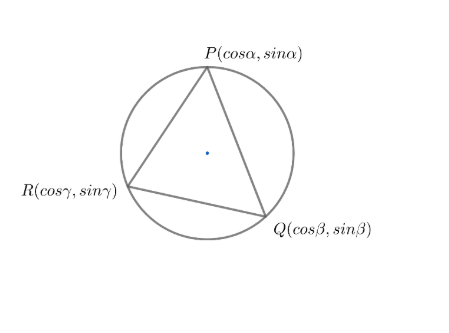
Now, we will consider the circumcircle of the triangle.
To find the equation of the circumcircle , we will see the vertices of the triangle.
By observation , we can conclude that all the vertices of the triangle satisfy the equation \[{{x}^{2}}+{{y}^{2}}=1\]
So , the equation of the circumcircle will be \[{{x}^{2}}+{{y}^{2}}=1......(i)\]
Now , we know the general equation of circle with centre at \[(a,b)\] and radius \[r\] is given as
\[{{(x-a)}^{2}}+{{(y-b)}^{2}}={{r}^{2}}\]
Compared with equation\[(i)\], we can say that the centre of the circle represented by equation \[(i)\] is \[(0,0)\] and radius is \[1\] units.
So, the centre of the circumcircle is \[(0,0)\] and hence the circumcentre is \[(0,0)\].
Now, we know the centroid of the triangle divides the line joining orthocentre and the circumcentre in the ratio \[2:1\].
Now, in the question it is given that the orthocentre of \[\vartriangle ABC\] is \[(0,0)\] and from equation\[(i)\] we get that the circumcentre is also \[(0,0)\].
So , centroid is also \[(0,0)\].
We know , if a triangle has vertices \[\left( {{x}_{1}},{{y}_{1}} \right),\left( {{x}_{2}},{{y}_{2}} \right)\]and \[\left( {{x}_{3}},{{y}_{3}} \right)\] then , its centroid is given as
\[\left( \left( \dfrac{{{x}_{1}}+{{x}_{2}}+{{x}_{3}}}{3} \right),\left( \dfrac{{{y}_{1}}+{{y}_{2}}+{{y}_{3}}}{3} \right) \right)\]
So , \[\left( \left( \dfrac{\cos \alpha +\cos \beta +\cos \gamma }{3} \right),\left( \dfrac{\sin \alpha +\sin \beta +\sin \gamma }{3} \right) \right)=\left( 0,0 \right)\]
Now,
\[\begin{align}
& \dfrac{\cos \alpha +\cos \beta +\cos \gamma }{3}=0 \\
& \Rightarrow \cos \alpha +\cos \beta +\cos \gamma =0 \\
\end{align}\]
\[\Rightarrow \cos \alpha +\cos \beta =-\cos \gamma \]
Now , we will square both sides .
On squaring on both the sides, we get
\[\Rightarrow {{\cos }^{2}}\alpha +{{\cos }^{2}}\beta +2\cos \alpha \cos \beta ={{\cos }^{2}}\gamma ......(ii)\]
Again , we have \[\dfrac{\sin \alpha +\sin \beta +\sin \gamma }{3}=0\]
\[\Rightarrow \sin \alpha +\sin \beta +\sin \gamma =0\]
\[\Rightarrow \sin \alpha +\sin \beta =-\sin \gamma \]
Now , we will square both sides .
On squaring on both the sides, we get
\[\Rightarrow {{\sin }^{2}}\alpha +{{\sin }^{2}}\beta +2\sin \alpha \sin \beta ={{\sin }^{2}}\gamma .......(iii)\]
Adding \[(ii)\]and \[(iii)\] we get ,\[\left( {{\cos }^{2}}\alpha +{{\sin }^{2}}\alpha \right)+\left( {{\cos }^{2}}\beta +{{\sin }^{2}}\beta \right)+2\left( \cos \alpha \cos \beta +\sin \alpha \sin \beta \right)=\left( {{\cos }^{2}}\gamma +{{\sin }^{2}}\gamma \right)\]
We know , \[{{\cos }^{2}}\theta +{{\sin }^{2}}\theta =1\] and \[\cos A\cos B+\sin A\sin B=\cos (A-B)\] .
So , \[\left( {{\cos }^{2}}\alpha +{{\sin }^{2}}\alpha \right)+\left( {{\cos }^{2}}\beta +{{\sin }^{2}}\beta \right)+2\left( \cos \alpha \cos \beta +\sin \alpha \sin \beta \right)=\left( {{\cos }^{2}}\gamma +{{\sin }^{2}}\gamma \right)\]can be written as \[1+1+2\left( \cos \left( \alpha -\beta \right) \right)=1\]
\[\Rightarrow 2\cos \left( \alpha -\beta \right)=-1\]
\[\Rightarrow \cos \left( \alpha -\beta \right)=\dfrac{-1}{2}........(iv)\]
Now , by symmetry we can say that
\[\cos \left( \beta -\gamma \right)=\dfrac{-1}{2}......(v)\]
And \[\cos \left( \gamma -\alpha \right)=\dfrac{-1}{2}.......(vi)\]
Adding \[(iv),(v)\]and \[(vi)\], we get
\[\begin{align}
& \cos \left( \alpha -\beta \right)+\cos \left( \beta -\alpha \right)+\cos \left( \gamma -\alpha \right)=\left( \dfrac{-1}{2} \right)+\left( \dfrac{-1}{2} \right)+\left( \dfrac{-1}{2} \right) \\
& \Rightarrow \cos \left( \alpha -\beta \right)+\cos \left( \beta -\alpha \right)+\cos \left( \gamma -\alpha \right)=\dfrac{-3}{2} \\
\end{align}\]
So , the value of $\cos \left( \alpha -\beta \right)+\cos \left( \beta -\gamma \right)+\cos \left( \gamma -\alpha \right)$ is equal to \[\dfrac{-3}{2}\].
Option (a) \[\dfrac{-3}{2}\] is correct answer
Note: Always remember that the centroid divides the line joining orthocentre and circumcentre in the ratio \[2:1\] and not \[1:2\]. Students often get confused and make mistakes.
The given vertices of the triangle are \[P(\cos \alpha ,\sin \alpha ),Q\left( \cos \beta ,\sin \beta \right)\] and \[R\left( \cos \gamma ,\sin \gamma \right)\].
Now, we will consider the circumcircle of the triangle.
To find the equation of the circumcircle , we will see the vertices of the triangle.
By observation , we can conclude that all the vertices of the triangle satisfy the equation \[{{x}^{2}}+{{y}^{2}}=1\]
So , the equation of the circumcircle will be \[{{x}^{2}}+{{y}^{2}}=1......(i)\]
Now , we know the general equation of circle with centre at \[(a,b)\] and radius \[r\] is given as
\[{{(x-a)}^{2}}+{{(y-b)}^{2}}={{r}^{2}}\]
Compared with equation\[(i)\], we can say that the centre of the circle represented by equation \[(i)\] is \[(0,0)\] and radius is \[1\] units.
So, the centre of the circumcircle is \[(0,0)\] and hence the circumcentre is \[(0,0)\].
Now, we know the centroid of the triangle divides the line joining orthocentre and the circumcentre in the ratio \[2:1\].
Now, in the question it is given that the orthocentre of \[\vartriangle ABC\] is \[(0,0)\] and from equation\[(i)\] we get that the circumcentre is also \[(0,0)\].
So , centroid is also \[(0,0)\].
We know , if a triangle has vertices \[\left( {{x}_{1}},{{y}_{1}} \right),\left( {{x}_{2}},{{y}_{2}} \right)\]and \[\left( {{x}_{3}},{{y}_{3}} \right)\] then , its centroid is given as
\[\left( \left( \dfrac{{{x}_{1}}+{{x}_{2}}+{{x}_{3}}}{3} \right),\left( \dfrac{{{y}_{1}}+{{y}_{2}}+{{y}_{3}}}{3} \right) \right)\]
So , \[\left( \left( \dfrac{\cos \alpha +\cos \beta +\cos \gamma }{3} \right),\left( \dfrac{\sin \alpha +\sin \beta +\sin \gamma }{3} \right) \right)=\left( 0,0 \right)\]
Now,
\[\begin{align}
& \dfrac{\cos \alpha +\cos \beta +\cos \gamma }{3}=0 \\
& \Rightarrow \cos \alpha +\cos \beta +\cos \gamma =0 \\
\end{align}\]
\[\Rightarrow \cos \alpha +\cos \beta =-\cos \gamma \]
Now , we will square both sides .
On squaring on both the sides, we get
\[\Rightarrow {{\cos }^{2}}\alpha +{{\cos }^{2}}\beta +2\cos \alpha \cos \beta ={{\cos }^{2}}\gamma ......(ii)\]
Again , we have \[\dfrac{\sin \alpha +\sin \beta +\sin \gamma }{3}=0\]
\[\Rightarrow \sin \alpha +\sin \beta +\sin \gamma =0\]
\[\Rightarrow \sin \alpha +\sin \beta =-\sin \gamma \]
Now , we will square both sides .
On squaring on both the sides, we get
\[\Rightarrow {{\sin }^{2}}\alpha +{{\sin }^{2}}\beta +2\sin \alpha \sin \beta ={{\sin }^{2}}\gamma .......(iii)\]
Adding \[(ii)\]and \[(iii)\] we get ,\[\left( {{\cos }^{2}}\alpha +{{\sin }^{2}}\alpha \right)+\left( {{\cos }^{2}}\beta +{{\sin }^{2}}\beta \right)+2\left( \cos \alpha \cos \beta +\sin \alpha \sin \beta \right)=\left( {{\cos }^{2}}\gamma +{{\sin }^{2}}\gamma \right)\]
We know , \[{{\cos }^{2}}\theta +{{\sin }^{2}}\theta =1\] and \[\cos A\cos B+\sin A\sin B=\cos (A-B)\] .
So , \[\left( {{\cos }^{2}}\alpha +{{\sin }^{2}}\alpha \right)+\left( {{\cos }^{2}}\beta +{{\sin }^{2}}\beta \right)+2\left( \cos \alpha \cos \beta +\sin \alpha \sin \beta \right)=\left( {{\cos }^{2}}\gamma +{{\sin }^{2}}\gamma \right)\]can be written as \[1+1+2\left( \cos \left( \alpha -\beta \right) \right)=1\]
\[\Rightarrow 2\cos \left( \alpha -\beta \right)=-1\]
\[\Rightarrow \cos \left( \alpha -\beta \right)=\dfrac{-1}{2}........(iv)\]
Now , by symmetry we can say that
\[\cos \left( \beta -\gamma \right)=\dfrac{-1}{2}......(v)\]
And \[\cos \left( \gamma -\alpha \right)=\dfrac{-1}{2}.......(vi)\]
Adding \[(iv),(v)\]and \[(vi)\], we get
\[\begin{align}
& \cos \left( \alpha -\beta \right)+\cos \left( \beta -\alpha \right)+\cos \left( \gamma -\alpha \right)=\left( \dfrac{-1}{2} \right)+\left( \dfrac{-1}{2} \right)+\left( \dfrac{-1}{2} \right) \\
& \Rightarrow \cos \left( \alpha -\beta \right)+\cos \left( \beta -\alpha \right)+\cos \left( \gamma -\alpha \right)=\dfrac{-3}{2} \\
\end{align}\]
So , the value of $\cos \left( \alpha -\beta \right)+\cos \left( \beta -\gamma \right)+\cos \left( \gamma -\alpha \right)$ is equal to \[\dfrac{-3}{2}\].
Option (a) \[\dfrac{-3}{2}\] is correct answer
Note: Always remember that the centroid divides the line joining orthocentre and circumcentre in the ratio \[2:1\] and not \[1:2\]. Students often get confused and make mistakes.
Recently Updated Pages
Master Class 10 Computer Science: Engaging Questions & Answers for Success

Master Class 10 General Knowledge: Engaging Questions & Answers for Success
Master Class 10 English: Engaging Questions & Answers for Success
Master Class 10 Social Science: Engaging Questions & Answers for Success
Master Class 10 Maths: Engaging Questions & Answers for Success
Master Class 10 Science: Engaging Questions & Answers for Success
Trending doubts
What is the median of the first 10 natural numbers class 10 maths CBSE
Which women's tennis player has 24 Grand Slam singles titles?
Who is the Brand Ambassador of Incredible India?
Why is there a time difference of about 5 hours between class 10 social science CBSE
Write a letter to the principal requesting him to grant class 10 english CBSE
State and prove converse of BPT Basic Proportionality class 10 maths CBSE