




ABCD is a square of side 0.2m. Charges of $2\times {{10}^{-9}}$, $4\times {{10}^{-9}}$ and $8\times {{10}^{-9}}$ coulomb are placed at the corners A, B and C respectively. Calculate the work required to transfer a charge of $2\times {{10}^{-9}}$ coulomb from corner D to the centre of the square.
Answer
 Verified
580.2k+ views
Hint: You could use the superposition principle to find the potential at corner D and centre O due to the system of charges. Also, you could find the potential difference between the two points by simply subtracting the two potentials from each other. From the definition of potential difference we get the work done as the product of charge and potential difference. Now, you substitute and get the answer.
Formula used:
Potential due to a system of charges (superposition principle),
$V=\dfrac{1}{4\pi {{\varepsilon }_{0}}}\left( \dfrac{{{q}_{1}}}{{{r}_{1}}}+\dfrac{{{q}_{2}}}{{{r}_{2}}}+\dfrac{{{q}_{3}}}{{{r}_{3}}}+...+\dfrac{{{q}_{n}}}{{{r}_{n}}} \right)$
Expression for potential difference,
$\Delta V=\dfrac{W}{q}$
Complete answer:
We are given a square of side 0.2 m with charges kept in each of its corners.
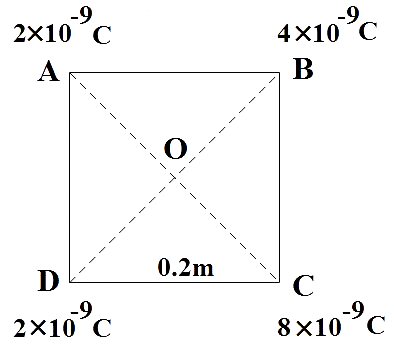
From the diagram, using Pythagorean theorem we get the diagonals of the given square AC and BD as,
$AC=BD=\sqrt{{{\left( 0.2 \right)}^{2}}+{{\left( 0.2 \right)}^{2}}}$
$AC=BD=\sqrt{0.08}=0.28m$
With our prior knowledge in geometry we know that diagonals of a square bisect each other. Therefore,
$DO=BO=AO=CO=\dfrac{0.28}{2}=0.14m$
We know that potential at given point due to charge Q is given by,
$V(r)=\dfrac{1}{4\pi {{\varepsilon }_{0}}}\dfrac{Q}{r}$ …………….. (1)
When it comes to a system of charges $\left( {{q}_{1}},{{q}_{2}},{{q}_{3}},...,{{q}_{n}} \right)$ with position vectors$\left( {{r}_{1}},{{r}_{2,}}{{r}_{3}},...,{{r}_{n}} \right)$with respect to some point, we have to apply superposition principle. As per the superposition principle, the potential due to a system of charges is the sum of the potentials due to individual charges. Let:
Potential due to${{q}_{1}}$ ,
${{V}_{1}}=\dfrac{1}{4\pi {{\varepsilon }_{0}}}\dfrac{{{q}_{1}}}{{{r}_{1}}}$
Potential due to${{q}_{2}}$ ,
${{V}_{2}}=\dfrac{1}{4\pi {{\varepsilon }_{0}}}\dfrac{{{q}_{2}}}{{{r}_{2}}}$
Potential due to${{q}_{n}}$,
${{V}_{n}}=\dfrac{1}{4\pi {{\varepsilon }_{0}}}\dfrac{{{q}_{n}}}{{{r}_{n}}}$
Then, by superposition principle,
$V={{V}_{1}}+{{V}_{2}}+{{V}_{3}}+...+{{V}_{n}}$
$V=\dfrac{1}{4\pi {{\varepsilon }_{0}}}\left( \dfrac{{{q}_{1}}}{{{r}_{1}}}+\dfrac{{{q}_{2}}}{{{r}_{2}}}+\dfrac{{{q}_{3}}}{{{r}_{3}}}+...+\dfrac{{{q}_{n}}}{{{r}_{n}}} \right)$ …………………. (2)
In the given question we have a system consisting of 4 charges. As a first step let us find potential due charges at A, B, and C on point D.
Potential at D due to${{q}_{A}}$ ,
${{V}_{A}}=\dfrac{1}{4\pi {{\varepsilon }_{0}}}\dfrac{{{q}_{A}}}{AD}$ ………………. (3)
Potential at D due to${{q}_{B}}$ ,
${{V}_{B}}=\dfrac{1}{4\pi {{\varepsilon }_{0}}}\dfrac{{{q}_{B}}}{BD}$ ………………… (4)
Potential at D due to${{q}_{C}}$ ,
${{V}_{C}}=\dfrac{1}{4\pi {{\varepsilon }_{0}}}\dfrac{{{q}_{C}}}{CD}$ ……………………. (5)
Adding (3), (4) and (5), we get the total potential at D as,
${{V}_{D}}=\dfrac{1}{4\pi {{\varepsilon }_{0}}}\left( \dfrac{{{q}_{A}}}{AD}+\dfrac{{{q}_{B}}}{BD}+\dfrac{{{q}_{C}}}{CD} \right)$ ………………… (6)
Similarly, we get total potential at centre O as,
${{V}_{O}}=\dfrac{1}{4\pi {{\varepsilon }_{0}}}\left( \dfrac{{{q}_{A}}}{AO}+\dfrac{{{q}_{B}}}{BO}+\dfrac{{{q}_{C}}}{CO} \right)$ ………………………. (7)
From the definition of potential difference between two points we know that it is the work done in order to bring a charge q from one point to the other point. It can be expressed as,
$\Delta V=\dfrac{W}{q}$ ………………. (8)
In the given question we are asked to find work done W to bring charge ‘${{q}_{D}}$’ from D to O. Equation (8) now becomes,
$W={{q}_{D}}\times \Delta V={{q}_{D}}\left( {{V}_{0}}-{{V}_{D}} \right)$ ……………… (9)
Subtracting (6) from (7), we get,
${{V}_{O}}-{{V}_{D}}=\dfrac{1}{4\pi {{\varepsilon }_{0}}}\left( {{q}_{A}}\left( \dfrac{1}{AO}-\dfrac{1}{AD} \right)+{{q}_{B}}\left( \dfrac{1}{BO}-\dfrac{1}{BD} \right)+{{q}_{C}}\left( \dfrac{1}{CO}-\dfrac{1}{CD} \right) \right)$ …………………… (10)
Substituting the given values in (10) we get,
${{V}_{O}}-{{V}_{D}}=\dfrac{1}{4\pi {{\varepsilon }_{0}}}\left( 2\times {{10}^{-9}}\left( \dfrac{1}{0.14}-\dfrac{1}{0.2} \right)+4\times {{10}^{-9}}\left( \dfrac{1}{0.14}-\dfrac{1}{0.28} \right)+8\times {{10}^{-9}}\left( \dfrac{1}{0.14}-\dfrac{1}{0.2} \right) \right)$
${{V}_{O}}-{{V}_{D}}=\dfrac{1}{4\pi {{\varepsilon }_{0}}}\left( 10\times {{10}^{-9}}\left( 0.21 \right)+4\times {{10}^{-9}}\left( 3.57 \right) \right)$
${{V}_{O}}-{{V}_{D}}=9\times {{10}^{9}}\times 16.38\times {{10}^{-9}}=147.42V$ ………………………… (11)
Substituting ${{q}_{D}}=2\times {{10}^{-9}}C$ and equation (11) in (9), we get,
$W=2\times {{10}^{-9}}\times 147.96=294.84\times {{10}^{-9}}J$
Hence, we get the work required to transfer a charge of $2\times {{10}^{-9}}$ coulomb from corner D to the centre of the square as $294.84\times {{10}^{-9}}J$ .
Note:
Since all the given quantities are in their SI units, we get the solution also in its SI units, that is, we get the work done in joules. Though, not all the required distances are given, one could use their prior knowledge in geometry to find them. The calculations may appear messy but the concept behind the solution is really simple, we are only using the superposition principle and the definition of potential difference to solve this problem.
Formula used:
Potential due to a system of charges (superposition principle),
$V=\dfrac{1}{4\pi {{\varepsilon }_{0}}}\left( \dfrac{{{q}_{1}}}{{{r}_{1}}}+\dfrac{{{q}_{2}}}{{{r}_{2}}}+\dfrac{{{q}_{3}}}{{{r}_{3}}}+...+\dfrac{{{q}_{n}}}{{{r}_{n}}} \right)$
Expression for potential difference,
$\Delta V=\dfrac{W}{q}$
Complete answer:
We are given a square of side 0.2 m with charges kept in each of its corners.
From the diagram, using Pythagorean theorem we get the diagonals of the given square AC and BD as,
$AC=BD=\sqrt{{{\left( 0.2 \right)}^{2}}+{{\left( 0.2 \right)}^{2}}}$
$AC=BD=\sqrt{0.08}=0.28m$
With our prior knowledge in geometry we know that diagonals of a square bisect each other. Therefore,
$DO=BO=AO=CO=\dfrac{0.28}{2}=0.14m$
We know that potential at given point due to charge Q is given by,
$V(r)=\dfrac{1}{4\pi {{\varepsilon }_{0}}}\dfrac{Q}{r}$ …………….. (1)
When it comes to a system of charges $\left( {{q}_{1}},{{q}_{2}},{{q}_{3}},...,{{q}_{n}} \right)$ with position vectors$\left( {{r}_{1}},{{r}_{2,}}{{r}_{3}},...,{{r}_{n}} \right)$with respect to some point, we have to apply superposition principle. As per the superposition principle, the potential due to a system of charges is the sum of the potentials due to individual charges. Let:
Potential due to${{q}_{1}}$ ,
${{V}_{1}}=\dfrac{1}{4\pi {{\varepsilon }_{0}}}\dfrac{{{q}_{1}}}{{{r}_{1}}}$
Potential due to${{q}_{2}}$ ,
${{V}_{2}}=\dfrac{1}{4\pi {{\varepsilon }_{0}}}\dfrac{{{q}_{2}}}{{{r}_{2}}}$
Potential due to${{q}_{n}}$,
${{V}_{n}}=\dfrac{1}{4\pi {{\varepsilon }_{0}}}\dfrac{{{q}_{n}}}{{{r}_{n}}}$
Then, by superposition principle,
$V={{V}_{1}}+{{V}_{2}}+{{V}_{3}}+...+{{V}_{n}}$
$V=\dfrac{1}{4\pi {{\varepsilon }_{0}}}\left( \dfrac{{{q}_{1}}}{{{r}_{1}}}+\dfrac{{{q}_{2}}}{{{r}_{2}}}+\dfrac{{{q}_{3}}}{{{r}_{3}}}+...+\dfrac{{{q}_{n}}}{{{r}_{n}}} \right)$ …………………. (2)
In the given question we have a system consisting of 4 charges. As a first step let us find potential due charges at A, B, and C on point D.
Potential at D due to${{q}_{A}}$ ,
${{V}_{A}}=\dfrac{1}{4\pi {{\varepsilon }_{0}}}\dfrac{{{q}_{A}}}{AD}$ ………………. (3)
Potential at D due to${{q}_{B}}$ ,
${{V}_{B}}=\dfrac{1}{4\pi {{\varepsilon }_{0}}}\dfrac{{{q}_{B}}}{BD}$ ………………… (4)
Potential at D due to${{q}_{C}}$ ,
${{V}_{C}}=\dfrac{1}{4\pi {{\varepsilon }_{0}}}\dfrac{{{q}_{C}}}{CD}$ ……………………. (5)
Adding (3), (4) and (5), we get the total potential at D as,
${{V}_{D}}=\dfrac{1}{4\pi {{\varepsilon }_{0}}}\left( \dfrac{{{q}_{A}}}{AD}+\dfrac{{{q}_{B}}}{BD}+\dfrac{{{q}_{C}}}{CD} \right)$ ………………… (6)
Similarly, we get total potential at centre O as,
${{V}_{O}}=\dfrac{1}{4\pi {{\varepsilon }_{0}}}\left( \dfrac{{{q}_{A}}}{AO}+\dfrac{{{q}_{B}}}{BO}+\dfrac{{{q}_{C}}}{CO} \right)$ ………………………. (7)
From the definition of potential difference between two points we know that it is the work done in order to bring a charge q from one point to the other point. It can be expressed as,
$\Delta V=\dfrac{W}{q}$ ………………. (8)
In the given question we are asked to find work done W to bring charge ‘${{q}_{D}}$’ from D to O. Equation (8) now becomes,
$W={{q}_{D}}\times \Delta V={{q}_{D}}\left( {{V}_{0}}-{{V}_{D}} \right)$ ……………… (9)
Subtracting (6) from (7), we get,
${{V}_{O}}-{{V}_{D}}=\dfrac{1}{4\pi {{\varepsilon }_{0}}}\left( {{q}_{A}}\left( \dfrac{1}{AO}-\dfrac{1}{AD} \right)+{{q}_{B}}\left( \dfrac{1}{BO}-\dfrac{1}{BD} \right)+{{q}_{C}}\left( \dfrac{1}{CO}-\dfrac{1}{CD} \right) \right)$ …………………… (10)
Substituting the given values in (10) we get,
${{V}_{O}}-{{V}_{D}}=\dfrac{1}{4\pi {{\varepsilon }_{0}}}\left( 2\times {{10}^{-9}}\left( \dfrac{1}{0.14}-\dfrac{1}{0.2} \right)+4\times {{10}^{-9}}\left( \dfrac{1}{0.14}-\dfrac{1}{0.28} \right)+8\times {{10}^{-9}}\left( \dfrac{1}{0.14}-\dfrac{1}{0.2} \right) \right)$
${{V}_{O}}-{{V}_{D}}=\dfrac{1}{4\pi {{\varepsilon }_{0}}}\left( 10\times {{10}^{-9}}\left( 0.21 \right)+4\times {{10}^{-9}}\left( 3.57 \right) \right)$
${{V}_{O}}-{{V}_{D}}=9\times {{10}^{9}}\times 16.38\times {{10}^{-9}}=147.42V$ ………………………… (11)
Substituting ${{q}_{D}}=2\times {{10}^{-9}}C$ and equation (11) in (9), we get,
$W=2\times {{10}^{-9}}\times 147.96=294.84\times {{10}^{-9}}J$
Hence, we get the work required to transfer a charge of $2\times {{10}^{-9}}$ coulomb from corner D to the centre of the square as $294.84\times {{10}^{-9}}J$ .
Note:
Since all the given quantities are in their SI units, we get the solution also in its SI units, that is, we get the work done in joules. Though, not all the required distances are given, one could use their prior knowledge in geometry to find them. The calculations may appear messy but the concept behind the solution is really simple, we are only using the superposition principle and the definition of potential difference to solve this problem.
Recently Updated Pages
Master Class 12 Economics: Engaging Questions & Answers for Success

Master Class 12 Physics: Engaging Questions & Answers for Success
Master Class 12 English: Engaging Questions & Answers for Success
Master Class 12 Social Science: Engaging Questions & Answers for Success
Master Class 12 Maths: Engaging Questions & Answers for Success
Master Class 12 Business Studies: Engaging Questions & Answers for Success
Trending doubts
Which are the Top 10 Largest Countries of the World?
What are the major means of transport Explain each class 12 social science CBSE
Draw a labelled sketch of the human eye class 12 physics CBSE
Why cannot DNA pass through cell membranes class 12 biology CBSE
Differentiate between insitu conservation and exsitu class 12 biology CBSE
Draw a neat and well labeled diagram of TS of ovary class 12 biology CBSE