




Although all proteins are made of the same amino acids, explain how your proteins may be different from those of a dog.
Answer
 Verified
589.5k+ views
Hint: Proteins are the polymers formed by the sequence of amino acids. The amino acids are linked together by peptide bonds. There are 20 amino acids present in the human body.
Complete Answer:
- The proteins are made up of several amino acids attached to one another by peptide bond and form a long chain. There are many types of protein structure.
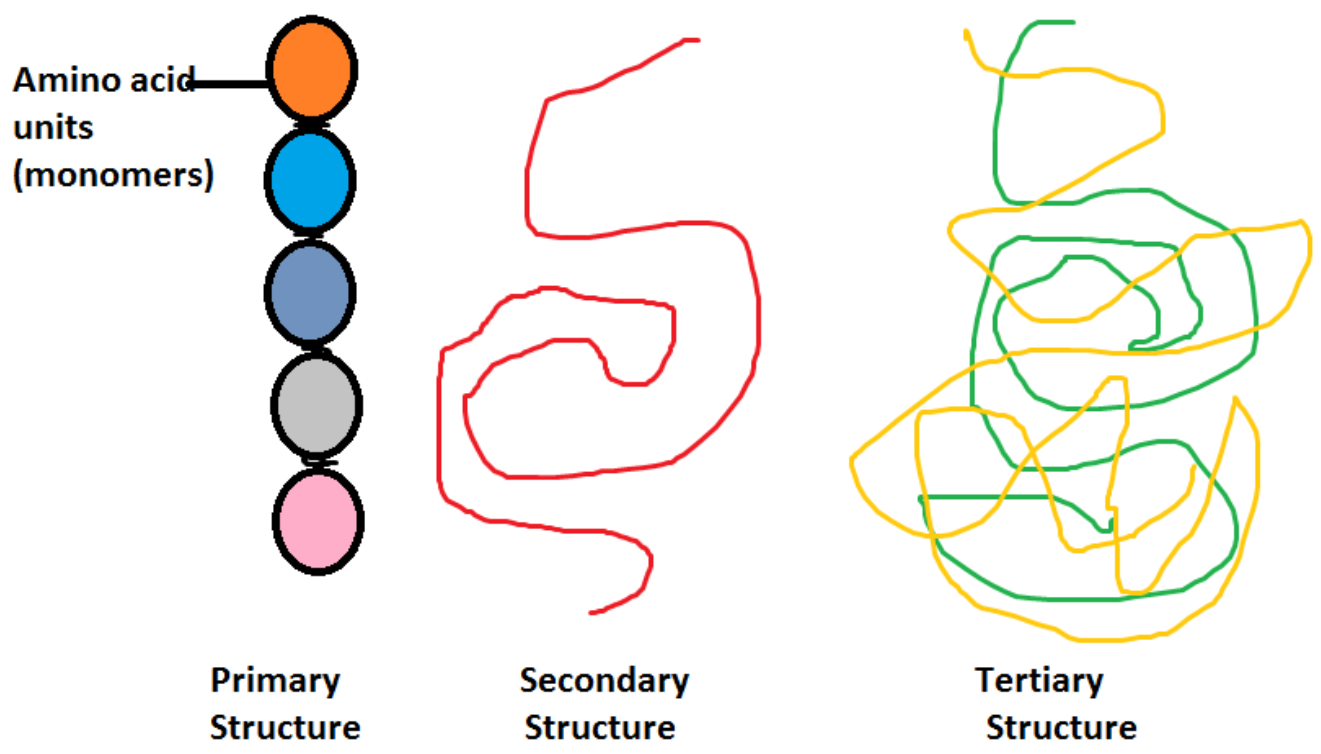
1) Primary structure- It is mostly seen in the human body where the protein structure is made up of a linear chain of 20 amino acids.
2) Secondary structure- It is formed by the interaction between the amino acid chains. The functional groups form bonds between them and form folding in proteins.
3) Tertiary structure- It refers to the 3D structure of proteins. Further folding of secondary structure leads to tertiary protein structure.
These rigid structures help the protein carry out complex roles.
- In humans there are only 20 amino acids required to form necessary proteins.
- But in dogs, they require 22 amino acids to make necessary proteins.
- A dog’s body can make only half of the essential amino acids.
- Selenocysteine and Pyrrolysine is the essential amino acid found in dogs which is absent in humans.
Note: The amino acid composition of both humans and dogs are different. Thus the alignment of amino acids in the proteins will be different. This will lead to a difference in structure and nature of protein.
Complete Answer:
- The proteins are made up of several amino acids attached to one another by peptide bond and form a long chain. There are many types of protein structure.
1) Primary structure- It is mostly seen in the human body where the protein structure is made up of a linear chain of 20 amino acids.
2) Secondary structure- It is formed by the interaction between the amino acid chains. The functional groups form bonds between them and form folding in proteins.
3) Tertiary structure- It refers to the 3D structure of proteins. Further folding of secondary structure leads to tertiary protein structure.
These rigid structures help the protein carry out complex roles.
- In humans there are only 20 amino acids required to form necessary proteins.
- But in dogs, they require 22 amino acids to make necessary proteins.
- A dog’s body can make only half of the essential amino acids.
- Selenocysteine and Pyrrolysine is the essential amino acid found in dogs which is absent in humans.
Note: The amino acid composition of both humans and dogs are different. Thus the alignment of amino acids in the proteins will be different. This will lead to a difference in structure and nature of protein.
Recently Updated Pages
Master Class 12 Economics: Engaging Questions & Answers for Success

Master Class 12 Physics: Engaging Questions & Answers for Success
Master Class 12 English: Engaging Questions & Answers for Success
Master Class 12 Social Science: Engaging Questions & Answers for Success
Master Class 12 Maths: Engaging Questions & Answers for Success
Master Class 12 Business Studies: Engaging Questions & Answers for Success
Trending doubts
Why cannot DNA pass through cell membranes class 12 biology CBSE
Differentiate between insitu conservation and exsitu class 12 biology CBSE
Draw a neat and well labeled diagram of TS of ovary class 12 biology CBSE
In a human foetus the limbs and digits develop after class 12 biology CBSE
AABbCc genotype forms how many types of gametes a 4 class 12 biology CBSE
The correct structure of ethylenediaminetetraacetic class 12 chemistry CBSE