




An AC voltmeter in an L-C-R circuit reads 30 volts across resistance, 80 volts across inductance and 40 volts across capacitance. The value of the applied voltage will be
A. 50 Volt
B. 25 Volt
C. 150 Volt
D. 70 Volt
Answer
 Verified
579.9k+ views
Hint: The question is a direct one. The value of the combination voltage will be the value of the applied voltage. The combination voltage is calculated as the root of the sum of the square of voltage value across the resistor and the square of the difference of the voltage value across the capacitor and voltage value across the inductor.
Formula used:
\[{{V}_{C}}=\sqrt{V_{R}^{2}+{{({{V}_{C}}-{{V}_{L}})}^{2}}}\]
Complete step by step answer:
A diagram representing a circuit diagram of L-C-R
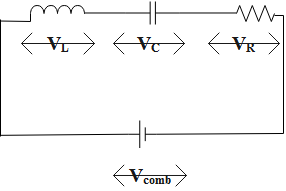
The formula used to find the value of the voltage applied, that is, the value of the combined voltage is given as follows:
\[{{V}_{C}}=\sqrt{V_{R}^{2}+{{({{V}_{C}}-{{V}_{L}})}^{2}}}\]
Where \[{{V}_{R}}\]is the voltage value across the resistor, \[{{V}_{C}}\] is the voltage value across the capacitor and \[{{V}_{L}}\] is the voltage value across the inductor.
From the data, we have,
The voltage value across the resistor is, \[{{V}_{R}}=30\,V\]
The voltage value across the capacitor is, \[{{V}_{C}}=40\,V\]
The voltage value across the inductor is, \[{{V}_{L}}=80\,V\]
Even though the value of the voltage across the capacitor is less than that across the inductor, as we square the difference, so, there won’t be a change in the value.
Therefore, the voltage applied is calculated as follows.
\[\begin{align}
& {{V}_{C}}=\sqrt{{{30}^{2}}+{{(40-80)}^{2}}} \\
& \Rightarrow {{V}_{C}}=\sqrt{900+1600} \\
\end{align}\]
Continue further calculation.
\[\begin{align}
& {{V}_{C}}=\sqrt{2500} \\
& \therefore {{V}_{C}}=50\,V \\
\end{align}\]
As the value of the applied voltage in an L-C-R circuit is obtained to be equal to 50 V, thus, the option (A) is correct.
Note:
The formula for finding the value of the combination voltage should be known to solve such problems. Even by providing the values of the combination voltage itself along with the values of the two of the three voltage values, the other voltage value can be asked. The units of the parameters should be taken care of.
Formula used:
\[{{V}_{C}}=\sqrt{V_{R}^{2}+{{({{V}_{C}}-{{V}_{L}})}^{2}}}\]
Complete step by step answer:
A diagram representing a circuit diagram of L-C-R
The formula used to find the value of the voltage applied, that is, the value of the combined voltage is given as follows:
\[{{V}_{C}}=\sqrt{V_{R}^{2}+{{({{V}_{C}}-{{V}_{L}})}^{2}}}\]
Where \[{{V}_{R}}\]is the voltage value across the resistor, \[{{V}_{C}}\] is the voltage value across the capacitor and \[{{V}_{L}}\] is the voltage value across the inductor.
From the data, we have,
The voltage value across the resistor is, \[{{V}_{R}}=30\,V\]
The voltage value across the capacitor is, \[{{V}_{C}}=40\,V\]
The voltage value across the inductor is, \[{{V}_{L}}=80\,V\]
Even though the value of the voltage across the capacitor is less than that across the inductor, as we square the difference, so, there won’t be a change in the value.
Therefore, the voltage applied is calculated as follows.
\[\begin{align}
& {{V}_{C}}=\sqrt{{{30}^{2}}+{{(40-80)}^{2}}} \\
& \Rightarrow {{V}_{C}}=\sqrt{900+1600} \\
\end{align}\]
Continue further calculation.
\[\begin{align}
& {{V}_{C}}=\sqrt{2500} \\
& \therefore {{V}_{C}}=50\,V \\
\end{align}\]
As the value of the applied voltage in an L-C-R circuit is obtained to be equal to 50 V, thus, the option (A) is correct.
Note:
The formula for finding the value of the combination voltage should be known to solve such problems. Even by providing the values of the combination voltage itself along with the values of the two of the three voltage values, the other voltage value can be asked. The units of the parameters should be taken care of.
Recently Updated Pages
Master Class 12 Economics: Engaging Questions & Answers for Success

Master Class 12 Physics: Engaging Questions & Answers for Success
Master Class 12 English: Engaging Questions & Answers for Success
Master Class 12 Social Science: Engaging Questions & Answers for Success
Master Class 12 Maths: Engaging Questions & Answers for Success
Master Class 12 Business Studies: Engaging Questions & Answers for Success
Trending doubts
Which are the Top 10 Largest Countries of the World?
What are the major means of transport Explain each class 12 social science CBSE
Draw a labelled sketch of the human eye class 12 physics CBSE
Why cannot DNA pass through cell membranes class 12 biology CBSE
Differentiate between insitu conservation and exsitu class 12 biology CBSE
Draw a neat and well labeled diagram of TS of ovary class 12 biology CBSE