




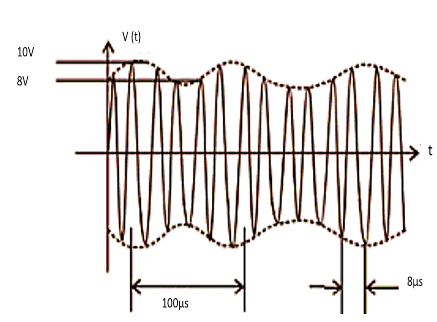
An amplitude modulated signal has been represented below. Which one of the following perfectly explains the mentioned signal?
$\begin{align}
& A.\left( 9+\sin \left( 2.5\pi \times {{10}^{5}}t \right) \right)\sin \left( 2\pi \times {{10}^{4}}t \right)V \\
& B.\left( 9+\sin \left( 4\pi \times {{10}^{4}}t \right) \right)\sin \left( 5\pi \times {{10}^{5}}t \right)V \\
& C.\left( 1+9+\sin \left( 2\pi \times {{10}^{4}}t \right) \right)\sin \left( 2.5\pi \times {{10}^{5}}t \right)V \\
& D.\left( 9+\sin \left( 2\pi \times {{10}^{4}}t \right) \right)\sin \left( 2.5\pi \times {{10}^{5}}t \right)V \\
\end{align}$
Answer
 Verified
579k+ views
Hint: First of all analyse the graph keenly. Find out the variation in amplitude from this graph. There will be two periods. One is of the signal wave and the other is of the carrier wave. Substitute these all in the general equation of the wave. This all will help you in solving this question.
Complete answer:
When we analyse the graph thoroughly, we will reach certain conclusions. The amplitude of the wave is being varied from $8-10V$. In this case the average voltage can be given as the average of this range. That is $9V$. Therefore the variation of the amplitude can be shown as, $9\pm 1V$.
Now let us look at the time periods. As we can see, there are two time periods in this graph. One is the time period of the carrier wave and the other one is the time period of the signal wave. The time period of the carrier wave has been given as,
${{T}_{C}}=8\mu s$
The time period of the signal wave has been given as,
${{T}_{s}}=100\mu s$
The general form of the equation of this wave can be shown as,
$\left[ 9\pm 1\sin \left( \dfrac{2\pi t}{{{T}_{S}}} \right) \right]\sin \dfrac{2\pi t}{{{T}_{C}}}$
Substituting the values in it will give,
$=\left[ 9\pm 1\sin \left( 2\pi \times {{10}^{4}}t \right) \right]\sin 2.5\pi \times {{10}^{5}}t$
So, the correct answer is “Option D”.
Note:
Amplitude modulation is a way of modulation which has been commonly used in electronic communication. The most common use of this technique is in transmitting messages with a radio carrier wave. In the case of amplitude modulation, the amplitude of the carrier wave is changed with respect to that of the message signal. One example of the message signal can be taken as an audio signal.
Complete answer:
When we analyse the graph thoroughly, we will reach certain conclusions. The amplitude of the wave is being varied from $8-10V$. In this case the average voltage can be given as the average of this range. That is $9V$. Therefore the variation of the amplitude can be shown as, $9\pm 1V$.
Now let us look at the time periods. As we can see, there are two time periods in this graph. One is the time period of the carrier wave and the other one is the time period of the signal wave. The time period of the carrier wave has been given as,
${{T}_{C}}=8\mu s$
The time period of the signal wave has been given as,
${{T}_{s}}=100\mu s$
The general form of the equation of this wave can be shown as,
$\left[ 9\pm 1\sin \left( \dfrac{2\pi t}{{{T}_{S}}} \right) \right]\sin \dfrac{2\pi t}{{{T}_{C}}}$
Substituting the values in it will give,
$=\left[ 9\pm 1\sin \left( 2\pi \times {{10}^{4}}t \right) \right]\sin 2.5\pi \times {{10}^{5}}t$
So, the correct answer is “Option D”.
Note:
Amplitude modulation is a way of modulation which has been commonly used in electronic communication. The most common use of this technique is in transmitting messages with a radio carrier wave. In the case of amplitude modulation, the amplitude of the carrier wave is changed with respect to that of the message signal. One example of the message signal can be taken as an audio signal.
Recently Updated Pages
Master Class 12 Economics: Engaging Questions & Answers for Success

Master Class 12 Physics: Engaging Questions & Answers for Success
Master Class 12 English: Engaging Questions & Answers for Success
Master Class 12 Social Science: Engaging Questions & Answers for Success
Master Class 12 Maths: Engaging Questions & Answers for Success
Master Class 12 Business Studies: Engaging Questions & Answers for Success
Trending doubts
Which are the Top 10 Largest Countries of the World?
What are the major means of transport Explain each class 12 social science CBSE
Draw a labelled sketch of the human eye class 12 physics CBSE
Why cannot DNA pass through cell membranes class 12 biology CBSE
Differentiate between insitu conservation and exsitu class 12 biology CBSE
Draw a neat and well labeled diagram of TS of ovary class 12 biology CBSE