




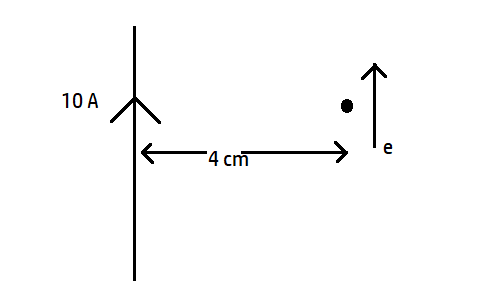
An e is moving parallel to a long current carrying wire with a velocity \[v={{10}^{5}}m/s\]as shown, force on electron is?
A- \[0.4\times {{10}^{-18}}N\]
B- \[0.8\times {{10}^{-18}}N\]
C- \[0.8\times {{10}^{-16}}N\]
D- \[1.6\times {{10}^{-18}}N\]
Answer
 Verified
579k+ views
Hint: We are given an electron placed at some distance from a current carrying wire. We know a current carrying wire generates a magnetic field. And we know moving charged particles experience a force in an external magnetic field.
Step by step answer:
Magnitude of charge= \[1.6\times {{10}^{-19}}C\]
The magnetic force on a charged particle placed in a magnetic field is given by \[\overrightarrow{F}=q(\overrightarrow{v}\times \overrightarrow{B})\]
But we need to first calculate the value of the field due to a long current carrying wire. We know the magnetic field due to a long current carrying wire at a distance from it by \[B=\dfrac{{{\mu }_{0}}\times 2I}{4\pi \times r}\].
Here r is the perpendicular distance from the wire and I is the current in the wire
Here r = 4 cm = 0.04 m and I= 10 A
\[B=\dfrac{{{\mu }_{0}}\times 2I}{4\pi \times r}=\dfrac{{{10}^{-7}}\times 2\times 10}{0.04}=5\times {{10}^{-5}}T\]
The direction of the field is into the plane of paper using the right hand thumb rule.
Now force,
\[
\overrightarrow{F}=q(\overrightarrow{v}\times \overrightarrow{B}) \\
\Rightarrow \overrightarrow{F} =qvB\sin \theta \\
\]
The angle between the velocity and the field is \[90{}^\circ \], thus, \[F=qvB\]
\[
F=1.6\times {{10}^{-19}}\times {{10}^{5}}\times 5\times {{10}^{-5}} \\
\therefore F=0.8\times {{10}^{-18}}N \\
\]
Thus, the correct option is (B).
Note: Right-hand rule states that, if the thumb of the right hand is in the direction of the current flow then, the curl fingers show the direction of the magnetic field. We need to remember that the magnetic field is a vector quantity and we have to use right-hand thumb rules carefully while determining the direction of the field.
Step by step answer:
Magnitude of charge= \[1.6\times {{10}^{-19}}C\]
The magnetic force on a charged particle placed in a magnetic field is given by \[\overrightarrow{F}=q(\overrightarrow{v}\times \overrightarrow{B})\]
But we need to first calculate the value of the field due to a long current carrying wire. We know the magnetic field due to a long current carrying wire at a distance from it by \[B=\dfrac{{{\mu }_{0}}\times 2I}{4\pi \times r}\].
Here r is the perpendicular distance from the wire and I is the current in the wire
Here r = 4 cm = 0.04 m and I= 10 A
\[B=\dfrac{{{\mu }_{0}}\times 2I}{4\pi \times r}=\dfrac{{{10}^{-7}}\times 2\times 10}{0.04}=5\times {{10}^{-5}}T\]
The direction of the field is into the plane of paper using the right hand thumb rule.
Now force,
\[
\overrightarrow{F}=q(\overrightarrow{v}\times \overrightarrow{B}) \\
\Rightarrow \overrightarrow{F} =qvB\sin \theta \\
\]
The angle between the velocity and the field is \[90{}^\circ \], thus, \[F=qvB\]
\[
F=1.6\times {{10}^{-19}}\times {{10}^{5}}\times 5\times {{10}^{-5}} \\
\therefore F=0.8\times {{10}^{-18}}N \\
\]
Thus, the correct option is (B).
Note: Right-hand rule states that, if the thumb of the right hand is in the direction of the current flow then, the curl fingers show the direction of the magnetic field. We need to remember that the magnetic field is a vector quantity and we have to use right-hand thumb rules carefully while determining the direction of the field.
Recently Updated Pages
Master Class 12 Economics: Engaging Questions & Answers for Success

Master Class 12 Physics: Engaging Questions & Answers for Success
Master Class 12 English: Engaging Questions & Answers for Success
Master Class 12 Social Science: Engaging Questions & Answers for Success
Master Class 12 Maths: Engaging Questions & Answers for Success
Master Class 12 Business Studies: Engaging Questions & Answers for Success
Trending doubts
Which are the Top 10 Largest Countries of the World?
What are the major means of transport Explain each class 12 social science CBSE
Draw a labelled sketch of the human eye class 12 physics CBSE
Why cannot DNA pass through cell membranes class 12 biology CBSE
Differentiate between insitu conservation and exsitu class 12 biology CBSE
Draw a neat and well labeled diagram of TS of ovary class 12 biology CBSE