




An infinite nonconducting sheet has a surface charge density $\sigma = 0.10\mu C/{m^2}$ on one side. How far apart are equipotential surfaces whose potentials differ by $50V$?
A. $8.8mm$
B. $8.8cm$
C. $8.8m$
D. $8.8\mu m$
Answer
 Verified
564.6k+ views
Hint: Potential of a charge conducting field is the product of the electric field and the distance between the parallel plates of the charged conductors. And the electric field on an infinite sheet is the ratio of its charge density to the relative permittivity.
Formula Used: $V = Ed$
Where,
$V = $ Potential
$E = $ Electric field
$d$ is the separation between the plates of the charged conductor
$E = \dfrac{\sigma }{{2{\varepsilon _0}}}$
Where,
$E$ is electric field due to infinite sheet
$\sigma $ is the surface charge density
${\varepsilon _0}$ is the relative permittivity of free space
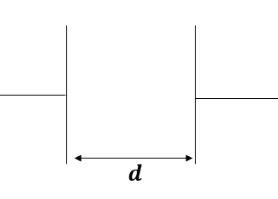
Complete step by step answer:Observe the diagram
We know that, for an infinite charged sheet
$E = \dfrac{\sigma }{{2{\varepsilon _0}}}$
and $V = Ed$
where,
$E$ is electric field
${\varepsilon _0} = 8.85 \times {10^{ - 12}}{C^2}{N^{ - 1}}{m^{ - 2}}$ is the permittivity of free space
$\sigma $ is surface charge density of the sheet
$V$ is potential
$d$ is separation between the sheets
Substituting the value of $E$ into the equation of $V$ we get
$V = \dfrac{{\sigma d}}{{2{\varepsilon _0}}}$
By rearranging it, we get
$d = \dfrac{{2V{\varepsilon _0}}}{\sigma }$
It is given to us that,
$\sigma = 0.10\mu C/{m^2}$
$ \Rightarrow \sigma = 0.10 \times {10^{ - 6}}C/{m^2}$
$ \Rightarrow \sigma = {10^{ - 7}}C/{m^2}$
$V = 50V$
Substituting these values in the above equation, we get
$d = \dfrac{{2 \times 50 \times 8.85 \times {{10}^{ - 12}}}}{{{{10}^{ - 7}}}}$
by simplifying it we get
$d = 100 \times 8.85 \times {10^{ - 5}}$
$ = 8.85 \times {10^{ - 3}}m$
$ \Rightarrow d = 0.88mm$
Therefore from the above explanation the correct option is (B) $8.8cm$
Note:Any surface over which the potential is constant is called an equipotential surface. In other words, the potential difference between any two points to an equipotential surface is zero. For this question, we considered the relativity of free space and it was not mentioned that there is any dielectric between the plates. But it is not always necessary. Sometimes, you might have a dielectric between the plates. Then the formula of electric field will be
$E = \dfrac{\sigma }{{2\varepsilon }}$
Where, $\varepsilon $ is the permittivity of dielectric.
Formula Used: $V = Ed$
Where,
$V = $ Potential
$E = $ Electric field
$d$ is the separation between the plates of the charged conductor
$E = \dfrac{\sigma }{{2{\varepsilon _0}}}$
Where,
$E$ is electric field due to infinite sheet
$\sigma $ is the surface charge density
${\varepsilon _0}$ is the relative permittivity of free space
Complete step by step answer:Observe the diagram
We know that, for an infinite charged sheet
$E = \dfrac{\sigma }{{2{\varepsilon _0}}}$
and $V = Ed$
where,
$E$ is electric field
${\varepsilon _0} = 8.85 \times {10^{ - 12}}{C^2}{N^{ - 1}}{m^{ - 2}}$ is the permittivity of free space
$\sigma $ is surface charge density of the sheet
$V$ is potential
$d$ is separation between the sheets
Substituting the value of $E$ into the equation of $V$ we get
$V = \dfrac{{\sigma d}}{{2{\varepsilon _0}}}$
By rearranging it, we get
$d = \dfrac{{2V{\varepsilon _0}}}{\sigma }$
It is given to us that,
$\sigma = 0.10\mu C/{m^2}$
$ \Rightarrow \sigma = 0.10 \times {10^{ - 6}}C/{m^2}$
$ \Rightarrow \sigma = {10^{ - 7}}C/{m^2}$
$V = 50V$
Substituting these values in the above equation, we get
$d = \dfrac{{2 \times 50 \times 8.85 \times {{10}^{ - 12}}}}{{{{10}^{ - 7}}}}$
by simplifying it we get
$d = 100 \times 8.85 \times {10^{ - 5}}$
$ = 8.85 \times {10^{ - 3}}m$
$ \Rightarrow d = 0.88mm$
Therefore from the above explanation the correct option is (B) $8.8cm$
Note:Any surface over which the potential is constant is called an equipotential surface. In other words, the potential difference between any two points to an equipotential surface is zero. For this question, we considered the relativity of free space and it was not mentioned that there is any dielectric between the plates. But it is not always necessary. Sometimes, you might have a dielectric between the plates. Then the formula of electric field will be
$E = \dfrac{\sigma }{{2\varepsilon }}$
Where, $\varepsilon $ is the permittivity of dielectric.
Recently Updated Pages
Master Class 12 Economics: Engaging Questions & Answers for Success

Master Class 12 Physics: Engaging Questions & Answers for Success
Master Class 12 English: Engaging Questions & Answers for Success
Master Class 12 Social Science: Engaging Questions & Answers for Success
Master Class 12 Maths: Engaging Questions & Answers for Success
Master Class 12 Business Studies: Engaging Questions & Answers for Success
Trending doubts
Which are the Top 10 Largest Countries of the World?
What are the major means of transport Explain each class 12 social science CBSE
Draw a labelled sketch of the human eye class 12 physics CBSE
Why cannot DNA pass through cell membranes class 12 biology CBSE
Differentiate between insitu conservation and exsitu class 12 biology CBSE
Draw a neat and well labeled diagram of TS of ovary class 12 biology CBSE