



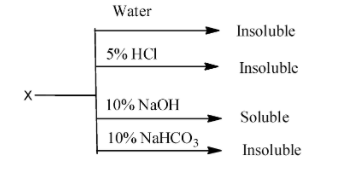
An organic compound ‘X’ showing the following solubility profile is:
A) m-Cresol
B) o-Toluidine
C) Oleic acid
D) Benzamide
Answer
 Verified
573.3k+ views
Hint: The answer here is based on the compound taken initially is a base or acid which later can be determined if it is soluble in another acid or base. The reaction of each option given with the reagents given leads you to the correct answer.
Complete step by step answer:
In the lower classes, we have studied the concepts in organic chemistry about the solubility of the compounds in acids or base or also neutral solutions.
Now, we shall look into each option and find whether the compound is soluble or insoluble in that particular reagent.
- Generally if X is a base, it would be soluble in acid but in the above given question, the compound does not react with both a weak base that is sodium hydroxide as well as a strong base that is sodium bicarbonate and gives an insoluble compound.
- By these above facts we can say that the compound is a weak acid because weak acid on treatment with strong base is insoluble whereas with weak base it reacts and the product is soluble.
- This weak acid with 10% $HCl$ will be insoluble and if we consider option A) m- Cresol which has methyl group in ortho position of phenol ring where –OH group is acidic.
- In option B) o-Tolidine, it is having an amine group and therefore is a base and thus this option is ruled out.
- In option C) Oleic acid has the formula ${{C}_{17}}{{H}_{33}}COOH$ which is strong acid than the m-Cresol because of presence of carboxylic acid group which is stronger that acidic –OH group.
- In option D) benzamide, it has a amide group which is also a base and thus is ruled out.
Therefore, based on all these facts, we can say that m-Cresol is a weak acid which is insoluble in water.
Therefore, the correct answer is option A) m-Cresol.
Note: Note that solubility of the compounds depends strongly on the pH of the solution and also the temperature as the solubility increases if the temperature is increased and this point is to be memorised which helps you to solve the questions asked on this basis.
Complete step by step answer:
In the lower classes, we have studied the concepts in organic chemistry about the solubility of the compounds in acids or base or also neutral solutions.
Now, we shall look into each option and find whether the compound is soluble or insoluble in that particular reagent.
- Generally if X is a base, it would be soluble in acid but in the above given question, the compound does not react with both a weak base that is sodium hydroxide as well as a strong base that is sodium bicarbonate and gives an insoluble compound.
- By these above facts we can say that the compound is a weak acid because weak acid on treatment with strong base is insoluble whereas with weak base it reacts and the product is soluble.
- This weak acid with 10% $HCl$ will be insoluble and if we consider option A) m- Cresol which has methyl group in ortho position of phenol ring where –OH group is acidic.
- In option B) o-Tolidine, it is having an amine group and therefore is a base and thus this option is ruled out.
- In option C) Oleic acid has the formula ${{C}_{17}}{{H}_{33}}COOH$ which is strong acid than the m-Cresol because of presence of carboxylic acid group which is stronger that acidic –OH group.
- In option D) benzamide, it has a amide group which is also a base and thus is ruled out.
Therefore, based on all these facts, we can say that m-Cresol is a weak acid which is insoluble in water.
Therefore, the correct answer is option A) m-Cresol.
Note: Note that solubility of the compounds depends strongly on the pH of the solution and also the temperature as the solubility increases if the temperature is increased and this point is to be memorised which helps you to solve the questions asked on this basis.
Recently Updated Pages
Master Class 12 Economics: Engaging Questions & Answers for Success

Master Class 12 Physics: Engaging Questions & Answers for Success
Master Class 12 English: Engaging Questions & Answers for Success
Master Class 12 Social Science: Engaging Questions & Answers for Success
Master Class 12 Maths: Engaging Questions & Answers for Success
Master Class 12 Business Studies: Engaging Questions & Answers for Success
Trending doubts
Why cannot DNA pass through cell membranes class 12 biology CBSE
Draw a neat and well labeled diagram of TS of ovary class 12 biology CBSE
In a human foetus the limbs and digits develop after class 12 biology CBSE
AABbCc genotype forms how many types of gametes a 4 class 12 biology CBSE
Differentiate between homogeneous and heterogeneous class 12 chemistry CBSE
The correct structure of ethylenediaminetetraacetic class 12 chemistry CBSE