




Assertion – Embryonal knob of the blastocyst is determined to form the embryo and extraembryonic membranes.
Reason – Blastocoel of blastocyst represents future coelom.
A) Both Assertion and Reason are correct and Reason is the correct explanation for Assertion.
B) Both Assertion and Reason are correct but Reason is not the correct explanation for Assertion.
C) Assertion is correct but Reason is not correct.
D) Both Assertion and Reason are incorrect.
Answer
 Verified
600.6k+ views
Hint: The inner cell mass that is attached to the embryonic or animal pole is the precursor of the embryo and later gives rise to all tissues and other body parts. The coelom formation begins at the gastrulation stage and is a mesodermally lined cavity.
Complete step-by-step answer:
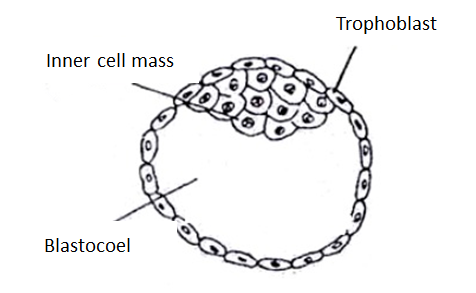
In mammals, the blastula is also called blastocyst because of the different nature of surface layers and eccentric inner cell mass. It is a 64 celled stage that contains a fluid-filled cavity called the blastocoel. The embryonal knob is a structure formed by the inner cell mass of the developing embryo and it gives rise to all the body tissues and structures.
Hence, the statement given as assertion seems to be correct. Now, since the coelom is formed by the splitting of mesodermal cells that are derived from the inner cell mass of the blastula, blastocoel does not represent the future coelom. Due to the repeated divisions in the blastula, the blastocoel expands and the inner cell mass that lies on one side of the external trophoblast cells further differentiates during the gastrulation to form germinal layers. Here, the spiral cleavage in the embryo and splitting of mesoderm from the coelom. A blastocyst has been shown below –
So, the correct answer is ‘Assertion is correct but Reason is not correct’.
Note: Gastrulation is the process of formation of a gastrula from blastula and it is the stage of embryonic developments during which the germinal layers are formed.
Blastocoel is a fluid-filled cavity that is contained in the 64 celled stage blastula. At this stage, the embryo is known as the blastocyst and consists of an inner cell mass that is attached to the embryonic or animal pole.
Complete step-by-step answer:
In mammals, the blastula is also called blastocyst because of the different nature of surface layers and eccentric inner cell mass. It is a 64 celled stage that contains a fluid-filled cavity called the blastocoel. The embryonal knob is a structure formed by the inner cell mass of the developing embryo and it gives rise to all the body tissues and structures.
Hence, the statement given as assertion seems to be correct. Now, since the coelom is formed by the splitting of mesodermal cells that are derived from the inner cell mass of the blastula, blastocoel does not represent the future coelom. Due to the repeated divisions in the blastula, the blastocoel expands and the inner cell mass that lies on one side of the external trophoblast cells further differentiates during the gastrulation to form germinal layers. Here, the spiral cleavage in the embryo and splitting of mesoderm from the coelom. A blastocyst has been shown below –
So, the correct answer is ‘Assertion is correct but Reason is not correct’.
Note: Gastrulation is the process of formation of a gastrula from blastula and it is the stage of embryonic developments during which the germinal layers are formed.
Blastocoel is a fluid-filled cavity that is contained in the 64 celled stage blastula. At this stage, the embryo is known as the blastocyst and consists of an inner cell mass that is attached to the embryonic or animal pole.
Recently Updated Pages
Master Class 12 Economics: Engaging Questions & Answers for Success

Master Class 12 Physics: Engaging Questions & Answers for Success
Master Class 12 English: Engaging Questions & Answers for Success
Master Class 12 Social Science: Engaging Questions & Answers for Success
Master Class 12 Maths: Engaging Questions & Answers for Success
Master Class 12 Business Studies: Engaging Questions & Answers for Success
Trending doubts
Which are the Top 10 Largest Countries of the World?
What are the major means of transport Explain each class 12 social science CBSE
Draw a labelled sketch of the human eye class 12 physics CBSE
Why cannot DNA pass through cell membranes class 12 biology CBSE
Differentiate between insitu conservation and exsitu class 12 biology CBSE
Draw a neat and well labeled diagram of TS of ovary class 12 biology CBSE