



How do you calculate the perimeter of an equilateral triangle?
Answer
 Verified
555.3k+ views
Hint:
The equilateral triangle is a triangle whose all sides are equal. The perimeter of any triangle can be calculated by adding all the sides of the triangle.
Complete step by step solution:
As the name equilateral triangle means a triangle whose all sides are equal in dimension and all angles are also equal. This is called an equilateral triangle. The internal angles of an equilateral triangle are \[60^\circ \]
The following is the equilateral triangle:
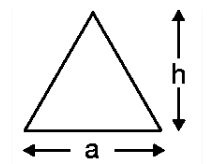
Where
a= side of the triangle
h= height of the triangle
Now we know that the perimeter of a triangle is equal to the sum of all its three sides.
Therefore,
$P = AB + BC + CA$
For an equilateral triangle
$AB = BC = CA = a$
Therefore, perimeter
$
P = a + a + a \\
= 3a \\
$
This is the perimeter of an equilateral triangle.
If we divide the perimeter of an equilateral triangle by two it becomes a semi perimeter of an equilateral triangle. Therefore, the becomes semi perimeter of an equilateral triangle is
$
P' = \dfrac{P}{2} \\
= \dfrac{{3a}}{2} \\
$
Additional information:
The other parameters of an equilateral triangle like area, height can be calculated by the following expressions:
The area of the equilateral triangle is given by the following formula:
$A = \dfrac{{\sqrt 3 }}{4}{a^2}$
The height of an equilateral triangle is given by the following formula:
$h = \dfrac{{\sqrt 3 }}{2}a$
Note:
1) The equilateral triangle has all sides equal.
2) The internal angles of an equilateral triangle are equals to $60^\circ $.
3) The perimeter of an equilateral triangle can be calculated by multiplying the side of the equilateral triangle with 3.
The equilateral triangle is a triangle whose all sides are equal. The perimeter of any triangle can be calculated by adding all the sides of the triangle.
Complete step by step solution:
As the name equilateral triangle means a triangle whose all sides are equal in dimension and all angles are also equal. This is called an equilateral triangle. The internal angles of an equilateral triangle are \[60^\circ \]
The following is the equilateral triangle:
Where
a= side of the triangle
h= height of the triangle
Now we know that the perimeter of a triangle is equal to the sum of all its three sides.
Therefore,
$P = AB + BC + CA$
For an equilateral triangle
$AB = BC = CA = a$
Therefore, perimeter
$
P = a + a + a \\
= 3a \\
$
This is the perimeter of an equilateral triangle.
If we divide the perimeter of an equilateral triangle by two it becomes a semi perimeter of an equilateral triangle. Therefore, the becomes semi perimeter of an equilateral triangle is
$
P' = \dfrac{P}{2} \\
= \dfrac{{3a}}{2} \\
$
Additional information:
The other parameters of an equilateral triangle like area, height can be calculated by the following expressions:
The area of the equilateral triangle is given by the following formula:
$A = \dfrac{{\sqrt 3 }}{4}{a^2}$
The height of an equilateral triangle is given by the following formula:
$h = \dfrac{{\sqrt 3 }}{2}a$
Note:
1) The equilateral triangle has all sides equal.
2) The internal angles of an equilateral triangle are equals to $60^\circ $.
3) The perimeter of an equilateral triangle can be calculated by multiplying the side of the equilateral triangle with 3.

Recently Updated Pages
Master Class 7 English: Engaging Questions & Answers for Success

Master Class 7 Maths: Engaging Questions & Answers for Success
Master Class 7 Science: Engaging Questions & Answers for Success
Class 7 Question and Answer - Your Ultimate Solutions Guide
Master Class 9 General Knowledge: Engaging Questions & Answers for Success
Master Class 9 Social Science: Engaging Questions & Answers for Success
Trending doubts
The value of 6 more than 7 is A 1 B 1 C 13 D 13 class 7 maths CBSE
Convert 200 Million dollars in rupees class 7 maths CBSE
How many lines of symmetry does a regular pentagon-class-7-maths-CBSE
List of coprime numbers from 1 to 100 class 7 maths CBSE
AIM To prepare stained temporary mount of onion peel class 7 biology CBSE
The plural of Chief is Chieves A True B False class 7 english CBSE