




Cells of which stage remain metabolically active but there is no longer proliferation?
A) G1 Phase
B) G2- Phase
C) G0- Phase
D) S Phase
Answer
 Verified
507.6k+ views
Hint: A cell cycle is a set of events that occur in a cell as it divides and grows. After that, the cell exits interphase, goes through mitosis, and completes its division. The daughter cells that result go through their own interphase and start a new round of the cell cycle.
Complete answer:
The process through which cells multiply and divide into two new cells is known as the cell cycle. G1, S, G2, and M are the phases of the cell cycle. The cell is in the G1 stage when it is prepared to divide. To accomplish this, the cell enters the S phase, during which it copies all of the DNA. DNA synthesis is denoted by the letter S.
The cell enters the G2 stage once the DNA has been duplicated and there is a complete additional set of all genetic material, where it organises and condenses the genetic material, or begins to condense the genetic material, and prepares to divide. M, which stands for mitosis, is the following step. The cell divides the two copies of the genetic material into the two daughter cells at this point.
After the M phase, cell division occurs, leaving two cells, and the cell cycle can resume. The G0 phase is often referred to as the quiescent phase. The cell is still metabolically active, but it is no longer proliferating. It is a resting stage for a cell in which the cell is neither dividing or preparing to divide and does not multiply unless the organism requires it.
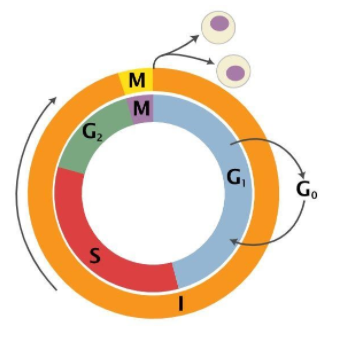
As a result, the correct answer is 'G0 phase.' Therefore the correct answer is option ‘C’.
Note: The cell cycle is the process through which cells, whether eukaryotes or prokaryotes, replicate and reproduce. It is beneficial to organisms in a variety of ways, but it mostly permits them to live. The cell cycle of prokaryotes, known as Binary Fission, permits them to live on by dividing into two new daughter cells.
Complete answer:
The process through which cells multiply and divide into two new cells is known as the cell cycle. G1, S, G2, and M are the phases of the cell cycle. The cell is in the G1 stage when it is prepared to divide. To accomplish this, the cell enters the S phase, during which it copies all of the DNA. DNA synthesis is denoted by the letter S.
The cell enters the G2 stage once the DNA has been duplicated and there is a complete additional set of all genetic material, where it organises and condenses the genetic material, or begins to condense the genetic material, and prepares to divide. M, which stands for mitosis, is the following step. The cell divides the two copies of the genetic material into the two daughter cells at this point.
After the M phase, cell division occurs, leaving two cells, and the cell cycle can resume. The G0 phase is often referred to as the quiescent phase. The cell is still metabolically active, but it is no longer proliferating. It is a resting stage for a cell in which the cell is neither dividing or preparing to divide and does not multiply unless the organism requires it.
As a result, the correct answer is 'G0 phase.' Therefore the correct answer is option ‘C’.
Note: The cell cycle is the process through which cells, whether eukaryotes or prokaryotes, replicate and reproduce. It is beneficial to organisms in a variety of ways, but it mostly permits them to live. The cell cycle of prokaryotes, known as Binary Fission, permits them to live on by dividing into two new daughter cells.
Recently Updated Pages
Master Class 10 Computer Science: Engaging Questions & Answers for Success

Master Class 10 General Knowledge: Engaging Questions & Answers for Success
Master Class 10 English: Engaging Questions & Answers for Success
Master Class 10 Social Science: Engaging Questions & Answers for Success
Master Class 10 Maths: Engaging Questions & Answers for Success
Master Class 10 Science: Engaging Questions & Answers for Success
Trending doubts
What is the median of the first 10 natural numbers class 10 maths CBSE
Which women's tennis player has 24 Grand Slam singles titles?
Who is the Brand Ambassador of Incredible India?
Why is there a time difference of about 5 hours between class 10 social science CBSE
Write a letter to the principal requesting him to grant class 10 english CBSE
State and prove converse of BPT Basic Proportionality class 10 maths CBSE