




How many chromosomes are found in human ovum?
a) 46
b) 64
c) 23
d) 32
Answer
 Verified
594k+ views
Hint: Human ovum is the female gamete. Gametes are formed by gametogenesis. Spermatogenesis forms sperms and oogenesis forms ovum. The ovum fuses with the sperm and thuis zygote is formed that undergoes further development to form embryo and then foetus.
Complete answer:
Sperms are formed by spermatogenesis and ovum is formed by oogenesis. The stem cells are the major pre-requirements for these processes. The main difference between the two processes is that oogenesis is an unequal division.
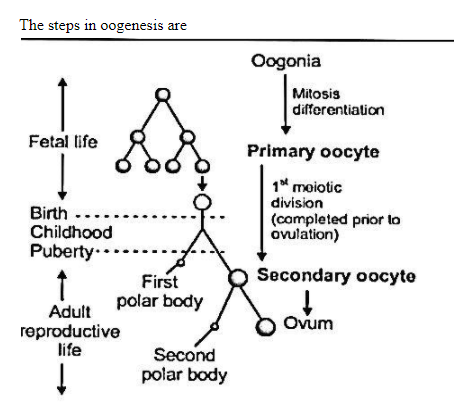
>Oogonia are the mother cells that start the process. These cells are formed in yolk sac but migrate to the gonads. These are diploid cells (2n=46).
>These cells undergo Mitosis to form Primary oocytes. Mitosis is equational division. Thus primary oocytes are also diploid.The Primary oocytes then undergo Meiosis 1 and form one secondary oocyte and first polar body. Meiosis 1 is reductional division. Hence the daughter cells are haploid (n=23).
>The secondary oocyte undergoes Meiosis 2 to form ovum and second polar body. (This process takes place only when sperm enters the egg). Meiosis 2 is also equational division and thus the ovum is haploid (n=23).
Hence the correct answer is option ‘c’.
Note: Humans show 46 chromosomes ( 23 pairs). The gametes are always haploid so that during fertilisation when the gametes fuse, the zygote is diploid and thus the ploidy level is maintained.
Complete answer:
Sperms are formed by spermatogenesis and ovum is formed by oogenesis. The stem cells are the major pre-requirements for these processes. The main difference between the two processes is that oogenesis is an unequal division.
>Oogonia are the mother cells that start the process. These cells are formed in yolk sac but migrate to the gonads. These are diploid cells (2n=46).
>These cells undergo Mitosis to form Primary oocytes. Mitosis is equational division. Thus primary oocytes are also diploid.The Primary oocytes then undergo Meiosis 1 and form one secondary oocyte and first polar body. Meiosis 1 is reductional division. Hence the daughter cells are haploid (n=23).
>The secondary oocyte undergoes Meiosis 2 to form ovum and second polar body. (This process takes place only when sperm enters the egg). Meiosis 2 is also equational division and thus the ovum is haploid (n=23).
Hence the correct answer is option ‘c’.
Note: Humans show 46 chromosomes ( 23 pairs). The gametes are always haploid so that during fertilisation when the gametes fuse, the zygote is diploid and thus the ploidy level is maintained.
Recently Updated Pages
Master Class 12 Economics: Engaging Questions & Answers for Success

Master Class 12 Physics: Engaging Questions & Answers for Success
Master Class 12 English: Engaging Questions & Answers for Success
Master Class 12 Social Science: Engaging Questions & Answers for Success
Master Class 12 Maths: Engaging Questions & Answers for Success
Master Class 12 Business Studies: Engaging Questions & Answers for Success
Trending doubts
Which are the Top 10 Largest Countries of the World?
What are the major means of transport Explain each class 12 social science CBSE
Draw a labelled sketch of the human eye class 12 physics CBSE
Why cannot DNA pass through cell membranes class 12 biology CBSE
Differentiate between insitu conservation and exsitu class 12 biology CBSE
Draw a neat and well labeled diagram of TS of ovary class 12 biology CBSE