




What is color blindness? Explain its inheritance with help of suitable charts.
Answer
 Verified
594.6k+ views
Hint: Color blindness frequently happens when a person cannot distinguish among certain colors.
Complete answer: Colour blindness is a usually hereditary condition that means it is commonly passed down from our parents.
Red/green colour blindness is passed from mother to son on the 23rd chromosome that is called as the sex chromosome as it additionally determines sex.
Chromosomes are structures which incorporate genes; these incorporate the instructions for the development of cells, tissues and organs.
The colour blind ‘gene’ is carried on one of the X chromosomes.
Since men have only one X chromosome, if his X chromosome incorporates the colour blind ‘gene’ (X) he could be colour blind (XY). A woman could have both two normal X chromosomes, so that she cannot be colour blind or be a carrier (XX), or, one normal X and one colour blind carrying X chromosome, in which case she could be a carrier (XX), or rarely she will inherit a colour blind X from her father and a colour blind X from her mother and be colour blind herself (XX). She will pass on colour blindness to all of her sons if that is the case.
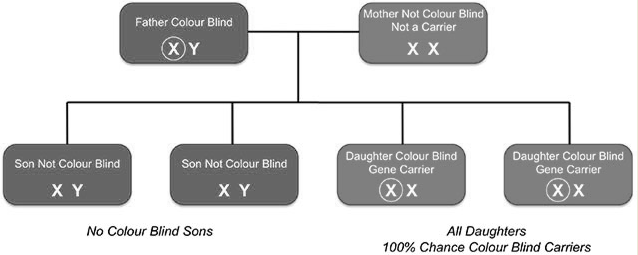
Additional information: Colour blindness is considered as recessive sex linked disease.
Its gene is located on the X - chromosome.
The colour - blind person cannot distinguish among red and green colours.
Colour blindness is more usual in male than in females.
Note: Color blindness is a genetic condition caused by a difference in how one or more of the light-sensitive cells observed within the retina of the eye respond to certain colors.
Complete answer: Colour blindness is a usually hereditary condition that means it is commonly passed down from our parents.
Red/green colour blindness is passed from mother to son on the 23rd chromosome that is called as the sex chromosome as it additionally determines sex.
Chromosomes are structures which incorporate genes; these incorporate the instructions for the development of cells, tissues and organs.
The colour blind ‘gene’ is carried on one of the X chromosomes.
Since men have only one X chromosome, if his X chromosome incorporates the colour blind ‘gene’ (X) he could be colour blind (XY). A woman could have both two normal X chromosomes, so that she cannot be colour blind or be a carrier (XX), or, one normal X and one colour blind carrying X chromosome, in which case she could be a carrier (XX), or rarely she will inherit a colour blind X from her father and a colour blind X from her mother and be colour blind herself (XX). She will pass on colour blindness to all of her sons if that is the case.
Additional information: Colour blindness is considered as recessive sex linked disease.
Its gene is located on the X - chromosome.
The colour - blind person cannot distinguish among red and green colours.
Colour blindness is more usual in male than in females.
Note: Color blindness is a genetic condition caused by a difference in how one or more of the light-sensitive cells observed within the retina of the eye respond to certain colors.
Recently Updated Pages
Master Class 12 Economics: Engaging Questions & Answers for Success

Master Class 12 Physics: Engaging Questions & Answers for Success
Master Class 12 English: Engaging Questions & Answers for Success
Master Class 12 Social Science: Engaging Questions & Answers for Success
Master Class 12 Maths: Engaging Questions & Answers for Success
Master Class 12 Business Studies: Engaging Questions & Answers for Success
Trending doubts
Which are the Top 10 Largest Countries of the World?
What are the major means of transport Explain each class 12 social science CBSE
Draw a labelled sketch of the human eye class 12 physics CBSE
Why cannot DNA pass through cell membranes class 12 biology CBSE
Differentiate between insitu conservation and exsitu class 12 biology CBSE
Draw a neat and well labeled diagram of TS of ovary class 12 biology CBSE