




Concave lens is used in cameras to focus an image of film. Is the statement true or false?
Answer
 Verified
563.4k+ views
Hint: We need to understand the different lenses used in the camera and the reasons for using these lenses to understand the usage of the concave lenses in the camera. This information can be used to find the correct solution to this problem.
Complete answer:
We know that the cameras are optical devices which are used in capturing the one-time view as it is to be preserved in a storable form such as on photographic film or in the digital form.
The cameras mostly use the converging lenses or the convex lenses to converge the incoming light rays and focussing an image on the film. In cases, where we have to get images of far objects with better size, we use the diverging lenses which form virtual images thus can be useful in reducing the tube length of the camera.
A converging mirror converges the light falling which can cause chromatic aberrations. The usage of a concave lens simultaneously can reduce this risk creating much effective photos.
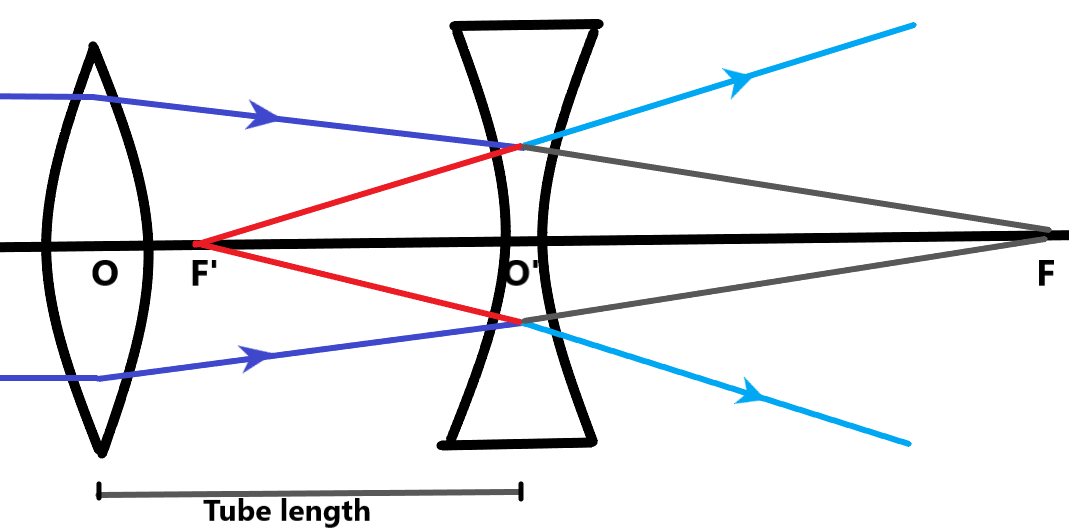
As we can see from the figure, if the concave lens is not used, the length of the camera will be so much longer.
The main purpose of using the concave lenses is to create a virtual and erect image so that a screen is not necessary at the point where the image is formed and therefore can effectively reduce the tube length of the camera, making the cameras handy and portable. This is the main purpose of the concave lenses.
These lenses are not used to focus the image on a film. It is FALSE.
This is the required solution.
Note:
The concave lenses are diverging lenses and they cannot be used for focussing an image on a screen, unlike the converging lenses which can form real images and will require physical surfaces to form images, which is the advantage in using a concave lens.
Complete answer:
We know that the cameras are optical devices which are used in capturing the one-time view as it is to be preserved in a storable form such as on photographic film or in the digital form.
The cameras mostly use the converging lenses or the convex lenses to converge the incoming light rays and focussing an image on the film. In cases, where we have to get images of far objects with better size, we use the diverging lenses which form virtual images thus can be useful in reducing the tube length of the camera.
A converging mirror converges the light falling which can cause chromatic aberrations. The usage of a concave lens simultaneously can reduce this risk creating much effective photos.
As we can see from the figure, if the concave lens is not used, the length of the camera will be so much longer.
The main purpose of using the concave lenses is to create a virtual and erect image so that a screen is not necessary at the point where the image is formed and therefore can effectively reduce the tube length of the camera, making the cameras handy and portable. This is the main purpose of the concave lenses.
These lenses are not used to focus the image on a film. It is FALSE.
This is the required solution.
Note:
The concave lenses are diverging lenses and they cannot be used for focussing an image on a screen, unlike the converging lenses which can form real images and will require physical surfaces to form images, which is the advantage in using a concave lens.
Recently Updated Pages
Master Class 12 Economics: Engaging Questions & Answers for Success

Master Class 12 Physics: Engaging Questions & Answers for Success
Master Class 12 English: Engaging Questions & Answers for Success
Master Class 12 Social Science: Engaging Questions & Answers for Success
Master Class 12 Maths: Engaging Questions & Answers for Success
Master Class 12 Business Studies: Engaging Questions & Answers for Success
Trending doubts
Which are the Top 10 Largest Countries of the World?
What are the major means of transport Explain each class 12 social science CBSE
Draw a labelled sketch of the human eye class 12 physics CBSE
Why cannot DNA pass through cell membranes class 12 biology CBSE
Differentiate between insitu conservation and exsitu class 12 biology CBSE
Draw a neat and well labeled diagram of TS of ovary class 12 biology CBSE