




Define refraction of light waves. Draw a ray diagram for refraction at a spherical separating two media. For refraction at a spherical surface, derive the relation $\dfrac{{{n_2}}}{v} - \dfrac{{{n_1}}}
{u} = \dfrac{{{n_2} - {n_1}}}{R}$ in object distance $(u)$, image distance $(v)$ , refractive index of
media $({n_1},{n_2})$ and radius of curvature $(R)$.
Answer
 Verified
585.9k+ views
Hint: Here we first draw the ray diagram correctly and label it. Then we assume the object distance, image distance and the radius of curvature and apply Snell’s law to get the answer.
Complete step by step answer:
If light rays enter a medium with different refractive index from another medium, they undergo a velocity transition. This is known as refraction of light. The velocity shift occurs in both the direction and amplitude of the light wave. Refraction of light is usually bending of light.
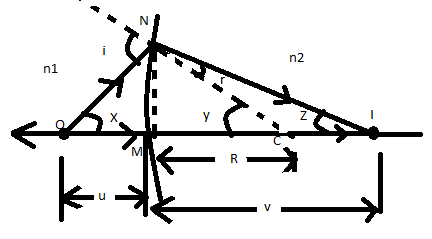
Now, let us consider $i$ and $r$ to be small.
Which means that $X,y,Z$ are small.
Also let $MN = $ length of arc, $OM \approx u$ is the object distance, $IM \approx V$ is the image distance and $CM \approx R$ is the radius.
Now,
From the figure we can observe that-
$i = X + y$ ...... (i)
$r = y - Z$ ...... (ii)
Using Snell’s law, we get-
${n_1}\sin i = {n_2}\sin r$
From equation (i) and (ii), we get-
${n_1}\sin (X + y) = {n_2}\sin (y - Z)$ ...... (iii)
Now let
$
\sin (X + y) \approx X + y \approx \sin X + \sin y \\
\sin (y - Z) \approx y - Z \approx \sin y - \sin Z \\
$
By using the sine formula we get-
$
\sin X \approx \dfrac{{MN}}
{u} \\
\sin Z \approx \dfrac{{MN}}
{v} \\
\sin y \approx \dfrac{{MN}}
{R} \\
$
Now, we can write equation (iii) as-
${n_1}\left( {\dfrac{{MN}}{u} + \dfrac{{MN}}{R}} \right) = {n_2}\left( {\dfrac{{MN}}{R} - \dfrac{{MN}}{v}} \right)$
Cancelling out $MN$
we get-
$\dfrac{{{n_1}}}
{u} + \dfrac{{{n_2}}}
{v} = \dfrac{{{n_2} - {n_1}}}
{R}$
Applying the correct sign conventions, we get-
$
u = - u \\
v = + v \\
R = + R \\
$
$\dfrac{{{n_2}}}
{v} - \dfrac{{{n_1}}}
{u} = \dfrac{{{n_2} - {n_1}}}
{R}$
Hence, the relationship is derived
Additional Information:
Snell’s law- Snell’s law is a formula used when applied to light or other waves moving across a border between two different isotropic media, such as water, glass or air to explain the connection between the angles of incidence and refraction. Snell’s law is also known as the law of refraction.
Note:
Here since, the object is placed to the left of the mirror, so we take the object distance as negative. Also we have to carefully use the sine formula here; otherwise we shall not get the required derivation.
Complete step by step answer:
If light rays enter a medium with different refractive index from another medium, they undergo a velocity transition. This is known as refraction of light. The velocity shift occurs in both the direction and amplitude of the light wave. Refraction of light is usually bending of light.
Now, let us consider $i$ and $r$ to be small.
Which means that $X,y,Z$ are small.
Also let $MN = $ length of arc, $OM \approx u$ is the object distance, $IM \approx V$ is the image distance and $CM \approx R$ is the radius.
Now,
From the figure we can observe that-
$i = X + y$ ...... (i)
$r = y - Z$ ...... (ii)
Using Snell’s law, we get-
${n_1}\sin i = {n_2}\sin r$
From equation (i) and (ii), we get-
${n_1}\sin (X + y) = {n_2}\sin (y - Z)$ ...... (iii)
Now let
$
\sin (X + y) \approx X + y \approx \sin X + \sin y \\
\sin (y - Z) \approx y - Z \approx \sin y - \sin Z \\
$
By using the sine formula we get-
$
\sin X \approx \dfrac{{MN}}
{u} \\
\sin Z \approx \dfrac{{MN}}
{v} \\
\sin y \approx \dfrac{{MN}}
{R} \\
$
Now, we can write equation (iii) as-
${n_1}\left( {\dfrac{{MN}}{u} + \dfrac{{MN}}{R}} \right) = {n_2}\left( {\dfrac{{MN}}{R} - \dfrac{{MN}}{v}} \right)$
Cancelling out $MN$
we get-
$\dfrac{{{n_1}}}
{u} + \dfrac{{{n_2}}}
{v} = \dfrac{{{n_2} - {n_1}}}
{R}$
Applying the correct sign conventions, we get-
$
u = - u \\
v = + v \\
R = + R \\
$
$\dfrac{{{n_2}}}
{v} - \dfrac{{{n_1}}}
{u} = \dfrac{{{n_2} - {n_1}}}
{R}$
Hence, the relationship is derived
Additional Information:
Snell’s law- Snell’s law is a formula used when applied to light or other waves moving across a border between two different isotropic media, such as water, glass or air to explain the connection between the angles of incidence and refraction. Snell’s law is also known as the law of refraction.
Note:
Here since, the object is placed to the left of the mirror, so we take the object distance as negative. Also we have to carefully use the sine formula here; otherwise we shall not get the required derivation.
Recently Updated Pages
Master Class 12 Economics: Engaging Questions & Answers for Success

Master Class 12 Physics: Engaging Questions & Answers for Success
Master Class 12 English: Engaging Questions & Answers for Success
Master Class 12 Social Science: Engaging Questions & Answers for Success
Master Class 12 Maths: Engaging Questions & Answers for Success
Master Class 12 Business Studies: Engaging Questions & Answers for Success
Trending doubts
Which are the Top 10 Largest Countries of the World?
What are the major means of transport Explain each class 12 social science CBSE
Draw a labelled sketch of the human eye class 12 physics CBSE
Why cannot DNA pass through cell membranes class 12 biology CBSE
Differentiate between insitu conservation and exsitu class 12 biology CBSE
Draw a neat and well labeled diagram of TS of ovary class 12 biology CBSE