




Derive the expression for motional EMF induced in a conductor moving in a uniform magnetic field.
Answer
 Verified
521.8k+ views
Hint: The magnetic flux enclosed in area A is given by
\[\Phi = BA\]
If the length of the conductor is l and displacement be x then the area A is given by
\[A = lx\]
Hence,
\[\Phi = Blx\]
Complete step by step solution:
1) Consider a straight conducting wire placed in an uniform magnetic field. The length of the wire is AB= l.
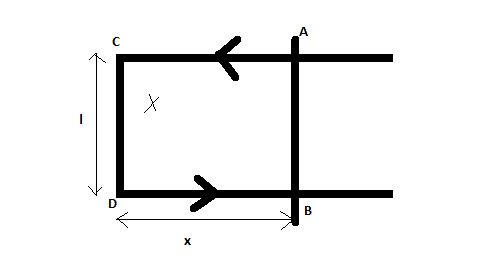
2) Now it is shifted x distance to another point CD.
3) Hence the flux associated with the loop ABCD is given by
\[{\Phi _B} = Blx\]
4) As the displacement x changes with time, then there is a rate of change of induced flux. According to Faraday’s law, this rate of change of flux will induce an emf in the conductor. The rate of change of flux is hence given by
\[
\varepsilon = - \dfrac{{d{\Phi _B}}}{{dt}} \\
\varepsilon = - \dfrac{d}{{dt}}(Blx) \\
\varepsilon = - Bl\dfrac{d}{{dt}}x \\
\varepsilon = - Blv \\
\]
This induced emf is called the motional emf.
Note: The negative sign given here indicates that this emf opposes the cause of its generation. Faraday’s law of electromagnetic induction gives the concept of motional emf which is different from the emf of the cell and opposes it.
\[\Phi = BA\]
If the length of the conductor is l and displacement be x then the area A is given by
\[A = lx\]
Hence,
\[\Phi = Blx\]
Complete step by step solution:
1) Consider a straight conducting wire placed in an uniform magnetic field. The length of the wire is AB= l.
2) Now it is shifted x distance to another point CD.
3) Hence the flux associated with the loop ABCD is given by
\[{\Phi _B} = Blx\]
4) As the displacement x changes with time, then there is a rate of change of induced flux. According to Faraday’s law, this rate of change of flux will induce an emf in the conductor. The rate of change of flux is hence given by
\[
\varepsilon = - \dfrac{{d{\Phi _B}}}{{dt}} \\
\varepsilon = - \dfrac{d}{{dt}}(Blx) \\
\varepsilon = - Bl\dfrac{d}{{dt}}x \\
\varepsilon = - Blv \\
\]
This induced emf is called the motional emf.
Note: The negative sign given here indicates that this emf opposes the cause of its generation. Faraday’s law of electromagnetic induction gives the concept of motional emf which is different from the emf of the cell and opposes it.
Recently Updated Pages
Master Class 12 Economics: Engaging Questions & Answers for Success

Master Class 12 Physics: Engaging Questions & Answers for Success
Master Class 12 English: Engaging Questions & Answers for Success
Master Class 12 Social Science: Engaging Questions & Answers for Success
Master Class 12 Maths: Engaging Questions & Answers for Success
Master Class 12 Business Studies: Engaging Questions & Answers for Success
Trending doubts
Which are the Top 10 Largest Countries of the World?
What are the major means of transport Explain each class 12 social science CBSE
Draw a labelled sketch of the human eye class 12 physics CBSE
Why cannot DNA pass through cell membranes class 12 biology CBSE
Differentiate between insitu conservation and exsitu class 12 biology CBSE
Draw a neat and well labeled diagram of TS of ovary class 12 biology CBSE