



Determine the LCM of 10, 25, 40.
(a) 5
(b) 20
(c) 150
(d) 200
Answer
 Verified
618.9k+ views
Hint: LCM stands for least common multiple. We can calculate LCM of two or more numbers with the help of the prime factorization method. Do the prime factorization of each number and hence find the LCM as well.
Complete step-by-step answer:
We know that LCM stands for least common multiple which can be calculated by prime factorization of the given numbers.
So, let us factorise the given numbers which are 10, 25, 40.
So, prime factorization of 10 can be done by following way:
Hence, 10 can be written as
$10=2\times 5................\left( i \right)$
Similarly, 25 can be factorized by the following approach
Hence, 25 can be written as
$25=5\times 5............\left( ii \right)$
Similarly, prime factorization of ‘40’ can be given as
Hence, 40 can be written as
$40=2\times 2\times 2\times 5................\left( iii \right)$
Now, from equation (i),(ii) and (iii), we get
$\begin{align}
& 10=2\times 5 \\
& 25=5\times 5 \\
& 40=2\times 5\times 2\times 2. \\
\end{align}$
As we know LCM from the prime factorization method can be calculated by multiplying the terms common to the prime factorization of numbers and the remaining numbers from each prime factorization of numbers.
So, common factors of 10, 25 and 40 are given as ‘5’.
So, LCM can be as
$\begin{align}
& LCM=\left( 5 \right)\times \left( 2\times 2\times 2 \right)\times \left( 5 \right) \\
& LCM=25\times 8 \\
\end{align}$
LCM = 200
Hence, LCM of the numbers 10, 25, 40 is 200.
So, option (d) is correct.
Note: Another simple approach for calculating LCM can be given as:
Try to factorize the terms in one go as following
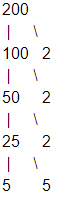
Now, multiply the above terms to get LCM that $2\times 2\times 2\times 5\times 5=200$
One can get confused while taking the common terms from 10, 25, 40. ‘5’ is common in factors of 10, 25, 40. So, we write ‘5’ for one time and 2 is also common in factors of 10 and 40. So, we will write ‘2’ one time as well. Hence, be careful with the rules of the prime factorization method.
One can use “writing the multiple of the given numbers” approach as well. Multiples of number be
10 = 10, 20, 30……..200…..
25 = 25, 50, 75………..200….
40 = 40, 80, 120, 160, 200….
The least common multiple of 10, 25, 40 i.e. 200 is the LCM.
Complete step-by-step answer:
We know that LCM stands for least common multiple which can be calculated by prime factorization of the given numbers.
So, let us factorise the given numbers which are 10, 25, 40.
So, prime factorization of 10 can be done by following way:
Hence, 10 can be written as
$10=2\times 5................\left( i \right)$
Similarly, 25 can be factorized by the following approach
Hence, 25 can be written as
$25=5\times 5............\left( ii \right)$
Similarly, prime factorization of ‘40’ can be given as
Hence, 40 can be written as
$40=2\times 2\times 2\times 5................\left( iii \right)$
Now, from equation (i),(ii) and (iii), we get
$\begin{align}
& 10=2\times 5 \\
& 25=5\times 5 \\
& 40=2\times 5\times 2\times 2. \\
\end{align}$
As we know LCM from the prime factorization method can be calculated by multiplying the terms common to the prime factorization of numbers and the remaining numbers from each prime factorization of numbers.
So, common factors of 10, 25 and 40 are given as ‘5’.
So, LCM can be as
$\begin{align}
& LCM=\left( 5 \right)\times \left( 2\times 2\times 2 \right)\times \left( 5 \right) \\
& LCM=25\times 8 \\
\end{align}$
LCM = 200
Hence, LCM of the numbers 10, 25, 40 is 200.
So, option (d) is correct.
Note: Another simple approach for calculating LCM can be given as:
Try to factorize the terms in one go as following
Now, multiply the above terms to get LCM that $2\times 2\times 2\times 5\times 5=200$
One can get confused while taking the common terms from 10, 25, 40. ‘5’ is common in factors of 10, 25, 40. So, we write ‘5’ for one time and 2 is also common in factors of 10 and 40. So, we will write ‘2’ one time as well. Hence, be careful with the rules of the prime factorization method.
One can use “writing the multiple of the given numbers” approach as well. Multiples of number be
10 = 10, 20, 30……..200…..
25 = 25, 50, 75………..200….
40 = 40, 80, 120, 160, 200….
The least common multiple of 10, 25, 40 i.e. 200 is the LCM.

Recently Updated Pages
Master Class 7 English: Engaging Questions & Answers for Success

Master Class 7 Maths: Engaging Questions & Answers for Success
Master Class 7 Science: Engaging Questions & Answers for Success
Class 7 Question and Answer - Your Ultimate Solutions Guide
Master Class 9 General Knowledge: Engaging Questions & Answers for Success
Master Class 9 Social Science: Engaging Questions & Answers for Success
Trending doubts
The value of 6 more than 7 is A 1 B 1 C 13 D 13 class 7 maths CBSE
Convert 200 Million dollars in rupees class 7 maths CBSE
How many lines of symmetry does a regular pentagon-class-7-maths-CBSE
List of coprime numbers from 1 to 100 class 7 maths CBSE
AIM To prepare stained temporary mount of onion peel class 7 biology CBSE
The plural of Chief is Chieves A True B False class 7 english CBSE