




Distinguish between the terms homopolymer and copolymer and give an example of each.
Answer
 Verified
590.4k+ views
Hint: The Classification homopolymer and copolymer is based on the number of different types of monomer units present in a polymer. In other words homopolymer and copolymer differ whether only one type of monomer unit is present or more than one type of monomer units are present.
Complete step by step answer:
There are different ways in which polymers are classified. One classification is based on the number of different types of monomer units present in a polymer. On this basis, the polymers can be classified into homopolymer and copolymer.
Note:
Homopolymer is usually an additional polymer whereas copolymer is usually a condensation polymer.
Complete step by step answer:
There are different ways in which polymers are classified. One classification is based on the number of different types of monomer units present in a polymer. On this basis, the polymers can be classified into homopolymer and copolymer.
| Homopolymer | Copolymer |
| Homopolymer is made from only one type of monomer unit. In the repeating structural unit of a homopolymer, only one type of monomer unit is present. | On the other hand, copolymer is made from two (or more) types of monomer units. In the repeating structural unit of a copolymer, two (or more) types of monomer unit are present. |
| Polythene, Teflon, PAN and nylon-6 are some examples of homopolymers. Thus, polythene is made from only one type of monomer unit which is ethylene. | Buna-S, Buna-N, polyester, Bakelite and nylon-6,6 are some examples of copolymers. Thus, buna-S is made from two types of monomer units which are styrene and 1,3-butadiene. |
The structure of polythene and its monomer are as shown below: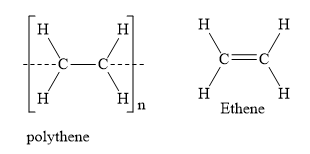
| The structure of buna S and its monomers are as shown below: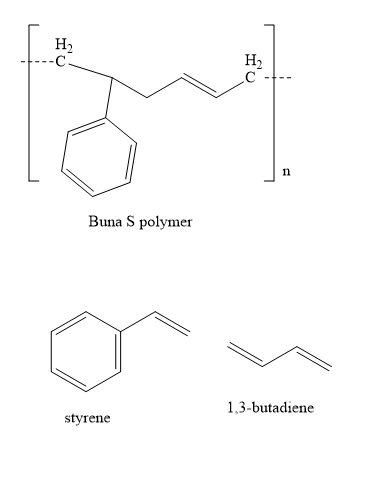
|
The reaction for the preparation of polythene is as shown below: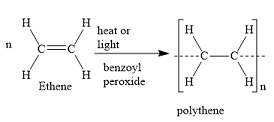
| The reaction for the preparation of buna-S is as shown below:
|
Note:
Homopolymer is usually an additional polymer whereas copolymer is usually a condensation polymer.
Recently Updated Pages
Master Class 12 Economics: Engaging Questions & Answers for Success

Master Class 12 Physics: Engaging Questions & Answers for Success
Master Class 12 English: Engaging Questions & Answers for Success
Master Class 12 Social Science: Engaging Questions & Answers for Success
Master Class 12 Maths: Engaging Questions & Answers for Success
Master Class 12 Business Studies: Engaging Questions & Answers for Success
Trending doubts
Which are the Top 10 Largest Countries of the World?
What are the major means of transport Explain each class 12 social science CBSE
Draw a labelled sketch of the human eye class 12 physics CBSE
Why cannot DNA pass through cell membranes class 12 biology CBSE
Differentiate between insitu conservation and exsitu class 12 biology CBSE
Draw a neat and well labeled diagram of TS of ovary class 12 biology CBSE