




Draw the number line and locate the points on them. The points are $\dfrac{1}{8},\dfrac{2}{8},\dfrac{3}{8},\dfrac{5}{8}$.
Answer
 Verified
610.2k+ views
Hint: Here, first we have to draw the number line from 0 to 1. Since all the denominators of numbers given in the question are the same, we have to divide the number line between 0 and 1 into 8 equal parts and then locate the numbers in the number line.
Complete step-by-step answer:
Here, we are given the points $\dfrac{1}{8},\dfrac{2}{8},\dfrac{3}{8},\dfrac{5}{8}$.
Now, we have to draw the number line and locate the points on them.
First let us discuss the number line. A number line is a pictorial representation of numbers on a straight line. It is a reference for comparing and ordering numbers. It is used to represent any real number that includes every whole number and natural numbers. Arithmetic operations of numbers can be better explained on a number line.
So, we have to draw $\dfrac{1}{8},\dfrac{2}{8},\dfrac{3}{8},\dfrac{5}{8}$.
First let us draw the number line from 0 to 1.

Here, in all the given numbers the denominator is the same and it is 8. Now, we have to divide the number line between 0 and 1 into 8 equal parts.
Now, we have to locate the numbers $\dfrac{1}{8},\dfrac{2}{8},\dfrac{3}{8},\dfrac{5}{8}$ on the number line.
The number line is as follows.
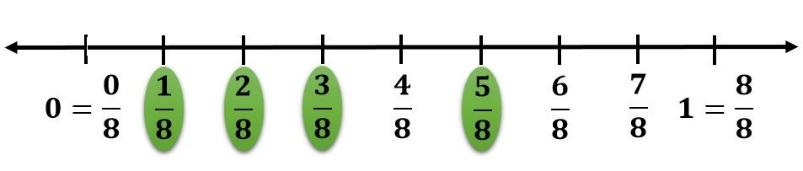
In the above number line the shaded numbers represents
$\dfrac{1}{8},\dfrac{2}{8},\dfrac{3}{8},\dfrac{5}{8}$.
Note: Writing numbers on the number line makes comparing numbers easier. Numbers on the left are smaller than the numbers on the right of the number line. A number line can also be used to carry out addition, subtraction and multiplication. We always move right to add, move left to subtract and skip count to multiply.
Complete step-by-step answer:
Here, we are given the points $\dfrac{1}{8},\dfrac{2}{8},\dfrac{3}{8},\dfrac{5}{8}$.
Now, we have to draw the number line and locate the points on them.
First let us discuss the number line. A number line is a pictorial representation of numbers on a straight line. It is a reference for comparing and ordering numbers. It is used to represent any real number that includes every whole number and natural numbers. Arithmetic operations of numbers can be better explained on a number line.
So, we have to draw $\dfrac{1}{8},\dfrac{2}{8},\dfrac{3}{8},\dfrac{5}{8}$.
First let us draw the number line from 0 to 1.
Here, in all the given numbers the denominator is the same and it is 8. Now, we have to divide the number line between 0 and 1 into 8 equal parts.
Now, we have to locate the numbers $\dfrac{1}{8},\dfrac{2}{8},\dfrac{3}{8},\dfrac{5}{8}$ on the number line.
The number line is as follows.
In the above number line the shaded numbers represents
$\dfrac{1}{8},\dfrac{2}{8},\dfrac{3}{8},\dfrac{5}{8}$.
Note: Writing numbers on the number line makes comparing numbers easier. Numbers on the left are smaller than the numbers on the right of the number line. A number line can also be used to carry out addition, subtraction and multiplication. We always move right to add, move left to subtract and skip count to multiply.
Recently Updated Pages
Master Class 10 Computer Science: Engaging Questions & Answers for Success

Master Class 10 General Knowledge: Engaging Questions & Answers for Success
Master Class 10 English: Engaging Questions & Answers for Success
Master Class 10 Social Science: Engaging Questions & Answers for Success
Master Class 10 Maths: Engaging Questions & Answers for Success
Master Class 10 Science: Engaging Questions & Answers for Success
Trending doubts
What is the median of the first 10 natural numbers class 10 maths CBSE
Which women's tennis player has 24 Grand Slam singles titles?
Who is the Brand Ambassador of Incredible India?
Why is there a time difference of about 5 hours between class 10 social science CBSE
Write a letter to the principal requesting him to grant class 10 english CBSE
State and prove converse of BPT Basic Proportionality class 10 maths CBSE