




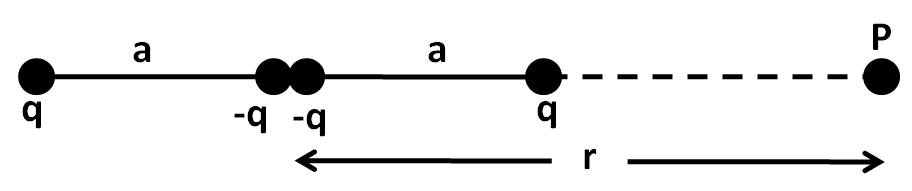
Figure shows a charge array known as an electric quadrupole. For a point on the axis of the quadruple, obtain the dependence of potential on $ r $ for $ r/a > > 1 $, and contrast your results with that due to an electric dipole, and an electric monopole (i.e., a single charge).
Answer
 Verified
568.8k+ views
Hint: To solve this question, we need to use the formula for the potential at a point due to a point charge for calculating the potential due to all the four point charges. Then we have to make the comparison with the known formulas for the potential due to a dipole and a monopole.
Formula used: The formulae used in solving this question are given by
$ V = \dfrac{{Kq}}{r} $, here $ V $ is the potential due to a point charge $ q $ at a distance of $ r $.
$ V = \dfrac{{Kp}}{{{r^2}}} $, here $ V $ is the potential due to an electric dipole of dipole moment $ p $ at an axial distance of $ r $ from its centre.
Complete step by step answer
Let us label the points as shown in the figure below.
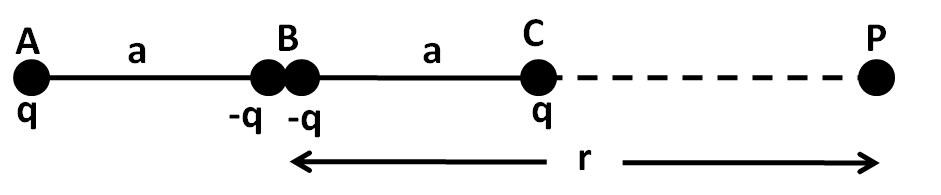
Since both the charges $ - q $ and $ - q $ at the point B, we can say that a total charge of $ - 2q $ is present at B. So we can redraw the above figure as

We can observe from the above figure that $ AP = r + a $, $ BP = r $, and $ CP = r - a $.
We know that the potential due to a point charge is given by
$\Rightarrow V = \dfrac{{Kq}}{r} $ …………………….(1)
So the potential at the point P due to the charge at A is
$\Rightarrow {V_A} = \dfrac{{Kq}}{{AP}} $
$ \Rightarrow {V_A} = \dfrac{{Kq}}{{r + a}} $ …………………….(2)
Similarly, the potential due to the charges at B and C at P are respectively,
$\Rightarrow {V_B} = \dfrac{{ - 2Kq}}{r} $ …………………….(3)
$\Rightarrow {V_C} = \dfrac{{Kq}}{{r - a}} $ …………………….(4)
So the net potential at the point P is
$\Rightarrow V = {V_A} + {V_B} + {V_C} $
From (2) (3) and (4) we have
$\Rightarrow V = \dfrac{{Kq}}{{r + a}} + \dfrac{{ - 2Kq}}{r} + \dfrac{{Kq}}{{r - a}} $
Taking $ Kq $ common, we get
$\Rightarrow V = Kq\left( {\dfrac{1}{{r + a}} - \dfrac{2}{r} + \dfrac{1}{{r - a}}} \right) $
Taking the LCM we have
$\Rightarrow V = Kq\left( {\dfrac{{r\left( {r - a} \right) - 2\left( {r + a} \right)\left( {r - a} \right) + r\left( {r + a} \right)}}{{\left( {r + a} \right)r\left( {r - a} \right)}}} \right) $
$ \Rightarrow V = Kq\left( {\dfrac{{{r^2} - ar - 2{r^2} + 2{a^2} + {r^2} + ar}}{{\left( {r + a} \right)r\left( {r - a} \right)}}} \right) $
On simplifying, we get
$\Rightarrow V = Kq\left( {\dfrac{{2{a^2}}}{{\left( {r + a} \right)r\left( {r - a} \right)}}} \right) $
$ \Rightarrow V = \dfrac{{2Kq{a^2}}}{{r\left( {{r^2} - {a^2}} \right)}} $
Taking $ {r^2} $ common from the denominator, we have
$\Rightarrow V = \dfrac{{2Kq{a^2}}}{{{r^3}\left( {1 - {a^2}/{r^2}} \right)}} $
According to the question, $ r/a > > 1 $. This means $ {a^2}/{r^2} \approx 0 $. So from above we get
$\Rightarrow V = \dfrac{{2Kq{a^2}}}{{{r^3}}} $
This is the potential due to the electric quadrupole.
$\Rightarrow V \propto \dfrac{1}{{{r^3}}} $
Also we know that for an electric dipole, the axial potential is given by
$\Rightarrow V = \dfrac{{Kp}}{{{r^2}}} $
So that
$\Rightarrow V \propto \dfrac{1}{{{r^2}}} $
Finally, the potential due to a point charge is given by
$\Rightarrow V = \dfrac{{Kq}}{r} $
This means that
$\Rightarrow V \propto \dfrac{1}{r} $
Hence, the potential due to a monopole, a dipole, and a quadruple is inversely proportional to the first, second and third power of distance respectively.
Note
We could also divide the given quadruple into two adjacent dipoles and apply the formula of the electric potential for both of the dipoles at the point P. Then on adding these two potentials we will get the required value of the net potential at the point.
Formula used: The formulae used in solving this question are given by
$ V = \dfrac{{Kq}}{r} $, here $ V $ is the potential due to a point charge $ q $ at a distance of $ r $.
$ V = \dfrac{{Kp}}{{{r^2}}} $, here $ V $ is the potential due to an electric dipole of dipole moment $ p $ at an axial distance of $ r $ from its centre.
Complete step by step answer
Let us label the points as shown in the figure below.
Since both the charges $ - q $ and $ - q $ at the point B, we can say that a total charge of $ - 2q $ is present at B. So we can redraw the above figure as
We can observe from the above figure that $ AP = r + a $, $ BP = r $, and $ CP = r - a $.
We know that the potential due to a point charge is given by
$\Rightarrow V = \dfrac{{Kq}}{r} $ …………………….(1)
So the potential at the point P due to the charge at A is
$\Rightarrow {V_A} = \dfrac{{Kq}}{{AP}} $
$ \Rightarrow {V_A} = \dfrac{{Kq}}{{r + a}} $ …………………….(2)
Similarly, the potential due to the charges at B and C at P are respectively,
$\Rightarrow {V_B} = \dfrac{{ - 2Kq}}{r} $ …………………….(3)
$\Rightarrow {V_C} = \dfrac{{Kq}}{{r - a}} $ …………………….(4)
So the net potential at the point P is
$\Rightarrow V = {V_A} + {V_B} + {V_C} $
From (2) (3) and (4) we have
$\Rightarrow V = \dfrac{{Kq}}{{r + a}} + \dfrac{{ - 2Kq}}{r} + \dfrac{{Kq}}{{r - a}} $
Taking $ Kq $ common, we get
$\Rightarrow V = Kq\left( {\dfrac{1}{{r + a}} - \dfrac{2}{r} + \dfrac{1}{{r - a}}} \right) $
Taking the LCM we have
$\Rightarrow V = Kq\left( {\dfrac{{r\left( {r - a} \right) - 2\left( {r + a} \right)\left( {r - a} \right) + r\left( {r + a} \right)}}{{\left( {r + a} \right)r\left( {r - a} \right)}}} \right) $
$ \Rightarrow V = Kq\left( {\dfrac{{{r^2} - ar - 2{r^2} + 2{a^2} + {r^2} + ar}}{{\left( {r + a} \right)r\left( {r - a} \right)}}} \right) $
On simplifying, we get
$\Rightarrow V = Kq\left( {\dfrac{{2{a^2}}}{{\left( {r + a} \right)r\left( {r - a} \right)}}} \right) $
$ \Rightarrow V = \dfrac{{2Kq{a^2}}}{{r\left( {{r^2} - {a^2}} \right)}} $
Taking $ {r^2} $ common from the denominator, we have
$\Rightarrow V = \dfrac{{2Kq{a^2}}}{{{r^3}\left( {1 - {a^2}/{r^2}} \right)}} $
According to the question, $ r/a > > 1 $. This means $ {a^2}/{r^2} \approx 0 $. So from above we get
$\Rightarrow V = \dfrac{{2Kq{a^2}}}{{{r^3}}} $
This is the potential due to the electric quadrupole.
$\Rightarrow V \propto \dfrac{1}{{{r^3}}} $
Also we know that for an electric dipole, the axial potential is given by
$\Rightarrow V = \dfrac{{Kp}}{{{r^2}}} $
So that
$\Rightarrow V \propto \dfrac{1}{{{r^2}}} $
Finally, the potential due to a point charge is given by
$\Rightarrow V = \dfrac{{Kq}}{r} $
This means that
$\Rightarrow V \propto \dfrac{1}{r} $
Hence, the potential due to a monopole, a dipole, and a quadruple is inversely proportional to the first, second and third power of distance respectively.
Note
We could also divide the given quadruple into two adjacent dipoles and apply the formula of the electric potential for both of the dipoles at the point P. Then on adding these two potentials we will get the required value of the net potential at the point.
Recently Updated Pages
Master Class 12 Economics: Engaging Questions & Answers for Success

Master Class 12 Physics: Engaging Questions & Answers for Success
Master Class 12 English: Engaging Questions & Answers for Success
Master Class 12 Social Science: Engaging Questions & Answers for Success
Master Class 12 Maths: Engaging Questions & Answers for Success
Master Class 12 Business Studies: Engaging Questions & Answers for Success
Trending doubts
Which are the Top 10 Largest Countries of the World?
What are the major means of transport Explain each class 12 social science CBSE
Draw a labelled sketch of the human eye class 12 physics CBSE
Why cannot DNA pass through cell membranes class 12 biology CBSE
Differentiate between insitu conservation and exsitu class 12 biology CBSE
Draw a neat and well labeled diagram of TS of ovary class 12 biology CBSE