




How do you find the absolute value of a number?
Answer
 Verified
563.4k+ views
Hint: We explain the term absolute value of a number. How the absolute value always remains positive. We expand the function and break it into two parts. Then we verify the result with an example.
Complete step by step answer:
Absolute value means the distance of the number from 0. The number can be both positive and negative but the distance of that number will always be positive. Distance can never be negative.
In mathematical notation we express it with modulus value. Let a number be x whose sign is not mentioned. The absolute value of that number will be $\left| x \right|$. We can say $\left| x \right|\ge 0$.
We can express the function $f\left( x \right)=\left| x \right|$ as $f\left( x \right)=\left\{ \begin{matrix}
x\left( x\ge 0 \right) \\
-x\left( x<0 \right) \\
\end{matrix} \right.$.
If the value of the number is 0 or greater than 0 which means positive then we take the value of that number as its absolute value and If the value of the number is less than 0 which means negative then we take the negative value of that number as its absolute value.
Let us explain the theorem with an example where we take the value of x as $x=7$. As $x>0$, the absolute value $f\left( 7 \right)=\left| 7 \right|=7$ is the number itself. Now we take $x=-4$. As $x<0$, the absolute value $f\left( -4 \right)=\left| -4 \right|=-\left( -4 \right)=4$ is the negative of the number itself.
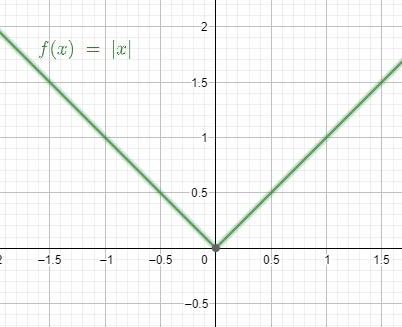
Note: The only time the absolute value becomes 0 is when the number itself is 0. For any other number the absolute value is greater than 0. Therefore, we can say $\left| x \right|>0$ when $x\ne 0$. The graph of the function is
Complete step by step answer:
Absolute value means the distance of the number from 0. The number can be both positive and negative but the distance of that number will always be positive. Distance can never be negative.
In mathematical notation we express it with modulus value. Let a number be x whose sign is not mentioned. The absolute value of that number will be $\left| x \right|$. We can say $\left| x \right|\ge 0$.
We can express the function $f\left( x \right)=\left| x \right|$ as $f\left( x \right)=\left\{ \begin{matrix}
x\left( x\ge 0 \right) \\
-x\left( x<0 \right) \\
\end{matrix} \right.$.
If the value of the number is 0 or greater than 0 which means positive then we take the value of that number as its absolute value and If the value of the number is less than 0 which means negative then we take the negative value of that number as its absolute value.
Let us explain the theorem with an example where we take the value of x as $x=7$. As $x>0$, the absolute value $f\left( 7 \right)=\left| 7 \right|=7$ is the number itself. Now we take $x=-4$. As $x<0$, the absolute value $f\left( -4 \right)=\left| -4 \right|=-\left( -4 \right)=4$ is the negative of the number itself.
Note: The only time the absolute value becomes 0 is when the number itself is 0. For any other number the absolute value is greater than 0. Therefore, we can say $\left| x \right|>0$ when $x\ne 0$. The graph of the function is
Recently Updated Pages
Master Class 12 Economics: Engaging Questions & Answers for Success

Master Class 12 Physics: Engaging Questions & Answers for Success
Master Class 12 English: Engaging Questions & Answers for Success
Master Class 12 Social Science: Engaging Questions & Answers for Success
Master Class 12 Maths: Engaging Questions & Answers for Success
Master Class 12 Business Studies: Engaging Questions & Answers for Success
Trending doubts
Which are the Top 10 Largest Countries of the World?
What are the major means of transport Explain each class 12 social science CBSE
Draw a labelled sketch of the human eye class 12 physics CBSE
Why cannot DNA pass through cell membranes class 12 biology CBSE
Differentiate between insitu conservation and exsitu class 12 biology CBSE
Draw a neat and well labeled diagram of TS of ovary class 12 biology CBSE