



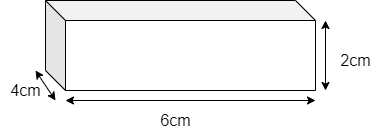
Find the total surface area of the following cuboid:
Answer
 Verified
559.2k+ views
Hint: In the given question, we have been given that there is a cuboid with given length, breadth and height. We have to calculate the total surface area of it. This question can be easily calculated if we know the formula of total surface area of the cuboid. It must be kept in mind that total surface area and lateral surface area have different formulae and must not be confused with one another. There is only one major difference between the two surface areas.
Formula Used:
We are going to use the formula of total surface area of cuboid, which is:
\[TSA = 2\left( {lb + bh + lh} \right)\] square units
Complete step-by-step answer:
In the given question,
\[l = 6cm\]
\[b = 4cm\]
\[h = 2cm\]
There is just one simple difference between total surface area (total surface area is also written as surface area) and lateral surface area – the areas of the roof and the ceiling are excluded in the lateral surface area.
Now, applying the formula of total surface area, \[TSA = 2\left( {lb + bh + lh} \right)\], we get,
\[TSA = 2\left( {6 \times 4 + 4 \times 2 + 6 \times 2} \right) = 2\left( {44} \right) = 88{\rm{ c}}{{\rm{m}}^2}\]
Hence, the total surface area of the given cuboid is \[88{\rm{ }}c{m^2}\].
Note:Here it was given that we had to find the total surface area, so we applied the formula for the same. It does not matter if we jumble up the measurements’ product which is multiplied in the formula because all of the three measurements’ products, taken two at a time, are finally being added only. In the question, if they would have been asking for lateral surface area, then we would have needed to apply a different formula.
Formula Used:
We are going to use the formula of total surface area of cuboid, which is:
\[TSA = 2\left( {lb + bh + lh} \right)\] square units
Complete step-by-step answer:
In the given question,
\[l = 6cm\]
\[b = 4cm\]
\[h = 2cm\]
There is just one simple difference between total surface area (total surface area is also written as surface area) and lateral surface area – the areas of the roof and the ceiling are excluded in the lateral surface area.
Now, applying the formula of total surface area, \[TSA = 2\left( {lb + bh + lh} \right)\], we get,
\[TSA = 2\left( {6 \times 4 + 4 \times 2 + 6 \times 2} \right) = 2\left( {44} \right) = 88{\rm{ c}}{{\rm{m}}^2}\]
Hence, the total surface area of the given cuboid is \[88{\rm{ }}c{m^2}\].
Note:Here it was given that we had to find the total surface area, so we applied the formula for the same. It does not matter if we jumble up the measurements’ product which is multiplied in the formula because all of the three measurements’ products, taken two at a time, are finally being added only. In the question, if they would have been asking for lateral surface area, then we would have needed to apply a different formula.
Recently Updated Pages
Master Class 9 General Knowledge: Engaging Questions & Answers for Success

Master Class 9 Social Science: Engaging Questions & Answers for Success
Master Class 9 English: Engaging Questions & Answers for Success
Master Class 9 Maths: Engaging Questions & Answers for Success
Master Class 9 Science: Engaging Questions & Answers for Success
Class 9 Question and Answer - Your Ultimate Solutions Guide
Trending doubts
Difference Between Plant Cell and Animal Cell
Fill the blanks with the suitable prepositions 1 The class 9 english CBSE
Who is eligible for RTE class 9 social science CBSE
Which places in India experience sunrise first and class 9 social science CBSE
What is pollution? How many types of pollution? Define it
Name 10 Living and Non living things class 9 biology CBSE