




First member of ketose sugar is:
A) Ketotriose
B) Ketotetrose
C) Ketopentose
D) Ketohexose
Answer
 Verified
587.7k+ views
Hint: A ketose is a monosaccharide containing one ketone group per molecule.Monosaccharides, also called simple sugar, are the simplest form of sugar and the most basic units of carbohydrates.
Complete step by step answer:
A monosaccharide is the most basic form of carbohydrates. Monosaccharides can be combined through glycosidic bonds to form larger carbohydrates, known as oligosaccharides or polysaccharides. An oligosaccharide with only two monosaccharides is known as a disaccharide. When more than 20 monosaccharides are combined with glycosidic bonds, a oligosaccharide becomes a polysaccharide. Some polysaccharides, like cellulose, contain thousands of monosaccharides. A monosaccharide is a type of monomer, or molecule that can combine with like molecules to create a large polymer.
A ketose is a monosaccharide containing one ketone group per molecule.
Optical activity of an organic compound: Optical rotation, also known as polarization rotation or circular birefringence, is the rotation of the orientation of the plane of polarization about the optical axis of linearly polarised light as it travels through certain materials. Optical activity occurs only in chiral materials, those lacking microscopic mirror symmetry.The rotation of the plane of polarization may be either clockwise, to the right ( — d-rotary), or to the left (— l-rotary) depending on which stereoisomer is present (or dominant).
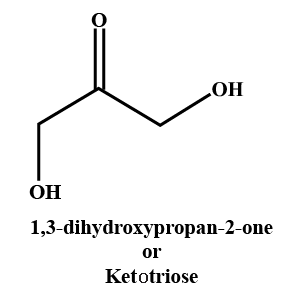
The simplest ketose is dihydroxyacetone, which has only three carbon atoms, and it is the only one with no optical activity.
Thus, the first member of ketose sugar is Ketotriose. It is also called 1,3-dihydroxypropan-2-one.
So, the correct answer is “Option A”.
Note: Ketose sugar is monosaccharide, not polysaccharide. Ketotriose is DHA, which helps for the brain development of kids.
Complete step by step answer:
A monosaccharide is the most basic form of carbohydrates. Monosaccharides can be combined through glycosidic bonds to form larger carbohydrates, known as oligosaccharides or polysaccharides. An oligosaccharide with only two monosaccharides is known as a disaccharide. When more than 20 monosaccharides are combined with glycosidic bonds, a oligosaccharide becomes a polysaccharide. Some polysaccharides, like cellulose, contain thousands of monosaccharides. A monosaccharide is a type of monomer, or molecule that can combine with like molecules to create a large polymer.
A ketose is a monosaccharide containing one ketone group per molecule.
Optical activity of an organic compound: Optical rotation, also known as polarization rotation or circular birefringence, is the rotation of the orientation of the plane of polarization about the optical axis of linearly polarised light as it travels through certain materials. Optical activity occurs only in chiral materials, those lacking microscopic mirror symmetry.The rotation of the plane of polarization may be either clockwise, to the right ( — d-rotary), or to the left (— l-rotary) depending on which stereoisomer is present (or dominant).
The simplest ketose is dihydroxyacetone, which has only three carbon atoms, and it is the only one with no optical activity.
Thus, the first member of ketose sugar is Ketotriose. It is also called 1,3-dihydroxypropan-2-one.
So, the correct answer is “Option A”.
Note: Ketose sugar is monosaccharide, not polysaccharide. Ketotriose is DHA, which helps for the brain development of kids.
Recently Updated Pages
Master Class 12 Economics: Engaging Questions & Answers for Success

Master Class 12 Physics: Engaging Questions & Answers for Success
Master Class 12 English: Engaging Questions & Answers for Success
Master Class 12 Social Science: Engaging Questions & Answers for Success
Master Class 12 Maths: Engaging Questions & Answers for Success
Master Class 12 Business Studies: Engaging Questions & Answers for Success
Trending doubts
Which are the Top 10 Largest Countries of the World?
What are the major means of transport Explain each class 12 social science CBSE
Draw a labelled sketch of the human eye class 12 physics CBSE
Why cannot DNA pass through cell membranes class 12 biology CBSE
Differentiate between insitu conservation and exsitu class 12 biology CBSE
Draw a neat and well labeled diagram of TS of ovary class 12 biology CBSE