




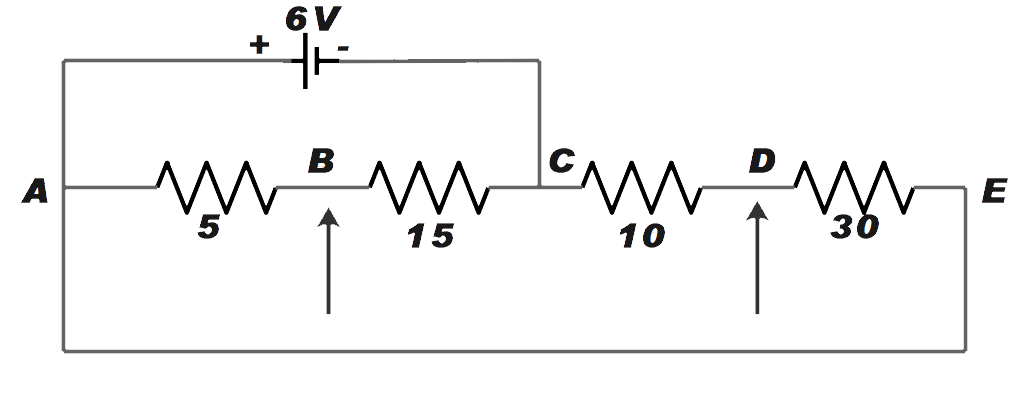
Four resistors are connected as shown in figure. A 6V battery of negligible resistance is connected across the terminal AC. The potential difference across terminals B and D will be
A. 0 V
B. 1.5 V
C. 2 V
D. 3 V
Answer
 Verified
572.7k+ views
Hint: In this question we have been asked to calculate the potential difference across terminals B and D in the given circuit diagram. From the diagram given we can see that the given circuit represents the Wheatstone bridge with four resistors. Therefore, to solve this we shall first draw the equivalent circuit diagram and use the concepts of a Wheatstone bridge.
Complete step by step solution:
The given circuit has 4 resistors connected to each other as shown in the given diagram.
Now,
The equivalent circuit of the given circuit can be drawn as shown below.
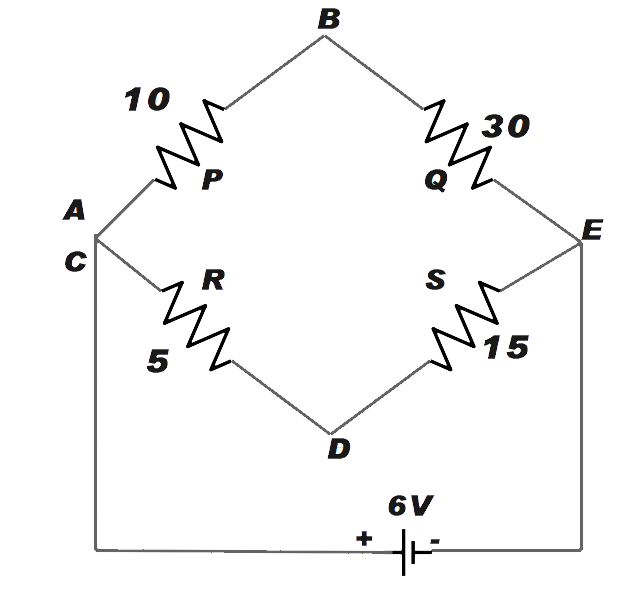
Now, from the above circuit we can say that, the given circuit can be converted to the Wheatstone bridge without changing the flow of current, the resistance or any other considerable aspect.
The condition for a balanced Wheatstone bridge is,
\[\dfrac{P}{Q}=\dfrac{R}{S}\]
After substituting the values,
we get,
\[\dfrac{P}{Q}=\dfrac{10}{30}=\dfrac{1}{3}\] ………… (1)
Similarly,
\[\dfrac{R}{S}=\dfrac{5}{15}=\dfrac{1}{3}\] ……………. (2)
From (1) and (2) we know that it is a balanced Wheatstone bridge. So, the terminals B and D are at the same potential. Therefore, the voltage across terminals B and D will be zero.
So, the correct answer is “Option A”.
Note: We know that a Wheatstone bridge is an electrical circuit consisting of 4 resistors making two legs. It is used to determine the unknown resistance by balancing the two legs one of which contains the resistor of unknown resistance. The Wheatstone bridge was invented by Samuel Christie. It was later popularized by Charles Wheatstone.
Complete step by step solution:
The given circuit has 4 resistors connected to each other as shown in the given diagram.
Now,
The equivalent circuit of the given circuit can be drawn as shown below.
Now, from the above circuit we can say that, the given circuit can be converted to the Wheatstone bridge without changing the flow of current, the resistance or any other considerable aspect.
The condition for a balanced Wheatstone bridge is,
\[\dfrac{P}{Q}=\dfrac{R}{S}\]
After substituting the values,
we get,
\[\dfrac{P}{Q}=\dfrac{10}{30}=\dfrac{1}{3}\] ………… (1)
Similarly,
\[\dfrac{R}{S}=\dfrac{5}{15}=\dfrac{1}{3}\] ……………. (2)
From (1) and (2) we know that it is a balanced Wheatstone bridge. So, the terminals B and D are at the same potential. Therefore, the voltage across terminals B and D will be zero.
So, the correct answer is “Option A”.
Note: We know that a Wheatstone bridge is an electrical circuit consisting of 4 resistors making two legs. It is used to determine the unknown resistance by balancing the two legs one of which contains the resistor of unknown resistance. The Wheatstone bridge was invented by Samuel Christie. It was later popularized by Charles Wheatstone.
Recently Updated Pages
Master Class 12 Economics: Engaging Questions & Answers for Success

Master Class 12 Physics: Engaging Questions & Answers for Success
Master Class 12 English: Engaging Questions & Answers for Success
Master Class 12 Social Science: Engaging Questions & Answers for Success
Master Class 12 Maths: Engaging Questions & Answers for Success
Master Class 12 Business Studies: Engaging Questions & Answers for Success
Trending doubts
Which are the Top 10 Largest Countries of the World?
What are the major means of transport Explain each class 12 social science CBSE
Draw a labelled sketch of the human eye class 12 physics CBSE
Why cannot DNA pass through cell membranes class 12 biology CBSE
Differentiate between insitu conservation and exsitu class 12 biology CBSE
Draw a neat and well labeled diagram of TS of ovary class 12 biology CBSE