




Gram (+) and Gram (-) forms of bacteria are differentiable through staining with
(A) Safranin and Gentian Violet
(B) Safranin and Iodine
(C) Acetocarmine and Iodine
(D) Crystal Violet and Iodine
Answer
 Verified
576.9k+ views
Hint:The bacteria which shows positive results in the stain test is called gram positive bacteria and the bacteria which produces the negative result in the stain test is called gram negative bacteria. In the gram stain test, violet radiation is made to pass through the bacteria.
Complete answer:
Staining method depends on the capacity of microorganisms to hold the shade of the stains utilized during the process of staining. Gram-positive bacteria maintain the purple shading after the process with Crystal Violet stain. Iodine is added to make the violet-iodine complex. They are not decolorized by treatment with the liquor.
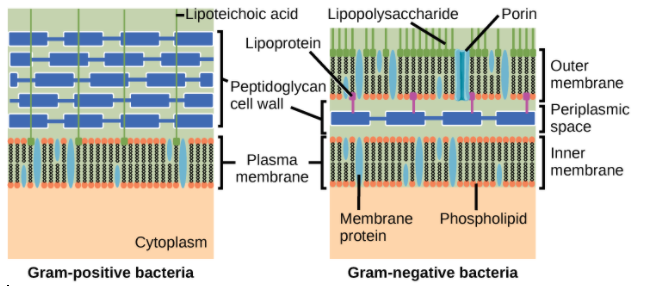
While gram-negative bacteria are decolorized by the liquor and lose the purple shade of Crystal Violet stain. When again recolored with second stain Safranin, they hold pink shading. This difference in the shading is mainly due to the absence of the cell wall in the gram-negative bacteria but has peptidoglycan layer which causes discoloration.
Thus, the option (D) is the correct answer.
Note:The example for the gram-positive bacteria are Staphylococcus, Bacillus anthracis etc. And the example for the gram-negative bacteria are Escherichia, Cocci etc. When compared to the gram-positive bacteria, gram negative bacteria are more dangerous and harmful to the human by causing certain diseases due to the presence of the slime layer.
Complete answer:
Staining method depends on the capacity of microorganisms to hold the shade of the stains utilized during the process of staining. Gram-positive bacteria maintain the purple shading after the process with Crystal Violet stain. Iodine is added to make the violet-iodine complex. They are not decolorized by treatment with the liquor.
While gram-negative bacteria are decolorized by the liquor and lose the purple shade of Crystal Violet stain. When again recolored with second stain Safranin, they hold pink shading. This difference in the shading is mainly due to the absence of the cell wall in the gram-negative bacteria but has peptidoglycan layer which causes discoloration.
Thus, the option (D) is the correct answer.
Note:The example for the gram-positive bacteria are Staphylococcus, Bacillus anthracis etc. And the example for the gram-negative bacteria are Escherichia, Cocci etc. When compared to the gram-positive bacteria, gram negative bacteria are more dangerous and harmful to the human by causing certain diseases due to the presence of the slime layer.
Recently Updated Pages
Master Class 12 Economics: Engaging Questions & Answers for Success

Master Class 12 Physics: Engaging Questions & Answers for Success
Master Class 12 English: Engaging Questions & Answers for Success
Master Class 12 Social Science: Engaging Questions & Answers for Success
Master Class 12 Maths: Engaging Questions & Answers for Success
Master Class 12 Business Studies: Engaging Questions & Answers for Success
Trending doubts
Which are the Top 10 Largest Countries of the World?
What are the major means of transport Explain each class 12 social science CBSE
Draw a labelled sketch of the human eye class 12 physics CBSE
Why cannot DNA pass through cell membranes class 12 biology CBSE
Differentiate between insitu conservation and exsitu class 12 biology CBSE
Draw a neat and well labeled diagram of TS of ovary class 12 biology CBSE