




How do you graph the inequality \[y\underline{>}\dfrac{3}{2}x-3\]?
Answer
 Verified
554.1k+ views
Hint: Suppose an equation of straight line to be \[y=ax+b\]. We can draw the graph of \[y=ax+b\] from the simple graph \[y=x\]. We need to modify the \[y=x\] graph by shifting and scaling methods. It is a better idea to modify the graph of \[y=x\] in such a manner that we get the required graph by going from left side to right side of the equation \[y=\dfrac{3}{2}x-3\].
Complete step by step answer:
As per the given question, we need to graph a straight line which is given by the equation \[y=\dfrac{3}{2}x-3\].
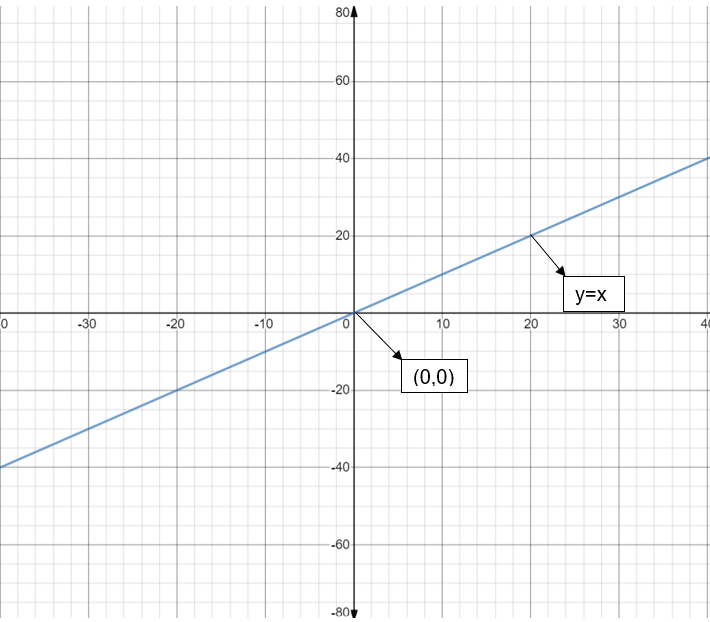
A straight line can be traced out on the cartesian plane by just two points lying on it. We can also use a third point for sort of check. It is very simple to graph the \[y=x\] line as it is symmetric to both x and y axes.
The graph of \[y=x\] is as shown in below figure:
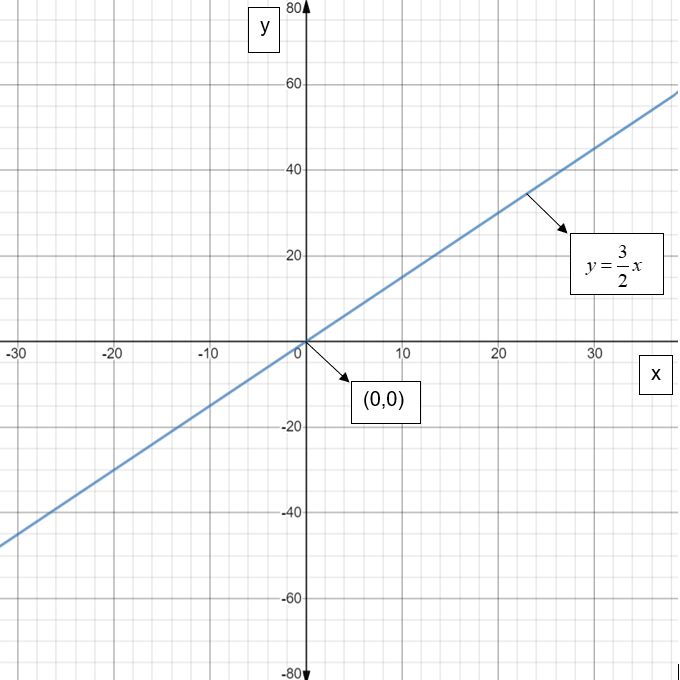
If we go from left hand side to right hand side of the equation \[y=\dfrac{3}{2}x-3\], it is clear that we need to first scale the \[y=x\] graph by a factor \[\dfrac{3}{2}\]. Then we get \[y=\dfrac{3}{2}x\].
And the graph of \[y=\dfrac{3}{2}x\] is as shown in the below figure:
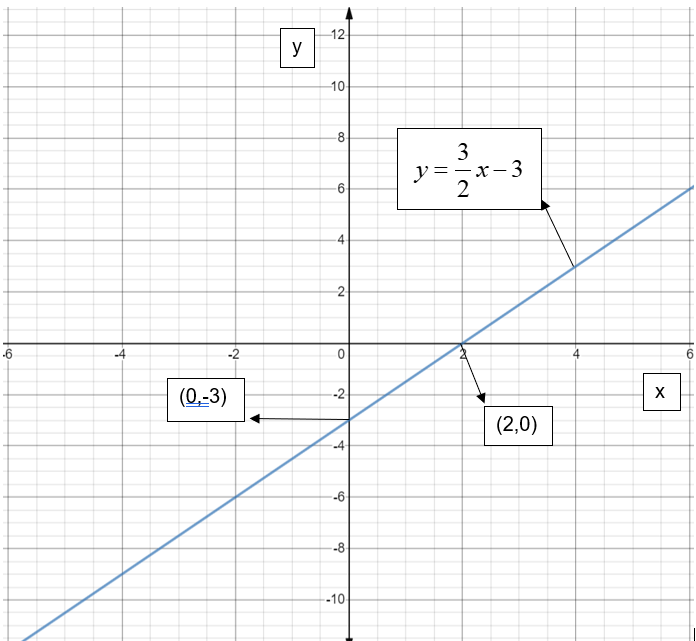
Now, we need to shift the \[y=\dfrac{3}{2}x\] graph right hand side by 3 units to get the required straight line \[y=\dfrac{3}{2}x-3\]. And the graph of \[y=\dfrac{3}{2}x-3\] is shown in the below figure:
Since we need to plot \[y\underline{>}\dfrac{3}{2}x-3\] we have to shade the part above the line. Thus, it looks like,
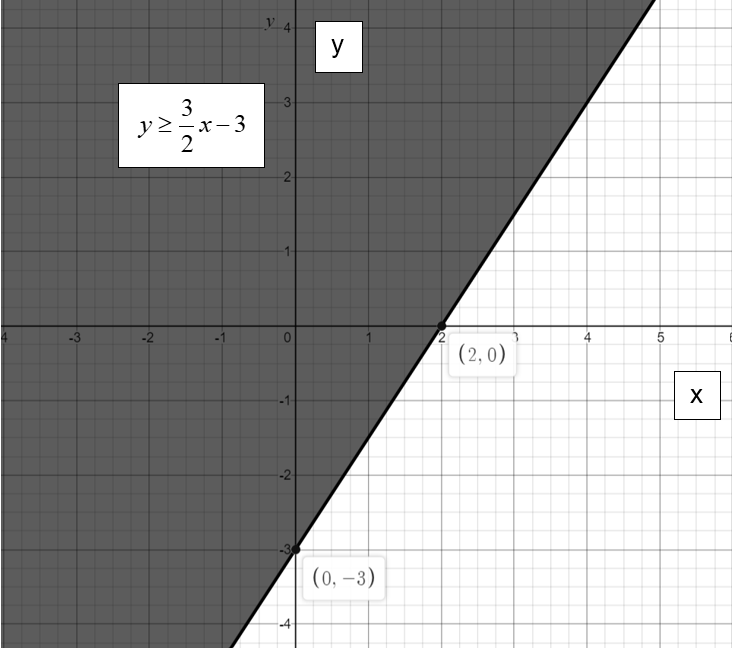
\[\therefore \] we have to compress \[y=x\] by \[\dfrac{3}{2}\] and then shift it to the right hand side by 3 units and shade the part above the line to get the desired plot \[y\underline{>}\dfrac{3}{2}x-3\].
Note:
We can trace the graph of \[y\underline{>}\dfrac{3}{2}x-3\] by substitution by any two random values of x and joining the two random variables with a line. we have to check which part to be shaded depending on the sign given in the problem.
Complete step by step answer:
As per the given question, we need to graph a straight line which is given by the equation \[y=\dfrac{3}{2}x-3\].
A straight line can be traced out on the cartesian plane by just two points lying on it. We can also use a third point for sort of check. It is very simple to graph the \[y=x\] line as it is symmetric to both x and y axes.
The graph of \[y=x\] is as shown in below figure:
If we go from left hand side to right hand side of the equation \[y=\dfrac{3}{2}x-3\], it is clear that we need to first scale the \[y=x\] graph by a factor \[\dfrac{3}{2}\]. Then we get \[y=\dfrac{3}{2}x\].
And the graph of \[y=\dfrac{3}{2}x\] is as shown in the below figure:
Now, we need to shift the \[y=\dfrac{3}{2}x\] graph right hand side by 3 units to get the required straight line \[y=\dfrac{3}{2}x-3\]. And the graph of \[y=\dfrac{3}{2}x-3\] is shown in the below figure:
Since we need to plot \[y\underline{>}\dfrac{3}{2}x-3\] we have to shade the part above the line. Thus, it looks like,
\[\therefore \] we have to compress \[y=x\] by \[\dfrac{3}{2}\] and then shift it to the right hand side by 3 units and shade the part above the line to get the desired plot \[y\underline{>}\dfrac{3}{2}x-3\].
Note:
We can trace the graph of \[y\underline{>}\dfrac{3}{2}x-3\] by substitution by any two random values of x and joining the two random variables with a line. we have to check which part to be shaded depending on the sign given in the problem.
Recently Updated Pages
Master Class 11 Computer Science: Engaging Questions & Answers for Success

Master Class 11 Business Studies: Engaging Questions & Answers for Success
Master Class 11 Economics: Engaging Questions & Answers for Success
Master Class 11 English: Engaging Questions & Answers for Success
Master Class 11 Maths: Engaging Questions & Answers for Success
Master Class 11 Biology: Engaging Questions & Answers for Success
Trending doubts
One Metric ton is equal to kg A 10000 B 1000 C 100 class 11 physics CBSE
There are 720 permutations of the digits 1 2 3 4 5 class 11 maths CBSE
Discuss the various forms of bacteria class 11 biology CBSE
Draw a diagram of a plant cell and label at least eight class 11 biology CBSE
State the laws of reflection of light
Explain zero factorial class 11 maths CBSE