




How do you graph \[r = 1 + 2\sin \theta \]?
Answer
 Verified
558.6k+ views
Hint: In this question, first we have to graph the given function which is in polar coordinate form in terms of \[\left( {r,\theta } \right)\], where \[r\] is the distance of the point from the origin and \[\theta \] is the angle between the line joining origin and the point and positive axis. Now taking some values for \[\theta \] and finding the values of \[r\], now tabulate the values and plot the points on the graph we will get the required graph.
Complete step-by-step answer:
Polar coordinate pairs can have positive angles or negative angles for values of theta. In addition, they can have positive and negative radii. When graphing polar coordinates, though, the radius can be negative, which means that you move in the opposite direction of the angle from the pole.
Now given function is \[r = 1 + 2\sin \theta \],
Take different values for \[\theta \] and then we will get the values for \[r\], and then plot the points on the graph.
So first take \[\theta = 0\],
Now substitute the value in the given function \[r = 1 + 2\sin \theta \], we get,
\[ \Rightarrow r = 1 + 2\sin 0\],
Now simplifying we get,
\[ \Rightarrow r = 1 + 2(0)\],
Now again simplifying we get,
\[ \Rightarrow r = 1 + 0\],
Now adding to simplify further we get,
\[ \Rightarrow r = 1\],
Now take \[\theta = \dfrac{\pi }{4}\],
Now substitute the value in the given function \[r = 1 + 2\sin \theta \], we get,
\[ \Rightarrow r = 1 + 2\sin \left( {\dfrac{\pi }{4}} \right)\],
Now simplifying we get,
\[ \Rightarrow r = 1 + 2\left( {\dfrac{1}{{\sqrt 2 }}} \right)\],
Now again simplifying we get,
\[ \Rightarrow r = 1 + \sqrt 2 \],
Now further simplifying we get,
\[ \Rightarrow r = 1 + 1.414\],
Now adding to simplify further we get,
\[ \Rightarrow r = 2.414\],
Now take \[\theta = \dfrac{\pi }{2}\],
Now substitute the value in the given function \[r = 1 + 2\sin \theta \], we get,
\[ \Rightarrow r = 1 + 2\sin \left( {\dfrac{\pi }{2}} \right)\],
Now simplifying we get,
\[ \Rightarrow r = 1 + 2\left( 1 \right)\],
Now again simplifying we get,
\[ \Rightarrow r = 1 + 2\],
Now adding to simplify further we get,
\[ \Rightarrow r = 3\],
Now take \[\theta = \dfrac{{3\pi }}{4}\],
Now substitute the value in the given function \[r = 1 + 2\sin \theta \], we get,
\[ \Rightarrow r = 1 + 2\sin \left( {\dfrac{{3\pi }}{4}} \right)\],
Now simplifying we get,
\[ \Rightarrow r = 1 + 2\left( {0.707} \right)\],
Now again simplifying we get,
\[ \Rightarrow r = 1 + 1.414\],
Now adding to simplify further we get,
\[ \Rightarrow r = 2.414\],
Now take \[\theta = \pi \],
Now substitute the value in the given function \[r = 1 + 2\sin \theta \], we get,
\[ \Rightarrow r = 1 + 2\sin \left( \pi \right)\],
Now simplifying we get,
\[ \Rightarrow r = 1 + 2\left( 0 \right)\],
Now again simplifying we get,
\[ \Rightarrow r = 1 + 0\],
Now adding to simplify further we get,
\[ \Rightarrow r = 1\],
Now take \[\theta = \dfrac{{5\pi }}{4}\],
Now substitute the value in the given function \[r = 1 + 2\sin \theta \], we get,
\[ \Rightarrow r = 1 + 2\sin \left( {\dfrac{{5\pi }}{4}} \right)\],
Now simplifying we get,
\[ \Rightarrow r = 1 + 2\left( { - 0.707} \right)\],
Now again simplifying we get,
\[ \Rightarrow r = 1 - 1.414\],
Now adding to simplify further we get,
\[ \Rightarrow r = - 0.414\],
Now take\[\theta = \dfrac{{3\pi }}{2}\],
Now substitute the value in the given function \[r = 1 + 2\sin \theta \], we get,
\[ \Rightarrow r = 1 + 2\sin \left( {\dfrac{{3\pi }}{2}} \right)\],
Now simplifying we get,
\[ \Rightarrow r = 1 + 2\left( { - 1} \right)\],
Now again simplifying we get,
\[ \Rightarrow r = 1 - 2\],
Now adding to simplify further we get,
\[ \Rightarrow r = - 1\],
Now take \[\theta = \dfrac{{7\pi }}{4}\],
Now substitute the value in the given function\[r = 1 + 2\sin \theta \], we get,
\[ \Rightarrow r = 1 + 2\sin \left( {\dfrac{{7\pi }}{4}} \right)\],
Now simplifying we get,
\[ \Rightarrow r = 1 + 2\left( { - 0.707} \right)\],
Now again simplifying we get,
\[ \Rightarrow r = 1 - 1.414\],
Now adding to simplify further we get,
\[ \Rightarrow r = - 0.414\],
Now take \[\theta = 2\pi \],
Now substitute the value in the given function \[r = 1 + 2\sin \theta \], we get,
\[ \Rightarrow r = 1 + 2\sin \left( {2\pi } \right)\],
Now simplifying we get,
\[ \Rightarrow r = 1 + 2\left( 0 \right)\],
Now again simplifying we get,
\[ \Rightarrow r = 1 + 0\],
Now adding to simplify further we get,
\[ \Rightarrow r = 1\],
Now tabulating the values we get,
Now plotting the graphs we get,
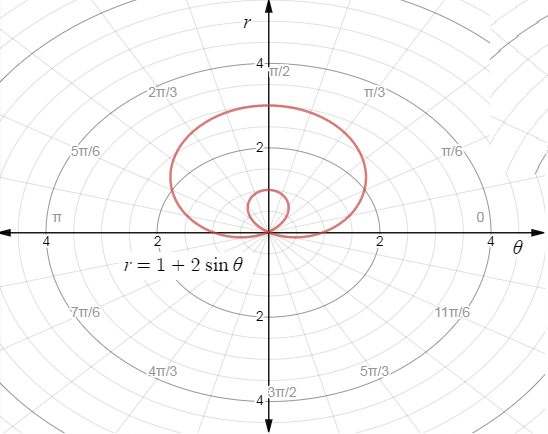
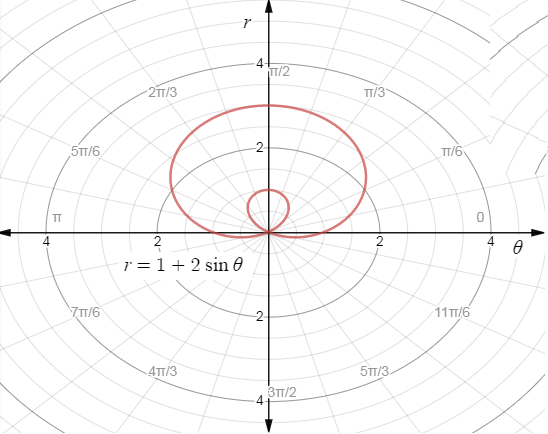
The plane appears this way because the polar coordinates are a given radius and a given angle in standard position from the pole. Each circle represents one radius unit, and each line represents the special angles from the unit circle.
\[\therefore \]The required graph for the function \[r = 1 + 2\sin \theta \] is,
Note:
Polar coordinates are based on angles, unlike Cartesian coordinates, polar coordinates have many different ordered pairs. Because infinitely many values of theta have the same angle in standard position, an infinite number of coordinate pairs describe the same point. Also, a positive and a negative coterminal angle can describe the same point for the same radius, and because the radius can be either positive or negative, you can express the point with polar coordinates in many ways.
Complete step-by-step answer:
Polar coordinate pairs can have positive angles or negative angles for values of theta. In addition, they can have positive and negative radii. When graphing polar coordinates, though, the radius can be negative, which means that you move in the opposite direction of the angle from the pole.
Now given function is \[r = 1 + 2\sin \theta \],
Take different values for \[\theta \] and then we will get the values for \[r\], and then plot the points on the graph.
So first take \[\theta = 0\],
Now substitute the value in the given function \[r = 1 + 2\sin \theta \], we get,
\[ \Rightarrow r = 1 + 2\sin 0\],
Now simplifying we get,
\[ \Rightarrow r = 1 + 2(0)\],
Now again simplifying we get,
\[ \Rightarrow r = 1 + 0\],
Now adding to simplify further we get,
\[ \Rightarrow r = 1\],
Now take \[\theta = \dfrac{\pi }{4}\],
Now substitute the value in the given function \[r = 1 + 2\sin \theta \], we get,
\[ \Rightarrow r = 1 + 2\sin \left( {\dfrac{\pi }{4}} \right)\],
Now simplifying we get,
\[ \Rightarrow r = 1 + 2\left( {\dfrac{1}{{\sqrt 2 }}} \right)\],
Now again simplifying we get,
\[ \Rightarrow r = 1 + \sqrt 2 \],
Now further simplifying we get,
\[ \Rightarrow r = 1 + 1.414\],
Now adding to simplify further we get,
\[ \Rightarrow r = 2.414\],
Now take \[\theta = \dfrac{\pi }{2}\],
Now substitute the value in the given function \[r = 1 + 2\sin \theta \], we get,
\[ \Rightarrow r = 1 + 2\sin \left( {\dfrac{\pi }{2}} \right)\],
Now simplifying we get,
\[ \Rightarrow r = 1 + 2\left( 1 \right)\],
Now again simplifying we get,
\[ \Rightarrow r = 1 + 2\],
Now adding to simplify further we get,
\[ \Rightarrow r = 3\],
Now take \[\theta = \dfrac{{3\pi }}{4}\],
Now substitute the value in the given function \[r = 1 + 2\sin \theta \], we get,
\[ \Rightarrow r = 1 + 2\sin \left( {\dfrac{{3\pi }}{4}} \right)\],
Now simplifying we get,
\[ \Rightarrow r = 1 + 2\left( {0.707} \right)\],
Now again simplifying we get,
\[ \Rightarrow r = 1 + 1.414\],
Now adding to simplify further we get,
\[ \Rightarrow r = 2.414\],
Now take \[\theta = \pi \],
Now substitute the value in the given function \[r = 1 + 2\sin \theta \], we get,
\[ \Rightarrow r = 1 + 2\sin \left( \pi \right)\],
Now simplifying we get,
\[ \Rightarrow r = 1 + 2\left( 0 \right)\],
Now again simplifying we get,
\[ \Rightarrow r = 1 + 0\],
Now adding to simplify further we get,
\[ \Rightarrow r = 1\],
Now take \[\theta = \dfrac{{5\pi }}{4}\],
Now substitute the value in the given function \[r = 1 + 2\sin \theta \], we get,
\[ \Rightarrow r = 1 + 2\sin \left( {\dfrac{{5\pi }}{4}} \right)\],
Now simplifying we get,
\[ \Rightarrow r = 1 + 2\left( { - 0.707} \right)\],
Now again simplifying we get,
\[ \Rightarrow r = 1 - 1.414\],
Now adding to simplify further we get,
\[ \Rightarrow r = - 0.414\],
Now take\[\theta = \dfrac{{3\pi }}{2}\],
Now substitute the value in the given function \[r = 1 + 2\sin \theta \], we get,
\[ \Rightarrow r = 1 + 2\sin \left( {\dfrac{{3\pi }}{2}} \right)\],
Now simplifying we get,
\[ \Rightarrow r = 1 + 2\left( { - 1} \right)\],
Now again simplifying we get,
\[ \Rightarrow r = 1 - 2\],
Now adding to simplify further we get,
\[ \Rightarrow r = - 1\],
Now take \[\theta = \dfrac{{7\pi }}{4}\],
Now substitute the value in the given function\[r = 1 + 2\sin \theta \], we get,
\[ \Rightarrow r = 1 + 2\sin \left( {\dfrac{{7\pi }}{4}} \right)\],
Now simplifying we get,
\[ \Rightarrow r = 1 + 2\left( { - 0.707} \right)\],
Now again simplifying we get,
\[ \Rightarrow r = 1 - 1.414\],
Now adding to simplify further we get,
\[ \Rightarrow r = - 0.414\],
Now take \[\theta = 2\pi \],
Now substitute the value in the given function \[r = 1 + 2\sin \theta \], we get,
\[ \Rightarrow r = 1 + 2\sin \left( {2\pi } \right)\],
Now simplifying we get,
\[ \Rightarrow r = 1 + 2\left( 0 \right)\],
Now again simplifying we get,
\[ \Rightarrow r = 1 + 0\],
Now adding to simplify further we get,
\[ \Rightarrow r = 1\],
Now tabulating the values we get,
| \[\theta \] | \[r\] |
| 0 | 1 |
| \[\dfrac{\pi }{4}\] | 2.414 |
| \[\dfrac{\pi }{2}\] | 3 |
| \[\dfrac{{3\pi }}{4}\] | 2.414 |
| \[\pi \] | 1 |
| \[\dfrac{{5\pi }}{4}\] | -0.414 |
| \[\dfrac{{3\pi }}{2}\] | -1 |
| \[\dfrac{{7\pi }}{4}\] | -0.414 |
| \[2\pi \] | 1 |
Now plotting the graphs we get,
The plane appears this way because the polar coordinates are a given radius and a given angle in standard position from the pole. Each circle represents one radius unit, and each line represents the special angles from the unit circle.
\[\therefore \]The required graph for the function \[r = 1 + 2\sin \theta \] is,
Note:
Polar coordinates are based on angles, unlike Cartesian coordinates, polar coordinates have many different ordered pairs. Because infinitely many values of theta have the same angle in standard position, an infinite number of coordinate pairs describe the same point. Also, a positive and a negative coterminal angle can describe the same point for the same radius, and because the radius can be either positive or negative, you can express the point with polar coordinates in many ways.
Recently Updated Pages
Master Class 12 Economics: Engaging Questions & Answers for Success

Master Class 12 Physics: Engaging Questions & Answers for Success
Master Class 12 English: Engaging Questions & Answers for Success
Master Class 12 Social Science: Engaging Questions & Answers for Success
Master Class 12 Maths: Engaging Questions & Answers for Success
Master Class 12 Business Studies: Engaging Questions & Answers for Success
Trending doubts
Which are the Top 10 Largest Countries of the World?
What are the major means of transport Explain each class 12 social science CBSE
Draw a labelled sketch of the human eye class 12 physics CBSE
Why cannot DNA pass through cell membranes class 12 biology CBSE
Differentiate between insitu conservation and exsitu class 12 biology CBSE
Draw a neat and well labeled diagram of TS of ovary class 12 biology CBSE