




How do you solve $10={{e}^{x}}$ ?
Answer
 Verified
554.1k+ views
Hint: We treat the two sides of the equation as two separate equations. Thus, we get two equations, which are $y={{e}^{x}}$ and $y=10$. We plot these two equations on a graph paper and find out the point of intersection which is the required solution.
Complete step-by-step solution:
The given equation is
$10={{e}^{x}}$
We solve the problem using the graphical method that is by using graphs. We treat the two sides of the equation as two separate equations. Thus, we get two equations, which are
$y={{e}^{x}}$ and $y=10$
We plot the two above equations on a single graph paper. Now, these two equations are two separate and completely different types of equations, and their respective graphs will be different. One is an exponential graph and the other is a straight line. If two different graphs intersect at some point, then that point is the common point for both the graphs. This means that the point of intersection is such a point which satisfies both the equations of the different graphs. The abscissa of the point of intersection will be the solution to the equations of the graphs which are in this case, $y={{e}^{x}}$ and $y=10$ .
The number of solutions to two functions will be the number of points of intersection of the two functions. If the number of points of intersection is one, then the number of solutions is one, if the number of points of intersection is zero, then there are no solutions and so on.
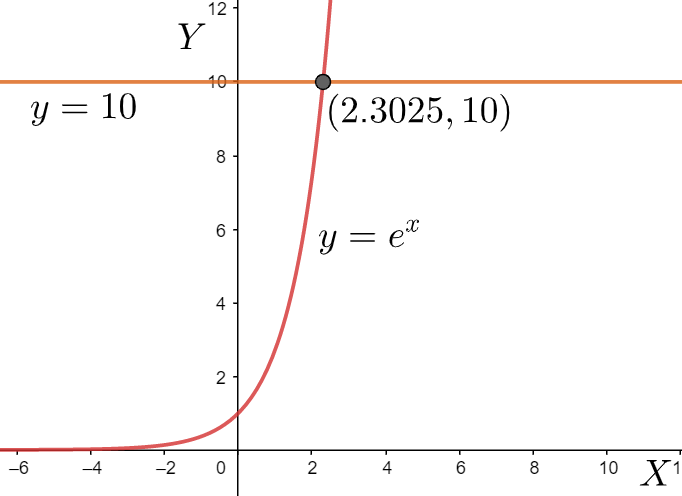
In the above graph, it is seen that the two graphs meet at the point $\left( 2.3025,10 \right)$ . This is the only point of intersection.
Therefore, we can conclude that the solution of the given equation $10={{e}^{x}}$ is $2.3025$ .
Note: We should plot the respective graphs carefully. We should look for more than one point of intersection if there. This problem can also be solved by taking natural logarithms on both sides.
$\begin{align}
& \Rightarrow \ln 10=\ln \left( {{e}^{x}} \right) \\
& \Rightarrow \ln 10=x\ln e \\
& \Rightarrow x=\dfrac{\ln 10}{\ln e} \\
& \Rightarrow x=2.3025 \\
\end{align}$
Complete step-by-step solution:
The given equation is
$10={{e}^{x}}$
We solve the problem using the graphical method that is by using graphs. We treat the two sides of the equation as two separate equations. Thus, we get two equations, which are
$y={{e}^{x}}$ and $y=10$
We plot the two above equations on a single graph paper. Now, these two equations are two separate and completely different types of equations, and their respective graphs will be different. One is an exponential graph and the other is a straight line. If two different graphs intersect at some point, then that point is the common point for both the graphs. This means that the point of intersection is such a point which satisfies both the equations of the different graphs. The abscissa of the point of intersection will be the solution to the equations of the graphs which are in this case, $y={{e}^{x}}$ and $y=10$ .
The number of solutions to two functions will be the number of points of intersection of the two functions. If the number of points of intersection is one, then the number of solutions is one, if the number of points of intersection is zero, then there are no solutions and so on.
In the above graph, it is seen that the two graphs meet at the point $\left( 2.3025,10 \right)$ . This is the only point of intersection.
Therefore, we can conclude that the solution of the given equation $10={{e}^{x}}$ is $2.3025$ .
Note: We should plot the respective graphs carefully. We should look for more than one point of intersection if there. This problem can also be solved by taking natural logarithms on both sides.
$\begin{align}
& \Rightarrow \ln 10=\ln \left( {{e}^{x}} \right) \\
& \Rightarrow \ln 10=x\ln e \\
& \Rightarrow x=\dfrac{\ln 10}{\ln e} \\
& \Rightarrow x=2.3025 \\
\end{align}$
Recently Updated Pages
Master Class 11 Computer Science: Engaging Questions & Answers for Success

Master Class 11 Business Studies: Engaging Questions & Answers for Success
Master Class 11 Economics: Engaging Questions & Answers for Success
Master Class 11 English: Engaging Questions & Answers for Success
Master Class 11 Maths: Engaging Questions & Answers for Success
Master Class 11 Biology: Engaging Questions & Answers for Success
Trending doubts
One Metric ton is equal to kg A 10000 B 1000 C 100 class 11 physics CBSE
There are 720 permutations of the digits 1 2 3 4 5 class 11 maths CBSE
Discuss the various forms of bacteria class 11 biology CBSE
Draw a diagram of a plant cell and label at least eight class 11 biology CBSE
State the laws of reflection of light
Explain zero factorial class 11 maths CBSE