




Identify the human development stage shown, as well as the related right place of its occurrence in a normal pregnant woman, and select the right option for the two together.
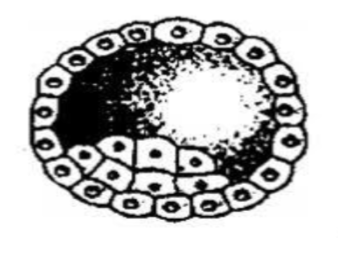
a. Development stage - blastula, Site of occurrence - end part of the fallopian tube
b. Development stage blastocyst; Site of occurrence - uterine wall
c. Development stage-8-celled morula: Site of the occurrence starting point of the fallopian tube
d. Development stage - late morula: Site of occurrence - middle part of the fallopian tube
Answer
 Verified
589.5k+ views
Hint: Fertilization is the process, where sperm and egg fuse together to form a zygote, which is the unicellular stage and this zygote undergoes further cleavage and finally forms the blastocyst and it is attached to the endometrium wall of the uterine.
Complete answer:
- Once the zygote is formed in the fallopian tubules, it undergoes cleavage.
- Whereas on the 2nd day, it is usually 2 cell stages. And the 3rd day is 4 cell stages.
- As the rapid division occurs the dividing zygote also moves forward in the fallopian tube.
- Once it reaches the 8 cell stage and it divides and forms the 16 cell stage called a morula, by this stage, it reaches the end of the fallopian tubule.
- It takes 5 days for the zygote to reach the morula stage and later this morula forms to blastula, where it is present as solid cell mass, and differentiation of cells happens.
- The cells are tightly compacted with each other and the outer layer cells form into trophoblast, and some cells inside form the inner cell mass, inside some cells disintegrates and fluid accumulates and appears as blastocoel.
- The inner cell mass is also called embryoblast, develops into a future embryo, while the outer layer trophoblast develops into the placenta in the future.
- The blastocyst stage forms one week after fertilization, and it occurs in the uterus.
- Later it implants into the endometrium uterine wall, with the help of a trophoblast.
Hence, the correct answer is option (B).
Note: After the blastocyst stage, the embryonic stage starts to begin, where all the internal organs and features, start to develop, and the heart, brain, spinal cord start to appear and visible in this age, after 3 months, it is called a fetus.
Complete answer:
- Once the zygote is formed in the fallopian tubules, it undergoes cleavage.
- Whereas on the 2nd day, it is usually 2 cell stages. And the 3rd day is 4 cell stages.
- As the rapid division occurs the dividing zygote also moves forward in the fallopian tube.
- Once it reaches the 8 cell stage and it divides and forms the 16 cell stage called a morula, by this stage, it reaches the end of the fallopian tubule.
- It takes 5 days for the zygote to reach the morula stage and later this morula forms to blastula, where it is present as solid cell mass, and differentiation of cells happens.
- The cells are tightly compacted with each other and the outer layer cells form into trophoblast, and some cells inside form the inner cell mass, inside some cells disintegrates and fluid accumulates and appears as blastocoel.
- The inner cell mass is also called embryoblast, develops into a future embryo, while the outer layer trophoblast develops into the placenta in the future.
- The blastocyst stage forms one week after fertilization, and it occurs in the uterus.
- Later it implants into the endometrium uterine wall, with the help of a trophoblast.
Hence, the correct answer is option (B).
Note: After the blastocyst stage, the embryonic stage starts to begin, where all the internal organs and features, start to develop, and the heart, brain, spinal cord start to appear and visible in this age, after 3 months, it is called a fetus.
Recently Updated Pages
Master Class 12 Economics: Engaging Questions & Answers for Success

Master Class 12 Physics: Engaging Questions & Answers for Success
Master Class 12 English: Engaging Questions & Answers for Success
Master Class 12 Social Science: Engaging Questions & Answers for Success
Master Class 12 Maths: Engaging Questions & Answers for Success
Master Class 12 Business Studies: Engaging Questions & Answers for Success
Trending doubts
Which are the Top 10 Largest Countries of the World?
What are the major means of transport Explain each class 12 social science CBSE
Draw a labelled sketch of the human eye class 12 physics CBSE
Why cannot DNA pass through cell membranes class 12 biology CBSE
Differentiate between insitu conservation and exsitu class 12 biology CBSE
Draw a neat and well labeled diagram of TS of ovary class 12 biology CBSE