




If a cone is cut into two parts by a horizontal plane passing through the mid-point of its axis, then the ratio of the volumes of the upper part and the cone is:
(a) 1 : 2
(b) 1 : 4
(c) 1 : 3
(d) 1 : 8
Answer
 Verified
612.6k+ views
Hint:In this question, we first need to calculate the base radius of the upper cone so formed on dividing into two parts. Then by using the formula for volume of a cone we can get their respective values and then calculate the ratio accordingly.
\[V=\dfrac{1}{3}\pi {{r}^{2}}h\]
Complete step-by-step answer:
Right Circular Cone:
A right circular cone is a solid generated by revolving of a right angled triangle through one of its sides (other than hypotenuse) containing the right angle as an axis.
Volume of a cone is given by the formula
\[V=\dfrac{1}{3}\pi {{r}^{2}}h\]
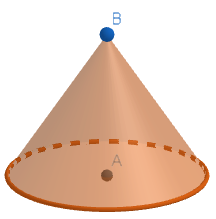
Let us assume the base radius of the cone as R and height of the cone as H.
Now, let us assume the volume of the cone as V which is given by
\[V=\dfrac{1}{3}\pi {{R}^{2}}H\]
Now, let us assume the volume of the upper cone to be v.
As the cone is divided into two equal parts so now the height of the cone will also be divided equally
Let us assume that the height of the upper cone as h and the base radius of the upper cone as r.
Now, the relation between h and H can be written as
\[h=\dfrac{H}{2}\]
Radius of the upper cone can be calculated by using similarity conditions of upper cone and cone i.e
\[\Rightarrow \dfrac{r}{h}=\dfrac{R}{H}\]
Now, by substituting the respective relation we get,
\[\begin{align}
& \Rightarrow \dfrac{r}{\dfrac{H}{2}}=\dfrac{R}{H} \\
& \therefore r=\dfrac{R}{2} \\
\end{align}\]
Now, the volume of the upper cone can be calculated by substituting the respective base radius and height in the formula.
\[\Rightarrow v=\dfrac{1}{3}\pi {{r}^{2}}h\]
Let us now substitute the corresponding values.
\[\Rightarrow v=\dfrac{1}{3}\pi {{\left( \dfrac{R}{2} \right)}^{2}}\dfrac{H}{2}\]
Now, on solving it further we get,
\[\Rightarrow v=\dfrac{1}{24}\pi {{R}^{2}}H\]
Let us now calculate the ratios of these volumes
\[\begin{align}
& \Rightarrow v:V \\
& \Rightarrow \dfrac{1}{24}\pi {{R}^{2}}H:\dfrac{1}{3}\pi {{R}^{2}}H \\
\end{align}\]
Now, on cancelling out the common terms we get,
\[\Rightarrow \dfrac{1}{8}:1\]
\[\Rightarrow 1:8\]
Hence, the correct option is d.
Note:It is important to note that on dividing the cone into two parts does not split it equally into two halves. The volume will not be halved on dividing at the midpoint as it is not a uniform figure on the up and down because the upper part so formed will be a cone but the lower part becomes a frustum.Thus the volume of the upper cone should be calculated accordingly. As we know that the height is halved then the radius of the upper cone can be found by using similarity condition which on further solving gives the relation between the base radius of the total cone and the upper cone.Then substituting accordingly gives the result.Here, while calculating the volumes we should not substitute the values of height and radius incorrectly because it changes the complete result.
\[V=\dfrac{1}{3}\pi {{r}^{2}}h\]
Complete step-by-step answer:
Right Circular Cone:
A right circular cone is a solid generated by revolving of a right angled triangle through one of its sides (other than hypotenuse) containing the right angle as an axis.
Volume of a cone is given by the formula
\[V=\dfrac{1}{3}\pi {{r}^{2}}h\]
Let us assume the base radius of the cone as R and height of the cone as H.
Now, let us assume the volume of the cone as V which is given by
\[V=\dfrac{1}{3}\pi {{R}^{2}}H\]
Now, let us assume the volume of the upper cone to be v.
As the cone is divided into two equal parts so now the height of the cone will also be divided equally
Let us assume that the height of the upper cone as h and the base radius of the upper cone as r.
Now, the relation between h and H can be written as
\[h=\dfrac{H}{2}\]
Radius of the upper cone can be calculated by using similarity conditions of upper cone and cone i.e
\[\Rightarrow \dfrac{r}{h}=\dfrac{R}{H}\]
Now, by substituting the respective relation we get,
\[\begin{align}
& \Rightarrow \dfrac{r}{\dfrac{H}{2}}=\dfrac{R}{H} \\
& \therefore r=\dfrac{R}{2} \\
\end{align}\]
Now, the volume of the upper cone can be calculated by substituting the respective base radius and height in the formula.
\[\Rightarrow v=\dfrac{1}{3}\pi {{r}^{2}}h\]
Let us now substitute the corresponding values.
\[\Rightarrow v=\dfrac{1}{3}\pi {{\left( \dfrac{R}{2} \right)}^{2}}\dfrac{H}{2}\]
Now, on solving it further we get,
\[\Rightarrow v=\dfrac{1}{24}\pi {{R}^{2}}H\]
Let us now calculate the ratios of these volumes
\[\begin{align}
& \Rightarrow v:V \\
& \Rightarrow \dfrac{1}{24}\pi {{R}^{2}}H:\dfrac{1}{3}\pi {{R}^{2}}H \\
\end{align}\]
Now, on cancelling out the common terms we get,
\[\Rightarrow \dfrac{1}{8}:1\]
\[\Rightarrow 1:8\]
Hence, the correct option is d.
Note:It is important to note that on dividing the cone into two parts does not split it equally into two halves. The volume will not be halved on dividing at the midpoint as it is not a uniform figure on the up and down because the upper part so formed will be a cone but the lower part becomes a frustum.Thus the volume of the upper cone should be calculated accordingly. As we know that the height is halved then the radius of the upper cone can be found by using similarity condition which on further solving gives the relation between the base radius of the total cone and the upper cone.Then substituting accordingly gives the result.Here, while calculating the volumes we should not substitute the values of height and radius incorrectly because it changes the complete result.
Recently Updated Pages
Master Class 12 Economics: Engaging Questions & Answers for Success

Master Class 12 Physics: Engaging Questions & Answers for Success
Master Class 12 English: Engaging Questions & Answers for Success
Master Class 12 Social Science: Engaging Questions & Answers for Success
Master Class 12 Maths: Engaging Questions & Answers for Success
Master Class 12 Business Studies: Engaging Questions & Answers for Success
Trending doubts
Which are the Top 10 Largest Countries of the World?
What are the major means of transport Explain each class 12 social science CBSE
Draw a labelled sketch of the human eye class 12 physics CBSE
Why cannot DNA pass through cell membranes class 12 biology CBSE
Differentiate between insitu conservation and exsitu class 12 biology CBSE
Draw a neat and well labeled diagram of TS of ovary class 12 biology CBSE