




If each edge of a cube is increased by 50%, then the percentage increase in the surface area is
A. 50
B. 125
C. 150
D. 300
Answer
 Verified
587.4k+ views
Hint: In this problem, first we need to find the surface area of the cube with increased in edges of the cube. Next, find the percentage increase in surface area.
Complete step-by-step solution:
The surface \[S\] are of a cube having edge length \[a\] is as follows.
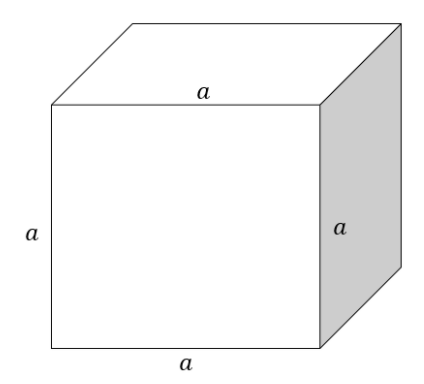
\[S = 6{a^2}\]
Since, the edge length of the cube is increased by 50%, therefore
${a_1} = \left( {a + \dfrac{{50}}{{100}} \times a} \right)$
$ \Rightarrow {a_1} = \left( {a + 0.5a} \right) $
$\Rightarrow {a_1} = 1.5a $
Substitute, \[1.5a\] for \[a\] in the above surface area formula to obtain the new surface area \[{S_1}\] of the cube.
${S_1} = 6{\left( {1.5a} \right)^2} $
$\Rightarrow {S_1} = 6\left( {2.25{a^2}} \right) $
The percentage increase in the surface area of the cube is calculated as shown below.
The percentage increase in the surface area = $\dfrac{{{S_1} - S}}{S} \times 100$
Substitute, \[6{a^2}\] for\[S\], \[6\left( {2.25{a^2}} \right)\] for \[{S_1}\] in above formula.
The percentage increase in the surface area = $\dfrac{{6\left( {2.25{a^2}} \right) - 6{a^2}}}{{6{a^2}}} \times 100 $
The percentage increase in the surface area = $\dfrac{{6{a^2}\left( {2.25 - 1} \right)}}{{6{a^2}}} \times 100 $
The percentage increase in the surface area = $1.25 \times 100$
The percentage increase in the surface area =$ 125 $
Thus, the percentage increase in surface area of the cube is 125, hence, option (B) is the correct answer.
Note: Here the mean of percentage changes in surface area is changing in the area of a cube on increasing the side. In the percentage increase formula, we divide by the initial surface area instead of new surface area as the changes are always to be found in respect of initial value. There are six identical faces of a cube having an area equal to the side’s square.
Complete step-by-step solution:
The surface \[S\] are of a cube having edge length \[a\] is as follows.
\[S = 6{a^2}\]
Since, the edge length of the cube is increased by 50%, therefore
${a_1} = \left( {a + \dfrac{{50}}{{100}} \times a} \right)$
$ \Rightarrow {a_1} = \left( {a + 0.5a} \right) $
$\Rightarrow {a_1} = 1.5a $
Substitute, \[1.5a\] for \[a\] in the above surface area formula to obtain the new surface area \[{S_1}\] of the cube.
${S_1} = 6{\left( {1.5a} \right)^2} $
$\Rightarrow {S_1} = 6\left( {2.25{a^2}} \right) $
The percentage increase in the surface area of the cube is calculated as shown below.
The percentage increase in the surface area = $\dfrac{{{S_1} - S}}{S} \times 100$
Substitute, \[6{a^2}\] for\[S\], \[6\left( {2.25{a^2}} \right)\] for \[{S_1}\] in above formula.
The percentage increase in the surface area = $\dfrac{{6\left( {2.25{a^2}} \right) - 6{a^2}}}{{6{a^2}}} \times 100 $
The percentage increase in the surface area = $\dfrac{{6{a^2}\left( {2.25 - 1} \right)}}{{6{a^2}}} \times 100 $
The percentage increase in the surface area = $1.25 \times 100$
The percentage increase in the surface area =$ 125 $
Thus, the percentage increase in surface area of the cube is 125, hence, option (B) is the correct answer.
Note: Here the mean of percentage changes in surface area is changing in the area of a cube on increasing the side. In the percentage increase formula, we divide by the initial surface area instead of new surface area as the changes are always to be found in respect of initial value. There are six identical faces of a cube having an area equal to the side’s square.

Recently Updated Pages
Master Class 11 Computer Science: Engaging Questions & Answers for Success

Master Class 11 Business Studies: Engaging Questions & Answers for Success
Master Class 11 Economics: Engaging Questions & Answers for Success
Master Class 11 English: Engaging Questions & Answers for Success
Master Class 11 Maths: Engaging Questions & Answers for Success
Master Class 11 Biology: Engaging Questions & Answers for Success
Trending doubts
Difference Between Plant Cell and Animal Cell
Fill the blanks with the suitable prepositions 1 The class 9 english CBSE
Which places in India experience sunrise first and class 9 social science CBSE
Who is eligible for RTE class 9 social science CBSE
What is pollution? How many types of pollution? Define it
Name 10 Living and Non living things class 9 biology CBSE