




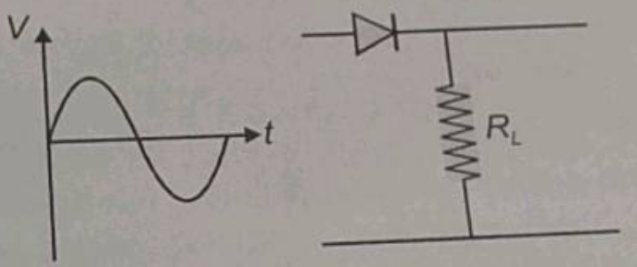
If in a p-n junction diode, a sinusoidal input signal is applied as shown. Then, the output signal across will be:
Answer
 Verified
587.1k+ views
Hint: In this question, we need to use the working principle of a diode to solve. The setup displayed by the circuit diagram in the figure above measures the output across the semiconductor diode. The voltage source used here is alternating in nature.
Complete step by step answer:
In the given question, an alternating voltage source is the input signal source. The first half of the voltage-time graph that is above the time axis is a positive signal, while the other half of the signal that is below the time axis is a negative signal.
The semiconductor diode (the one shown in the diagram) operates when it is forward biased. When the diode is forward biased, it offers minimal resistance. The first part of the signal makes the diode operate in forward biased condition, so the same signal appears in the output.
In the second half of the signal, the diode operates in the reversed biased condition as the signal is negative. So, the diode offers infinite resistance, and hence no signal appears in the output. Again, when the positive signal goes into the diode, it appears in the output.
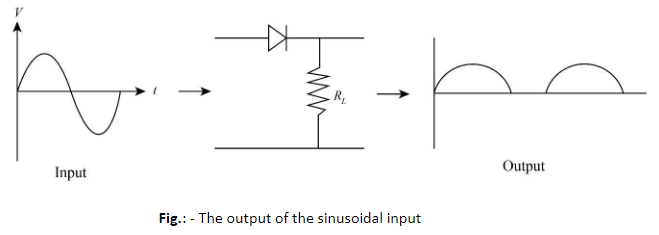
Therefore, we will receive an alternative voltage signal in which only the positive portions are present. In other words, we will receive a rectified version of the input signal as shown in the figure above.
Note: In the current question, we consider that the diode has a very small cut-in voltage. The cut-in voltage is considered to be small enough that it does not manifest itself in the output of the diode. If the cut-in voltage becomes comparable to the input signal, then we will lose a significant portion of the positive signal in overcoming the potential barrier. The negative part will still not appear in the output signal.
Complete step by step answer:
In the given question, an alternating voltage source is the input signal source. The first half of the voltage-time graph that is above the time axis is a positive signal, while the other half of the signal that is below the time axis is a negative signal.
The semiconductor diode (the one shown in the diagram) operates when it is forward biased. When the diode is forward biased, it offers minimal resistance. The first part of the signal makes the diode operate in forward biased condition, so the same signal appears in the output.
In the second half of the signal, the diode operates in the reversed biased condition as the signal is negative. So, the diode offers infinite resistance, and hence no signal appears in the output. Again, when the positive signal goes into the diode, it appears in the output.
Therefore, we will receive an alternative voltage signal in which only the positive portions are present. In other words, we will receive a rectified version of the input signal as shown in the figure above.
Note: In the current question, we consider that the diode has a very small cut-in voltage. The cut-in voltage is considered to be small enough that it does not manifest itself in the output of the diode. If the cut-in voltage becomes comparable to the input signal, then we will lose a significant portion of the positive signal in overcoming the potential barrier. The negative part will still not appear in the output signal.
Recently Updated Pages
Master Class 12 Economics: Engaging Questions & Answers for Success

Master Class 12 Physics: Engaging Questions & Answers for Success
Master Class 12 English: Engaging Questions & Answers for Success
Master Class 12 Social Science: Engaging Questions & Answers for Success
Master Class 12 Maths: Engaging Questions & Answers for Success
Master Class 12 Business Studies: Engaging Questions & Answers for Success
Trending doubts
Why cannot DNA pass through cell membranes class 12 biology CBSE
Differentiate between insitu conservation and exsitu class 12 biology CBSE
Draw a neat and well labeled diagram of TS of ovary class 12 biology CBSE
In a human foetus the limbs and digits develop after class 12 biology CBSE
AABbCc genotype forms how many types of gametes a 4 class 12 biology CBSE
The correct structure of ethylenediaminetetraacetic class 12 chemistry CBSE