




If segregation of alleles does not occur during meiosis, which of the following will occur as a result?
A. Diploid gametes would result.
B. Gametes with one half of a homologous pair of chromosomes.
C. Crossing over between homologous pairs will not occur.
D. The chromosomes would demonstrate linkage.
E. The crossover percentage would be very small.
Answer
 Verified
588.6k+ views
Hint: In the gamete cells meiosis division takes place.
During meiosis, the genetic material of the parent cells gets halved and divides.
Each of the gametes receives half of its parents’ genetic material to form a complete embryo after fertilization.
Complete answer: Every gene has two alleles.
1. Alleles are molecular variant forms of a gene.
2. Alleles are some genes that are located at the same position or locus of a chromosome.
3. Humans are diploid organisms because they have two alleles located at each genetic locus - one allele inherited from the father and another gene is inherited from the mother.
4. Alleles separate independently when gamete formation takes place – which is the law of segregation.
5. If segregation does not occur during the meiosis cell division, then one of the gametes will receive both the alleles and the other will receive none.
6. This segregation will produce a diploid gamete and a gamete with no allele.
So, the correct answer is option A. Diploid gametes would result.
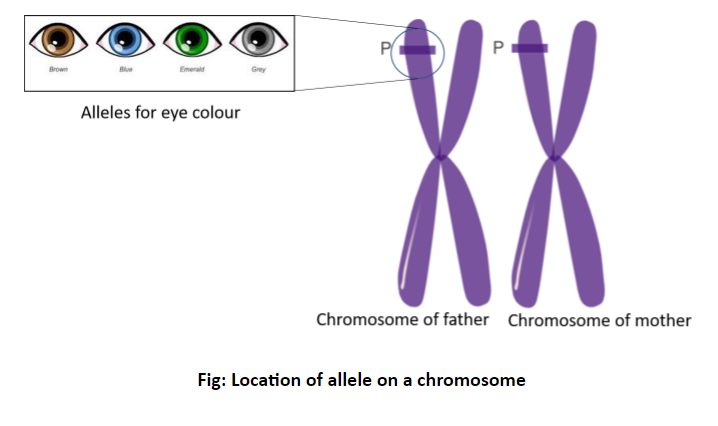
Note: From the diagram we can see that P is an allele which is present on the chromosomes of father and mother and the allele is specific for eye color detection.
During meiosis, the genetic material of the parent cells gets halved and divides.
Each of the gametes receives half of its parents’ genetic material to form a complete embryo after fertilization.
Complete answer: Every gene has two alleles.
1. Alleles are molecular variant forms of a gene.
2. Alleles are some genes that are located at the same position or locus of a chromosome.
3. Humans are diploid organisms because they have two alleles located at each genetic locus - one allele inherited from the father and another gene is inherited from the mother.
4. Alleles separate independently when gamete formation takes place – which is the law of segregation.
5. If segregation does not occur during the meiosis cell division, then one of the gametes will receive both the alleles and the other will receive none.
6. This segregation will produce a diploid gamete and a gamete with no allele.
So, the correct answer is option A. Diploid gametes would result.
Note: From the diagram we can see that P is an allele which is present on the chromosomes of father and mother and the allele is specific for eye color detection.
Recently Updated Pages
Master Class 12 Economics: Engaging Questions & Answers for Success

Master Class 12 Physics: Engaging Questions & Answers for Success
Master Class 12 English: Engaging Questions & Answers for Success
Master Class 12 Social Science: Engaging Questions & Answers for Success
Master Class 12 Maths: Engaging Questions & Answers for Success
Master Class 12 Business Studies: Engaging Questions & Answers for Success
Trending doubts
Which are the Top 10 Largest Countries of the World?
What are the major means of transport Explain each class 12 social science CBSE
Draw a labelled sketch of the human eye class 12 physics CBSE
Why cannot DNA pass through cell membranes class 12 biology CBSE
Differentiate between insitu conservation and exsitu class 12 biology CBSE
Draw a neat and well labeled diagram of TS of ovary class 12 biology CBSE