




If the angles of elevation of the top of a tower from three collinear points A, B and C on a line leading to the foot of the tower, are \[{30^ \circ }\], \[{45^ \circ }\] and \[{60^ \circ }\] respectively, then the ratio AB : BC, is:
A) \[\sqrt 3 :1\]
B) \[\sqrt 3 :\sqrt 2 \]
C) \[1 :\sqrt 3 \]
D) \[2:3\]
Answer
 Verified
591k+ views
Hint: Here we will assume the height of the tower as h and then find \[\tan {45^ \circ },\tan {60^ \circ },\tan {30^ \circ }\]in terms of ratio of height and base of the triangle and then finally find the ratio of AB: BC.
\[\tan \theta = \dfrac{{perpendicular}}{{base}}\]
Complete step-by-step answer:
Let us assume the height of the tower as h
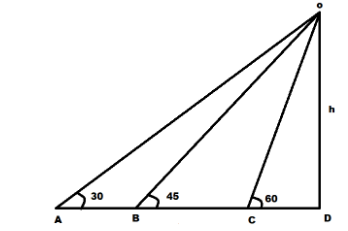
We know that:
\[\tan \theta = \dfrac{{perpendicular}}{{base}}\]
Now in\[\Delta OAD\],
Evaluating \[\tan {30^ \circ }\] we get:-
\[\tan {30^ \circ } = \dfrac{{OD}}{{AD}}\]
We know that:
\[\tan {30^ \circ } = \dfrac{1}{{\sqrt 3 }}\]
\[OD = h\]
Hence putting in the values we get:-
\[\dfrac{1}{{\sqrt 3 }} = \dfrac{h}{{AD}}\]
\[ \Rightarrow AD = \sqrt 3 h\]……………………………..(1)
In\[\Delta OBD\],
Evaluating \[\tan {45^ \circ }\] we get:-
\[\tan {45^ \circ } = \dfrac{{OD}}{{BD}}\]
We know that:
\[\tan {45^ \circ } = 1\]
\[OD = h\]
Hence putting in the values we get:-
\[1 = \dfrac{h}{{BD}}\]
\[ \Rightarrow BD = h\]…………………………….(2)
In\[\Delta OCD\],
Evaluating \[\tan {60^ \circ }\] we get:-
\[\tan {60^ \circ } = \dfrac{{OD}}{{CD}}\]
We know that:
\[\tan {60^ \circ } = \sqrt 3 \]
\[OD = h\]
Hence putting in the values we get:-
\[\sqrt 3 = \dfrac{h}{{CD}}\]
\[ \Rightarrow CD = \dfrac{h}{{\sqrt 3 }}\]…………………………….(3)
Now we know that:-
\[AB = AD - BD\]
Hence putting in the respective value from equation 1 and 2 we get:-
\[AB = \sqrt 3 h - h\]
Taking h common we get:-
\[ \Rightarrow AB = h\left( {\sqrt 3 - 1} \right)\]………………………(4)
Now we know that:-
\[BC = BD - CD\]
Hence putting in the respective value from equation 2 and 3 we get:-
\[BC = h - \dfrac{h}{{\sqrt 3 }}\]
Solving it further we get:-
\[BC = \dfrac{{\sqrt 3 h - h}}{{\sqrt 3 }}\]
Taking h common we get:-
\[ \Rightarrow BC = \dfrac{{h\left( {\sqrt 3 - 1} \right)}}{{\sqrt 3 }}\]………………………(5)
Now we have to find the ratio AB: BC
Hence dividing (4) by (5) we get:-
\[\dfrac{{AB}}{{BC}} = \dfrac{{h\left( {\sqrt 3 - 1} \right)}}{{\dfrac{{h\left( {\sqrt 3 - 1} \right)}}{{\sqrt 3 }}}}\]
Solving it further we get:-
\[\dfrac{{AB}}{{BC}} = h\left( {\sqrt 3 - 1} \right) \times \dfrac{{\sqrt 3 }}{{h\left( {\sqrt 3 - 1} \right)}}\]
Cancelling the terms we get:-
\[\dfrac{{AB}}{{BC}} = \dfrac{{\sqrt 3 }}{1}\]
Hence, \[AB:BC = \sqrt 3 :1\]
Therefore, option A is correct.
Note: Students might note in making the diagram, hence they should note that as we move towards the tower the angle of elevation increases so the angle of elevation at point C which is nearest to the tower will be \[{60^ \circ }\] and at point A it would be \[{30^ \circ }\].
\[\tan \theta = \dfrac{{perpendicular}}{{base}}\]
Complete step-by-step answer:
Let us assume the height of the tower as h
We know that:
\[\tan \theta = \dfrac{{perpendicular}}{{base}}\]
Now in\[\Delta OAD\],
Evaluating \[\tan {30^ \circ }\] we get:-
\[\tan {30^ \circ } = \dfrac{{OD}}{{AD}}\]
We know that:
\[\tan {30^ \circ } = \dfrac{1}{{\sqrt 3 }}\]
\[OD = h\]
Hence putting in the values we get:-
\[\dfrac{1}{{\sqrt 3 }} = \dfrac{h}{{AD}}\]
\[ \Rightarrow AD = \sqrt 3 h\]……………………………..(1)
In\[\Delta OBD\],
Evaluating \[\tan {45^ \circ }\] we get:-
\[\tan {45^ \circ } = \dfrac{{OD}}{{BD}}\]
We know that:
\[\tan {45^ \circ } = 1\]
\[OD = h\]
Hence putting in the values we get:-
\[1 = \dfrac{h}{{BD}}\]
\[ \Rightarrow BD = h\]…………………………….(2)
In\[\Delta OCD\],
Evaluating \[\tan {60^ \circ }\] we get:-
\[\tan {60^ \circ } = \dfrac{{OD}}{{CD}}\]
We know that:
\[\tan {60^ \circ } = \sqrt 3 \]
\[OD = h\]
Hence putting in the values we get:-
\[\sqrt 3 = \dfrac{h}{{CD}}\]
\[ \Rightarrow CD = \dfrac{h}{{\sqrt 3 }}\]…………………………….(3)
Now we know that:-
\[AB = AD - BD\]
Hence putting in the respective value from equation 1 and 2 we get:-
\[AB = \sqrt 3 h - h\]
Taking h common we get:-
\[ \Rightarrow AB = h\left( {\sqrt 3 - 1} \right)\]………………………(4)
Now we know that:-
\[BC = BD - CD\]
Hence putting in the respective value from equation 2 and 3 we get:-
\[BC = h - \dfrac{h}{{\sqrt 3 }}\]
Solving it further we get:-
\[BC = \dfrac{{\sqrt 3 h - h}}{{\sqrt 3 }}\]
Taking h common we get:-
\[ \Rightarrow BC = \dfrac{{h\left( {\sqrt 3 - 1} \right)}}{{\sqrt 3 }}\]………………………(5)
Now we have to find the ratio AB: BC
Hence dividing (4) by (5) we get:-
\[\dfrac{{AB}}{{BC}} = \dfrac{{h\left( {\sqrt 3 - 1} \right)}}{{\dfrac{{h\left( {\sqrt 3 - 1} \right)}}{{\sqrt 3 }}}}\]
Solving it further we get:-
\[\dfrac{{AB}}{{BC}} = h\left( {\sqrt 3 - 1} \right) \times \dfrac{{\sqrt 3 }}{{h\left( {\sqrt 3 - 1} \right)}}\]
Cancelling the terms we get:-
\[\dfrac{{AB}}{{BC}} = \dfrac{{\sqrt 3 }}{1}\]
Hence, \[AB:BC = \sqrt 3 :1\]
Therefore, option A is correct.
Note: Students might note in making the diagram, hence they should note that as we move towards the tower the angle of elevation increases so the angle of elevation at point C which is nearest to the tower will be \[{60^ \circ }\] and at point A it would be \[{30^ \circ }\].
Recently Updated Pages
Master Class 10 Computer Science: Engaging Questions & Answers for Success

Master Class 10 General Knowledge: Engaging Questions & Answers for Success
Master Class 10 English: Engaging Questions & Answers for Success
Master Class 10 Social Science: Engaging Questions & Answers for Success
Master Class 10 Maths: Engaging Questions & Answers for Success
Master Class 10 Science: Engaging Questions & Answers for Success
Trending doubts
What is the median of the first 10 natural numbers class 10 maths CBSE
Which women's tennis player has 24 Grand Slam singles titles?
Who is the Brand Ambassador of Incredible India?
Why is there a time difference of about 5 hours between class 10 social science CBSE
Write a letter to the principal requesting him to grant class 10 english CBSE
State and prove converse of BPT Basic Proportionality class 10 maths CBSE