




If the sequence of bases in one strand of DNA is ATGACTGTC then the sequence of bases in its complementary strand is: -
(a) TACTGACAG
b) TUCTGUCCUG
c) GUAGTUAUG
(d) none of the above
Answer
 Verified
586.5k+ views
Hint: Base pairing in DNA is complementary i.e. one strand of DNA is bonded to the other by sequence of base pairs. A purine (Adenine and Guanine) always forms bonds with pyrimidine (Thymine and Cytosine) and vice-versa. Solve it.
Complete answer:
As we know that DNA is double stranded and is made up of pentose sugar, phosphoric acid nitrogenous bases.
A nitrogenous base is that which consists of nitrogen atoms and has similar properties as that of a base and its main function is to form bonds between the two strands of DNA.
Nitrogenous bases are divided into two main categories: -
Purines
Pyrimidines
Purines are nine membered double rings and Pyrimidines are six membered rings.
DNA has a total four nitrogenous bases, two purines and two pyrimidines.
Purines: -
1.Adenine
2.Guanine
Pyrimidines: -
1. cytosine and
2.Thymine (in DNA)
3.Uracil (in RNA)
As discussed above, base pairing in DNA is always complementary and always occurs between a purine and a pyrimidine and forms the bond between the two strands of DNA.
Adenine forms bonds with Thymine (A-T) in DNA and with Uracil(A-U) in RNA.
Cytosine forms with Guanine (C-G).
If the sequence in one strand of DNA is ATGACTGTC, then in its complementary strand it is: -
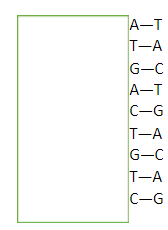
Therefore, the sequence of the base pairs in the complementary strand of DNA is TACTGACAG.
So, option (a) is correct.
Note:
Pairing always takes place between a purine and pyrimidine and not between purine-purine or pyrimidine- pyrimidine.
In DNA, Adenine is paired with thymine and in RNA, it is always with uracil
Complete answer:
As we know that DNA is double stranded and is made up of pentose sugar, phosphoric acid nitrogenous bases.
A nitrogenous base is that which consists of nitrogen atoms and has similar properties as that of a base and its main function is to form bonds between the two strands of DNA.
Nitrogenous bases are divided into two main categories: -
Purines
Pyrimidines
Purines are nine membered double rings and Pyrimidines are six membered rings.
DNA has a total four nitrogenous bases, two purines and two pyrimidines.
Purines: -
1.Adenine
2.Guanine
Pyrimidines: -
1. cytosine and
2.Thymine (in DNA)
3.Uracil (in RNA)
As discussed above, base pairing in DNA is always complementary and always occurs between a purine and a pyrimidine and forms the bond between the two strands of DNA.
Adenine forms bonds with Thymine (A-T) in DNA and with Uracil(A-U) in RNA.
Cytosine forms with Guanine (C-G).
If the sequence in one strand of DNA is ATGACTGTC, then in its complementary strand it is: -
Therefore, the sequence of the base pairs in the complementary strand of DNA is TACTGACAG.
So, option (a) is correct.
Note:
Pairing always takes place between a purine and pyrimidine and not between purine-purine or pyrimidine- pyrimidine.
In DNA, Adenine is paired with thymine and in RNA, it is always with uracil
Recently Updated Pages
Master Class 12 Economics: Engaging Questions & Answers for Success

Master Class 12 Physics: Engaging Questions & Answers for Success
Master Class 12 English: Engaging Questions & Answers for Success
Master Class 12 Social Science: Engaging Questions & Answers for Success
Master Class 12 Maths: Engaging Questions & Answers for Success
Master Class 12 Business Studies: Engaging Questions & Answers for Success
Trending doubts
Which are the Top 10 Largest Countries of the World?
What are the major means of transport Explain each class 12 social science CBSE
Draw a labelled sketch of the human eye class 12 physics CBSE
Differentiate between insitu conservation and exsitu class 12 biology CBSE
Draw a neat and well labeled diagram of TS of ovary class 12 biology CBSE
Give 10 examples of unisexual and bisexual flowers