




If \[y=\sin (2{{\sin }^{-1}}x)\], then \[\dfrac{dy}{dx}=\]
A.\[\dfrac{(2-4{{x}^{2}})}{\sqrt{(1-{{x}^{2}})}}\]
B.\[\dfrac{(2+4{{x}^{2}})}{\sqrt{(1-{{x}^{2}})}}\]
C.\[\dfrac{(2-4{{x}^{2}})}{\sqrt{(1+{{x}^{2}})}}\]
D.None of these
Answer
 Verified
506.7k+ views
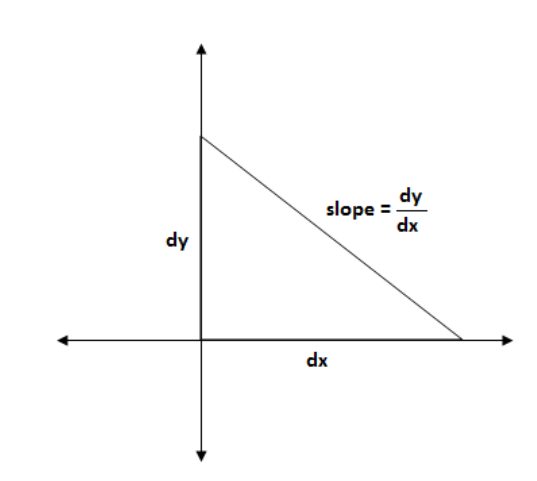
Hint: To find the derivative we can use the slope formula, that is, \[slope=\dfrac{dy}{dx}\].
\[dy\]is the changes in \[Y\]and \[dx\] is the changes in \[X\]
To find the derivative of two variables in multiplication, this formula is used
\[\dfrac{d}{dx}(uv)=u\dfrac{d}{dx}(v)+v\dfrac{d}{dx}(u)\]
Mechanically, \[\dfrac{d}{dx}(f(x))\] measures the rate of change of \[f(x)\] with respect to \[x\] .
Differentiation of any constant is zero. Differentiation of constant and a function is equal to constant times the differentiation of the function. Geometrically, graph of a constant function is a straight line parallel to the \[x-axis\]. Consequently slope of the tangent is zero.
Complete step-by-step answer:
Given that \[y=\sin (2{{\sin }^{-1}}x)\]
Let us assume that \[x=\sin \theta \]
Differentiating both sides with respect to \[\theta \] we get
\[\dfrac{dx}{d\theta }=\cos \theta \]
Substituting these values in the equation we get
\[y=\sin (2{{\sin }^{-1}}\sin \theta )\]
Solving the above equation we get
\[y=\sin 2\theta \]
Differentiating both sides with respect to \[\theta \] we get
\[\dfrac{dy}{d\theta }=2\cos 2\theta \]
We know that \[\dfrac{dy}{dx}=\dfrac{dy}{d\theta }\times \dfrac{d\theta }{dx}\]
Substituting the values in the equation we get
\[\dfrac{dy}{dx}=\dfrac{2\cos 2\theta }{\cos \theta }\]
Further solving by applying trigonometric identities we get
\[\dfrac{dy}{dx}=\dfrac{2(1-2{{\sin }^{2}}\theta )}{\sqrt{(1-{{\sin }^{2}}\theta )}}\]
Substituting \[x=\sin \theta \] in the above equation we get
\[\dfrac{dy}{dx}=\dfrac{2(1-2{{x}^{2}})}{\sqrt{1-{{x}^{2}}}}\]
Further solving we get
\[\dfrac{dy}{dx}=\dfrac{(2-4{{x}^{2}})}{\sqrt{(1-{{x}^{2}})}}\]
Therefore, option \[A\] is the correct answer.
So, the correct answer is “Option A”.
Note: \[\dfrac{d}{dx}(f(x))=\underset{h\to 0}{\mathop{\lim }}\,\dfrac{f(x+h)-f(x)}{h}\] is the formula for finding the derivative from the first principles. The slope is the rate of change of \[y\] with respect to \[x\] that means if \[x\] is increased by an additional unit the change in \[y\] is given by \[\dfrac{dy}{dx}\] . Let us understand with an example, the rate of change of displacement of an object is defined as the velocity \[Km/hr~\] that means when time is increased by one hour the displacement changes by \[Km\]. For solving derivative problems different techniques of differentiation must be known.
\[dy\]is the changes in \[Y\]and \[dx\] is the changes in \[X\]
To find the derivative of two variables in multiplication, this formula is used
\[\dfrac{d}{dx}(uv)=u\dfrac{d}{dx}(v)+v\dfrac{d}{dx}(u)\]
Mechanically, \[\dfrac{d}{dx}(f(x))\] measures the rate of change of \[f(x)\] with respect to \[x\] .
Differentiation of any constant is zero. Differentiation of constant and a function is equal to constant times the differentiation of the function. Geometrically, graph of a constant function is a straight line parallel to the \[x-axis\]. Consequently slope of the tangent is zero.
Complete step-by-step answer:
Given that \[y=\sin (2{{\sin }^{-1}}x)\]
Let us assume that \[x=\sin \theta \]
Differentiating both sides with respect to \[\theta \] we get
\[\dfrac{dx}{d\theta }=\cos \theta \]
Substituting these values in the equation we get
\[y=\sin (2{{\sin }^{-1}}\sin \theta )\]
Solving the above equation we get
\[y=\sin 2\theta \]
Differentiating both sides with respect to \[\theta \] we get
\[\dfrac{dy}{d\theta }=2\cos 2\theta \]
We know that \[\dfrac{dy}{dx}=\dfrac{dy}{d\theta }\times \dfrac{d\theta }{dx}\]
Substituting the values in the equation we get
\[\dfrac{dy}{dx}=\dfrac{2\cos 2\theta }{\cos \theta }\]
Further solving by applying trigonometric identities we get
\[\dfrac{dy}{dx}=\dfrac{2(1-2{{\sin }^{2}}\theta )}{\sqrt{(1-{{\sin }^{2}}\theta )}}\]
Substituting \[x=\sin \theta \] in the above equation we get
\[\dfrac{dy}{dx}=\dfrac{2(1-2{{x}^{2}})}{\sqrt{1-{{x}^{2}}}}\]
Further solving we get
\[\dfrac{dy}{dx}=\dfrac{(2-4{{x}^{2}})}{\sqrt{(1-{{x}^{2}})}}\]
Therefore, option \[A\] is the correct answer.
So, the correct answer is “Option A”.
Note: \[\dfrac{d}{dx}(f(x))=\underset{h\to 0}{\mathop{\lim }}\,\dfrac{f(x+h)-f(x)}{h}\] is the formula for finding the derivative from the first principles. The slope is the rate of change of \[y\] with respect to \[x\] that means if \[x\] is increased by an additional unit the change in \[y\] is given by \[\dfrac{dy}{dx}\] . Let us understand with an example, the rate of change of displacement of an object is defined as the velocity \[Km/hr~\] that means when time is increased by one hour the displacement changes by \[Km\]. For solving derivative problems different techniques of differentiation must be known.
Recently Updated Pages
Master Class 12 Economics: Engaging Questions & Answers for Success

Master Class 12 Physics: Engaging Questions & Answers for Success
Master Class 12 English: Engaging Questions & Answers for Success
Master Class 12 Social Science: Engaging Questions & Answers for Success
Master Class 12 Maths: Engaging Questions & Answers for Success
Master Class 12 Business Studies: Engaging Questions & Answers for Success
Trending doubts
Which are the Top 10 Largest Countries of the World?
What are the major means of transport Explain each class 12 social science CBSE
Draw a labelled sketch of the human eye class 12 physics CBSE
Why cannot DNA pass through cell membranes class 12 biology CBSE
Differentiate between insitu conservation and exsitu class 12 biology CBSE
Draw a neat and well labeled diagram of TS of ovary class 12 biology CBSE