




In a photocell 4 unit photoelectric current is flowing, the distance between source and cathode is 4 units. Now the distance between source and cathode becomes 1 unit. What will be photoelectric current now?
Answer
 Verified
587.7k+ views
Hint: Intensity is defined as the power transferred by the light source per unit area where the area is measured in the plane perpendicular to the direction of propagation of the light.
$I = \dfrac{P}{A}$
Complete step by step solution:
One of the results of the photoelectric effect experiment is –
The number of photoelectrons emitted per second also called photoelectric current, is directly proportional to the intensity of the incident light.
$Current \propto I$
In order to calculate the intensity, we have the definition of intensity –
$I = \dfrac{P}{A}$
If we consider a point source of light, the light emanates in all directions in the form of a sphere. Thus, the area here is considered as the surface area of the sphere.
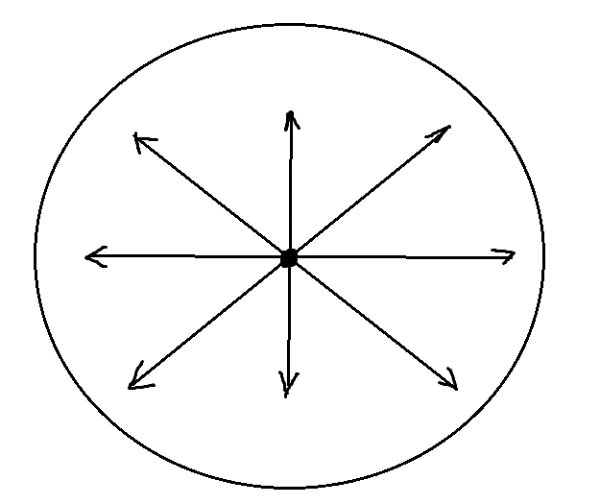
Thus,
$Area,A = 4\pi {r^2}$
Substituting,
$
I = \dfrac{P}{A} \\
I = \dfrac{P}{{4\pi {r^2}}} \\
$
Therefore, from this relation, we get to know that –
$I \propto \dfrac{1}{{{r^2}}}$
and also,
$
Current \propto I \\
\Rightarrow Current \propto \dfrac{1}{{{r^2}}} \\
$
In this problem,
At 4 units of photocurrent $ \Rightarrow $ Distance between source and cathode, $r = 4 $units
At how many (?) units of photocurrent $ \Rightarrow $ Distance between source and cathode, $r = 1$units
To calculate the units of photocurrent,
$
Current \propto \dfrac{1}{{{r^2}}} \\
\dfrac{{Curren{t_2}}}{{Curren{t_1}}} = \dfrac{{r_1^2}}{{r_2^2}} \\
Curren{t_2} = Curren{t_1}\left( {\dfrac{{{4^2}}}{{{1^2}}}} \right) \\
Curren{t_2} = 4 \times \left( {\dfrac{{{4^2}}}{{{1^2}}}} \right) \\
Solving, \\
\therefore Current = {4^3} = 64 \\
$
Thus, the new photocurrent = 64 units.
Note:
This principle of variation of photoelectric current with the intensity of light is applicable in the device photocell. This device is used as a sensor in automatic lighting systems. When there is excess light in the surroundings, the photocell detects the high change in intensity, and the photoelectric current increases. This increase in current triggers the lights to turn dim.
$I = \dfrac{P}{A}$
Complete step by step solution:
One of the results of the photoelectric effect experiment is –
The number of photoelectrons emitted per second also called photoelectric current, is directly proportional to the intensity of the incident light.
$Current \propto I$
In order to calculate the intensity, we have the definition of intensity –
$I = \dfrac{P}{A}$
If we consider a point source of light, the light emanates in all directions in the form of a sphere. Thus, the area here is considered as the surface area of the sphere.
Thus,
$Area,A = 4\pi {r^2}$
Substituting,
$
I = \dfrac{P}{A} \\
I = \dfrac{P}{{4\pi {r^2}}} \\
$
Therefore, from this relation, we get to know that –
$I \propto \dfrac{1}{{{r^2}}}$
and also,
$
Current \propto I \\
\Rightarrow Current \propto \dfrac{1}{{{r^2}}} \\
$
In this problem,
At 4 units of photocurrent $ \Rightarrow $ Distance between source and cathode, $r = 4 $units
At how many (?) units of photocurrent $ \Rightarrow $ Distance between source and cathode, $r = 1$units
To calculate the units of photocurrent,
$
Current \propto \dfrac{1}{{{r^2}}} \\
\dfrac{{Curren{t_2}}}{{Curren{t_1}}} = \dfrac{{r_1^2}}{{r_2^2}} \\
Curren{t_2} = Curren{t_1}\left( {\dfrac{{{4^2}}}{{{1^2}}}} \right) \\
Curren{t_2} = 4 \times \left( {\dfrac{{{4^2}}}{{{1^2}}}} \right) \\
Solving, \\
\therefore Current = {4^3} = 64 \\
$
Thus, the new photocurrent = 64 units.
Note:
This principle of variation of photoelectric current with the intensity of light is applicable in the device photocell. This device is used as a sensor in automatic lighting systems. When there is excess light in the surroundings, the photocell detects the high change in intensity, and the photoelectric current increases. This increase in current triggers the lights to turn dim.
Recently Updated Pages
Master Class 12 Economics: Engaging Questions & Answers for Success

Master Class 12 Physics: Engaging Questions & Answers for Success
Master Class 12 English: Engaging Questions & Answers for Success
Master Class 12 Social Science: Engaging Questions & Answers for Success
Master Class 12 Maths: Engaging Questions & Answers for Success
Master Class 12 Business Studies: Engaging Questions & Answers for Success
Trending doubts
Which are the Top 10 Largest Countries of the World?
What are the major means of transport Explain each class 12 social science CBSE
Draw a labelled sketch of the human eye class 12 physics CBSE
Why cannot DNA pass through cell membranes class 12 biology CBSE
Differentiate between insitu conservation and exsitu class 12 biology CBSE
Draw a neat and well labeled diagram of TS of ovary class 12 biology CBSE