




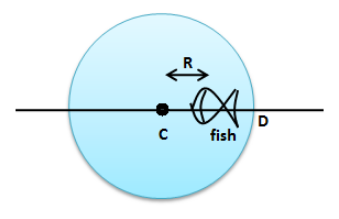
In a thin spherical fish bowl of radius $10 cm$ filled with water of refractive index \[\dfrac{4}{3}\], there is a fish at a distance $4 cm$ from the centre C as shown. The image of the fist appears when seen from the point D would be
A. $5.2 cm$
B. $4.8 cm$
C. $2.6 cm$
D. $7.4 cm$
Answer
 Verified
570.9k+ views
Hint: Use the formula for refraction through spherical lens when the refractive index of the medium is different on the two sides of the lens. Take the appropriate signs for the position of fish and radius of curvature. The sign of the image position should be negative and assume its absolute value for the answer.
Formula used:
\[\dfrac{{{\mu _2}}}{v} - \dfrac{{{\mu _1}}}{u} = \dfrac{{{\mu _2} - {\mu _1}}}{R}\]
Here, \[{\mu _2}\] is the refractive index of the medium on the convex side of the lens, \[{\mu _1}\] is the refractive index of the medium on the concave side of the lens, R is the radius of curvature, v is the position of the image and u is the position of the object.
Complete step by step answer:
We know the formula for refraction through a spherical lens when the refractive index of the medium is different on the two sides of the lens.
\[\dfrac{{{\mu _2}}}{v} - \dfrac{{{\mu _1}}}{u} = \dfrac{{{\mu _2} - {\mu _1}}}{R}\]
Here, \[{\mu _2}\] is the refractive index of the medium on the convex side of the lens, \[{\mu _1}\] is the refractive index of the medium on the concave side of the lens, R is the radius of curvature, v is the position of the image and u is the position of the object.
We know that the refractive index of the air is 1. We can observe that both image position and object position is negative as the optical centre of the lens is D. We substitute 1 for \[{\mu _2}\], \[\dfrac{4}{3}\] for \[{\mu _1}\], \[ - 6\,cm\] for u and \[ - 10\,cm\] for R in the above equation.
\[\dfrac{1}{v} - \dfrac{{4/3}}{{ - 6}} = \dfrac{{1 - 4/3}}{{ - 10}}\]
\[ \Rightarrow \dfrac{1}{v} + \dfrac{4}{{18}} = \dfrac{1}{{30}}\]
\[ \Rightarrow \dfrac{1}{v} = \dfrac{1}{{30}} - \dfrac{4}{{18}}\]
\[ \Rightarrow \dfrac{1}{v} = - \dfrac{{17}}{{90}}\]
\[ \therefore v \approx - 5.2\,cm\]
Therefore, the image of the fish will appear at 5.2 cm from the point D. So, the correct answer is option (A).
Note:We have taken the object distance 6 cm since the position of the fish is 4 cm from the centre of the bowl and not from the point D. We cannot determine the apparent depth of the fish using the relation between real depth, apparent depth and refractive index as it is a spherical lens. While using the above formula, the signs of object distance and image distance should be taken such that distance towards the left from the lens is negative and distance towards the right from the lens is positive.
Formula used:
\[\dfrac{{{\mu _2}}}{v} - \dfrac{{{\mu _1}}}{u} = \dfrac{{{\mu _2} - {\mu _1}}}{R}\]
Here, \[{\mu _2}\] is the refractive index of the medium on the convex side of the lens, \[{\mu _1}\] is the refractive index of the medium on the concave side of the lens, R is the radius of curvature, v is the position of the image and u is the position of the object.
Complete step by step answer:
We know the formula for refraction through a spherical lens when the refractive index of the medium is different on the two sides of the lens.
\[\dfrac{{{\mu _2}}}{v} - \dfrac{{{\mu _1}}}{u} = \dfrac{{{\mu _2} - {\mu _1}}}{R}\]
Here, \[{\mu _2}\] is the refractive index of the medium on the convex side of the lens, \[{\mu _1}\] is the refractive index of the medium on the concave side of the lens, R is the radius of curvature, v is the position of the image and u is the position of the object.
We know that the refractive index of the air is 1. We can observe that both image position and object position is negative as the optical centre of the lens is D. We substitute 1 for \[{\mu _2}\], \[\dfrac{4}{3}\] for \[{\mu _1}\], \[ - 6\,cm\] for u and \[ - 10\,cm\] for R in the above equation.
\[\dfrac{1}{v} - \dfrac{{4/3}}{{ - 6}} = \dfrac{{1 - 4/3}}{{ - 10}}\]
\[ \Rightarrow \dfrac{1}{v} + \dfrac{4}{{18}} = \dfrac{1}{{30}}\]
\[ \Rightarrow \dfrac{1}{v} = \dfrac{1}{{30}} - \dfrac{4}{{18}}\]
\[ \Rightarrow \dfrac{1}{v} = - \dfrac{{17}}{{90}}\]
\[ \therefore v \approx - 5.2\,cm\]
Therefore, the image of the fish will appear at 5.2 cm from the point D. So, the correct answer is option (A).
Note:We have taken the object distance 6 cm since the position of the fish is 4 cm from the centre of the bowl and not from the point D. We cannot determine the apparent depth of the fish using the relation between real depth, apparent depth and refractive index as it is a spherical lens. While using the above formula, the signs of object distance and image distance should be taken such that distance towards the left from the lens is negative and distance towards the right from the lens is positive.
Recently Updated Pages
Master Class 12 Economics: Engaging Questions & Answers for Success

Master Class 12 Physics: Engaging Questions & Answers for Success
Master Class 12 English: Engaging Questions & Answers for Success
Master Class 12 Social Science: Engaging Questions & Answers for Success
Master Class 12 Maths: Engaging Questions & Answers for Success
Master Class 12 Business Studies: Engaging Questions & Answers for Success
Trending doubts
Which are the Top 10 Largest Countries of the World?
What are the major means of transport Explain each class 12 social science CBSE
Draw a labelled sketch of the human eye class 12 physics CBSE
Why cannot DNA pass through cell membranes class 12 biology CBSE
Differentiate between insitu conservation and exsitu class 12 biology CBSE
Draw a neat and well labeled diagram of TS of ovary class 12 biology CBSE