




In ∆ABC prove that: ${\text{Sin}}\left( {\dfrac{{{\text{B - C}}}}{2}} \right) = \left( {\dfrac{{{\text{b - c}}}}{2}} \right){\text{Cos}}\dfrac{{\text{A}}}{2}$.
Answer
 Verified
583.2k+ views
Hint: In order to prove the given we make use of the Lami’s theorem. Lami’s Theorem states that when three forces acting at a point are in equilibrium, then each force is proportional to the sine of the angle between the other two forces. If we join the tails of these vectors it forms a triangle.
The Lami’s theorems:
${\text{k = }}\dfrac{{{\text{Sin A}}}}{{\text{a}}}{\text{ = }}\dfrac{{{\text{Sin B}}}}{{\text{b}}}{\text{ = }}\dfrac{{{\text{Sin C}}}}{{\text{c}}}$
(k is a constant, denoting all are equal to k)
Complete step-by-step answer:
Let us construct a triangle ABC with sides of lengths a, b and c respectively as shown in the figure below.
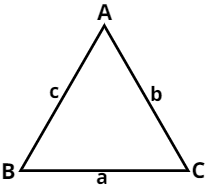
From the diagram we are very clear that A, B and C are angles of the triangle whereas a, b and c are respective sides.
We know the formula given by the Lami’s theorem, as follows:
${\text{k = }}\dfrac{{{\text{Sin A}}}}{{\text{a}}}{\text{ = }}\dfrac{{{\text{Sin B}}}}{{\text{b}}}{\text{ = }}\dfrac{{{\text{Sin C}}}}{{\text{c}}}$
(k is a constant, denoting all are equal to k)
We know,
From the formula, ${\text{a = }}\dfrac{{{\text{Sin A}}}}{{\text{k}}},{\text{b = }}\dfrac{{{\text{Sin B}}}}{{\text{k}}}{\text{ and c = }}\dfrac{{{\text{Sin C}}}}{{\text{k}}}$
We know from the identities of trigonometric ratios that, ${\text{Sin x - Sin y = 2Cos}}\left( {\dfrac{{{\text{x + y}}}}{2}} \right)\operatorname{Sin} \left( {\dfrac{{{\text{x - y}}}}{2}} \right)$
Also given angles, A, B and C form a triangle, hence A + B + C = 180°
Also according to the properties of Sin and Cos functions, Sin (180 – x) = Sin x and Cos (180 – x) = -Cos x
Using all the above relations and identities, we solve to obtain the given as follows:
$
\Rightarrow 2{\text{Cos}}\left( {\dfrac{{{\text{B + C}}}}{2}} \right){\text{Sin}}\left( {\dfrac{{{\text{B - C}}}}{2}} \right) = \left( {{\text{b - c}}} \right){\text{k}} \\
\Rightarrow {\text{2Sin}}\dfrac{{\text{A}}}{2}{\text{Sin}}\left( {\dfrac{{{\text{B - C}}}}{2}} \right) = \left( {{\text{b - c}}} \right){\text{k}} \\
\left( {\because {\text{SinA = ak}}} \right) \\
\Rightarrow 2{\text{Sin}}\dfrac{{\text{A}}}{2}{\text{cos}}\dfrac{{\text{A}}}{2} = {\text{ak}} \\
\Rightarrow \dfrac{{{\text{Sin}}\left( {\dfrac{{{\text{B - C}}}}{2}} \right)}}{{{\text{cos}}\dfrac{{\text{A}}}{2}}} = \left( {\dfrac{{{\text{b - c}}}}{{\text{a}}}} \right) \\
\Rightarrow {\text{Sin}}\left( {\dfrac{{{\text{B - C}}}}{2}} \right) = \left( {\dfrac{{{\text{b - c}}}}{2}} \right){\text{Cos}}\dfrac{{\text{A}}}{2} \\
$
Hence proved.
Note: In order to solve these types of questions the key is to just simplify the given using suitable trigonometric formulas. Drawing diagrams will make the solution a bit easier. Here we have used lami’s theorem. Identifying that the sum of all angles here is 180° is the key step which helps us solve the problem. Good knowledge in trigonometric formulae is required.
The Lami’s theorems:
${\text{k = }}\dfrac{{{\text{Sin A}}}}{{\text{a}}}{\text{ = }}\dfrac{{{\text{Sin B}}}}{{\text{b}}}{\text{ = }}\dfrac{{{\text{Sin C}}}}{{\text{c}}}$
(k is a constant, denoting all are equal to k)
Complete step-by-step answer:
Let us construct a triangle ABC with sides of lengths a, b and c respectively as shown in the figure below.
From the diagram we are very clear that A, B and C are angles of the triangle whereas a, b and c are respective sides.
We know the formula given by the Lami’s theorem, as follows:
${\text{k = }}\dfrac{{{\text{Sin A}}}}{{\text{a}}}{\text{ = }}\dfrac{{{\text{Sin B}}}}{{\text{b}}}{\text{ = }}\dfrac{{{\text{Sin C}}}}{{\text{c}}}$
(k is a constant, denoting all are equal to k)
We know,
From the formula, ${\text{a = }}\dfrac{{{\text{Sin A}}}}{{\text{k}}},{\text{b = }}\dfrac{{{\text{Sin B}}}}{{\text{k}}}{\text{ and c = }}\dfrac{{{\text{Sin C}}}}{{\text{k}}}$
We know from the identities of trigonometric ratios that, ${\text{Sin x - Sin y = 2Cos}}\left( {\dfrac{{{\text{x + y}}}}{2}} \right)\operatorname{Sin} \left( {\dfrac{{{\text{x - y}}}}{2}} \right)$
Also given angles, A, B and C form a triangle, hence A + B + C = 180°
Also according to the properties of Sin and Cos functions, Sin (180 – x) = Sin x and Cos (180 – x) = -Cos x
Using all the above relations and identities, we solve to obtain the given as follows:
$
\Rightarrow 2{\text{Cos}}\left( {\dfrac{{{\text{B + C}}}}{2}} \right){\text{Sin}}\left( {\dfrac{{{\text{B - C}}}}{2}} \right) = \left( {{\text{b - c}}} \right){\text{k}} \\
\Rightarrow {\text{2Sin}}\dfrac{{\text{A}}}{2}{\text{Sin}}\left( {\dfrac{{{\text{B - C}}}}{2}} \right) = \left( {{\text{b - c}}} \right){\text{k}} \\
\left( {\because {\text{SinA = ak}}} \right) \\
\Rightarrow 2{\text{Sin}}\dfrac{{\text{A}}}{2}{\text{cos}}\dfrac{{\text{A}}}{2} = {\text{ak}} \\
\Rightarrow \dfrac{{{\text{Sin}}\left( {\dfrac{{{\text{B - C}}}}{2}} \right)}}{{{\text{cos}}\dfrac{{\text{A}}}{2}}} = \left( {\dfrac{{{\text{b - c}}}}{{\text{a}}}} \right) \\
\Rightarrow {\text{Sin}}\left( {\dfrac{{{\text{B - C}}}}{2}} \right) = \left( {\dfrac{{{\text{b - c}}}}{2}} \right){\text{Cos}}\dfrac{{\text{A}}}{2} \\
$
Hence proved.
Note: In order to solve these types of questions the key is to just simplify the given using suitable trigonometric formulas. Drawing diagrams will make the solution a bit easier. Here we have used lami’s theorem. Identifying that the sum of all angles here is 180° is the key step which helps us solve the problem. Good knowledge in trigonometric formulae is required.
Recently Updated Pages
Master Class 11 English: Engaging Questions & Answers for Success

Master Class 11 Maths: Engaging Questions & Answers for Success
Master Class 11 Biology: Engaging Questions & Answers for Success
Master Class 11 Physics: Engaging Questions & Answers for Success
Master Class 11 Accountancy: Engaging Questions & Answers for Success
Class 11 Question and Answer - Your Ultimate Solutions Guide
Trending doubts
One Metric ton is equal to kg A 10000 B 1000 C 100 class 11 physics CBSE
Discuss the various forms of bacteria class 11 biology CBSE
Draw a diagram of a plant cell and label at least eight class 11 biology CBSE
State the laws of reflection of light
Explain zero factorial class 11 maths CBSE
10 examples of friction in our daily life