




In an isosceles triangle $ABC$, with $AB = AC$, the bisectors of $\angle B = \angle C$ intersect each other at $O$.Join $A$ to $O$. Show that $(i) OB = OC $ and $(ii) AO$ bisects $\angle A$.
Answer
 Verified
621.9k+ views
Hint: Join $A$ to $O$. Apply the given condition to the isosceles triangle and use similarity criterion.
According to given data we have 3 conditions,
$AB = AC \to (1)$
$OB$ is the bisector of $\angle B$
So,$\angle ABO = \angle OBC = \dfrac{1}{2}\angle B \to (2)$
$OC$ is the bisector of$\angle C$
So,$\angle ACO = \angle OCB = \dfrac{1}{2}\angle C$$ \to (3)$
Case-1
So, here we have to prove $OB = OC$
Proof:
Now by using condition (1) we can say that,
$AB = AC$
From this condition we say that
$ \Rightarrow \angle ACB = \angle ABC$ [ Where we know that Angles opposite to equal sides are equal]
$\
\Rightarrow \dfrac{1}{2}\angle ACB = \dfrac{1}{2}\angle ABC \\
\\
\ $
$ \Rightarrow \angle OCB = \angle OBC$ [From (2) and (3)]
Hence,
$OB = OC$ [Sides opposite to equal angles are equal]
Hence proved that $OB = OC$.
Case-2
We have to prove that $\angle OAB = \angle OAC$
By using case (1) we know that $OB = OC$
And also from $\Delta ABO$ and$\Delta ACO$, we have
$ \Rightarrow AB = AC$ (Given)
$ \Rightarrow AO = OA$ (Common)
$ \Rightarrow OB = OC$(From (case 1))
$\therefore \Delta ABO \cong \Delta ACO$ (By SSS Congruence rule)
$ \Rightarrow \angle OAB = \angle OAC$ (CPCPT Theorem)
Hence we have proved that$\angle OAB = \angle OAC$.
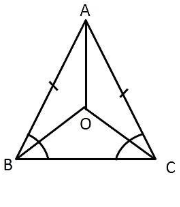
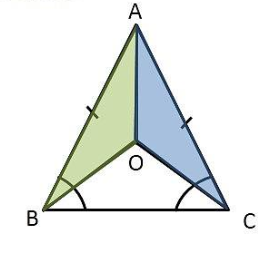
CASE - 1 CASE - 2
NOTE: In this problem given construction is mandatory to prove the given statements so join $A$ and $O$ points.
According to given data we have 3 conditions,
$AB = AC \to (1)$
$OB$ is the bisector of $\angle B$
So,$\angle ABO = \angle OBC = \dfrac{1}{2}\angle B \to (2)$
$OC$ is the bisector of$\angle C$
So,$\angle ACO = \angle OCB = \dfrac{1}{2}\angle C$$ \to (3)$
Case-1
So, here we have to prove $OB = OC$
Proof:
Now by using condition (1) we can say that,
$AB = AC$
From this condition we say that
$ \Rightarrow \angle ACB = \angle ABC$ [ Where we know that Angles opposite to equal sides are equal]
$\
\Rightarrow \dfrac{1}{2}\angle ACB = \dfrac{1}{2}\angle ABC \\
\\
\ $
$ \Rightarrow \angle OCB = \angle OBC$ [From (2) and (3)]
Hence,
$OB = OC$ [Sides opposite to equal angles are equal]
Hence proved that $OB = OC$.
Case-2
We have to prove that $\angle OAB = \angle OAC$
By using case (1) we know that $OB = OC$
And also from $\Delta ABO$ and$\Delta ACO$, we have
$ \Rightarrow AB = AC$ (Given)
$ \Rightarrow AO = OA$ (Common)
$ \Rightarrow OB = OC$(From (case 1))
$\therefore \Delta ABO \cong \Delta ACO$ (By SSS Congruence rule)
$ \Rightarrow \angle OAB = \angle OAC$ (CPCPT Theorem)
Hence we have proved that$\angle OAB = \angle OAC$.
CASE - 1 CASE - 2
NOTE: In this problem given construction is mandatory to prove the given statements so join $A$ and $O$ points.
Recently Updated Pages
Master Class 10 Computer Science: Engaging Questions & Answers for Success

Master Class 10 General Knowledge: Engaging Questions & Answers for Success
Master Class 10 English: Engaging Questions & Answers for Success
Master Class 10 Social Science: Engaging Questions & Answers for Success
Master Class 10 Maths: Engaging Questions & Answers for Success
Master Class 10 Science: Engaging Questions & Answers for Success
Trending doubts
What is the median of the first 10 natural numbers class 10 maths CBSE
Which women's tennis player has 24 Grand Slam singles titles?
Who is the Brand Ambassador of Incredible India?
Why is there a time difference of about 5 hours between class 10 social science CBSE
Write a letter to the principal requesting him to grant class 10 english CBSE
A moving boat is observed from the top of a 150 m high class 10 maths CBSE