




In humans, what is the ratio of the number of gametes produced from one male primary sex cell to the number of gametes produced from one female primary sex cell?
(A) 1:1
(B) 1:3
(C) 1:4
(D) 4:1
Answer
 Verified
574.8k+ views
Hint: The number of spermatozoa produced is four times the number of oocytes produced by humans during their puberty. Sex cells are also known as gametes and they are the reproductive cells.
Complete answer:
In humans, From a diploid, primary spermatocyte, four haploid spermatozoa are produced through meiosis. From a diploid primary oocyte, just one haploid ovum is made. The remaining are polar bodies. These polar bodies don't develop as ovum or ovum.
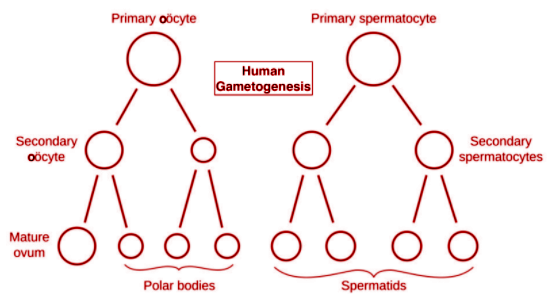
From a diploid, primary spermatocyte, four haploid spermatozoa are produced through meiosis. From a diploid primary oocyte, just one haploid ovum is made. The remaining are polar bodies. These polar bodies don't develop as an ovum. The ratio of the number of gametes produced from one male primary sex cell to the number of gametes produced from one female primary sex cell is 4:1.
Additional Information: Gametes are haploid cells, and every cell carries just one copy of every chromosome. These reproductive cells are produced through a kind of cellular division called meiosis. During meiosis, a diploid parent cell, which has two copies of every chromosome, undergoes one round of DNA replication followed by two separate cycles of nuclear division to supply four haploid cells. These cells become sperm or ova. The ova mature within the ovaries of females, and therefore the sperm develop within the testes of males. Each sperm, or spermatozoon, is little and motile. The spermatozoon features a flagellum, which may be a tail-shaped structure that permits the cell to propel and move. In contrast, each ovum, or ovum, is comparatively large and non-motile. During fertilization, a spermatozoon and ovum unite to make a replacement diploid organism.
So, the correct answer is ‘(d) 4:1’.
Note: Meiosis is a process where one cell divides twice to produce four cells containing half the initial amount of genetic information. The cells which undergo meiosis are our sex cells – sperm in males, eggs in females.
Complete answer:
In humans, From a diploid, primary spermatocyte, four haploid spermatozoa are produced through meiosis. From a diploid primary oocyte, just one haploid ovum is made. The remaining are polar bodies. These polar bodies don't develop as ovum or ovum.
From a diploid, primary spermatocyte, four haploid spermatozoa are produced through meiosis. From a diploid primary oocyte, just one haploid ovum is made. The remaining are polar bodies. These polar bodies don't develop as an ovum. The ratio of the number of gametes produced from one male primary sex cell to the number of gametes produced from one female primary sex cell is 4:1.
Additional Information: Gametes are haploid cells, and every cell carries just one copy of every chromosome. These reproductive cells are produced through a kind of cellular division called meiosis. During meiosis, a diploid parent cell, which has two copies of every chromosome, undergoes one round of DNA replication followed by two separate cycles of nuclear division to supply four haploid cells. These cells become sperm or ova. The ova mature within the ovaries of females, and therefore the sperm develop within the testes of males. Each sperm, or spermatozoon, is little and motile. The spermatozoon features a flagellum, which may be a tail-shaped structure that permits the cell to propel and move. In contrast, each ovum, or ovum, is comparatively large and non-motile. During fertilization, a spermatozoon and ovum unite to make a replacement diploid organism.
So, the correct answer is ‘(d) 4:1’.
Note: Meiosis is a process where one cell divides twice to produce four cells containing half the initial amount of genetic information. The cells which undergo meiosis are our sex cells – sperm in males, eggs in females.
Recently Updated Pages
Master Class 12 Economics: Engaging Questions & Answers for Success

Master Class 12 Physics: Engaging Questions & Answers for Success
Master Class 12 English: Engaging Questions & Answers for Success
Master Class 12 Social Science: Engaging Questions & Answers for Success
Master Class 12 Maths: Engaging Questions & Answers for Success
Master Class 12 Business Studies: Engaging Questions & Answers for Success
Trending doubts
Which are the Top 10 Largest Countries of the World?
What are the major means of transport Explain each class 12 social science CBSE
Draw a labelled sketch of the human eye class 12 physics CBSE
Why cannot DNA pass through cell membranes class 12 biology CBSE
Differentiate between insitu conservation and exsitu class 12 biology CBSE
Draw a neat and well labeled diagram of TS of ovary class 12 biology CBSE