




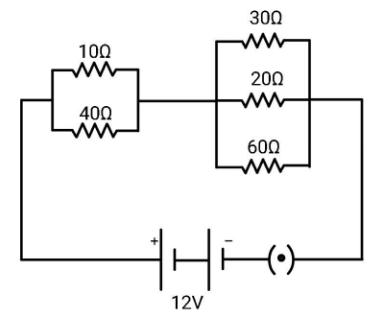
In the circuit diagram given below five resistances of $10\Omega$, $40\Omega $, $30\Omega $, $20\Omega $ and $60\Omega $ are connected as shown to a $12V$ battery.Calculate total resistance in the circuit and net current drawn from the battery.
Answer
 Verified
561.9k+ views
Hint: We are supposed to find the total resistance of the circuit, meaning that, we will find such a value of single resistance which will provide equal resistance that is offered by this combination of resistances. Here, you can see five resistors are present, find the series and parallel combination of these resistances and reduce it to a single resistance. This single resistance will be the total resistance. To find the current, use Ohm’s Law.
Complete step by step answer:
To identify series and parallel, one always looks for the end points of the resistors. Consider two resistors. If only one end of both the resistors are connected to the same point, then the resistors are in series. If both the ends of both resistors are connected to the same point, then the resistors are in parallel. For a clear understanding, let us try labelling the ends. Let the resistors have resistances ${R_1}$ and ${R_2}$. Let the ends of resistor ${R_1}$ be denoted by points A and B and that of resistor ${R_2}$ be denoted by C and D.
We say that, when the points A and C are connected to some point X and the points B and D are connected to some other point Y, the resistors are connected in parallel. Orientation in resistors doesn’t matter, so there is no need for different combinations of end points. Now, let us look for series and parallel combinations of resistances in the circuit. You can see that the resistors $10\Omega $ and $40\Omega $ are in parallel and the resistors $30\Omega $, $20\Omega $ and $60\Omega $ are in parallel combination. When the resistances are connected in parallel combination, the equivalent resistance will be equal to reciprocal of sum of reciprocals. Mathematically,
${R_{eff}} = \dfrac{1}{{\dfrac{1}{{{R_1}}} + \dfrac{1}{{{R_2}}} + \dfrac{1}{{{R_3}}} + ....}}$
So, the equivalent resistance of $10\Omega $ and $40\Omega $ will be $\dfrac{1}{{\dfrac{1}{{10}} + \dfrac{1}{{40}}}} = 8\Omega $ and equivalent resistance of $30\Omega $, $20\Omega $ and $60\Omega $ will be $\dfrac{1}{{\dfrac{1}{{30}} + \dfrac{1}{{20}} + \dfrac{1}{{60}}}} = 10\Omega $.
Now, the circuit is reduced and it can be seen as a series combination of equivalent resistances $8\Omega\, \&\, 10\Omega $. When the resistors are connected in series, the equivalent will be simply the sum of the resistances. Therefore, ${R_{eq}} = 10 + 8 = 18\Omega $. The resistance of the circuit is $18\Omega $.
Using Ohm’s Law, we have $V = IR$ where $V$ is the applied voltage, $I$ is the current and $R$ is the resistance. Here, we have $V = 12V$, $R = 18\Omega $.
Therefore, $I = \dfrac{V}{R} = \dfrac{{12}}{{18}} = \dfrac{2}{3}A$.
Hence, total resistance in the circuit is $18\Omega $ and net current drawn from the battery is $\dfrac{2}{3}A$.
Note: Remember the method of determining the combination in which the resistances are connected, whether they are in series, or in parallel or it is a combination of series and parallel. Also remember Ohm’s Law which gives the relation between current, potential difference (voltage) and resistance.
Complete step by step answer:
To identify series and parallel, one always looks for the end points of the resistors. Consider two resistors. If only one end of both the resistors are connected to the same point, then the resistors are in series. If both the ends of both resistors are connected to the same point, then the resistors are in parallel. For a clear understanding, let us try labelling the ends. Let the resistors have resistances ${R_1}$ and ${R_2}$. Let the ends of resistor ${R_1}$ be denoted by points A and B and that of resistor ${R_2}$ be denoted by C and D.
We say that, when the points A and C are connected to some point X and the points B and D are connected to some other point Y, the resistors are connected in parallel. Orientation in resistors doesn’t matter, so there is no need for different combinations of end points. Now, let us look for series and parallel combinations of resistances in the circuit. You can see that the resistors $10\Omega $ and $40\Omega $ are in parallel and the resistors $30\Omega $, $20\Omega $ and $60\Omega $ are in parallel combination. When the resistances are connected in parallel combination, the equivalent resistance will be equal to reciprocal of sum of reciprocals. Mathematically,
${R_{eff}} = \dfrac{1}{{\dfrac{1}{{{R_1}}} + \dfrac{1}{{{R_2}}} + \dfrac{1}{{{R_3}}} + ....}}$
So, the equivalent resistance of $10\Omega $ and $40\Omega $ will be $\dfrac{1}{{\dfrac{1}{{10}} + \dfrac{1}{{40}}}} = 8\Omega $ and equivalent resistance of $30\Omega $, $20\Omega $ and $60\Omega $ will be $\dfrac{1}{{\dfrac{1}{{30}} + \dfrac{1}{{20}} + \dfrac{1}{{60}}}} = 10\Omega $.
Now, the circuit is reduced and it can be seen as a series combination of equivalent resistances $8\Omega\, \&\, 10\Omega $. When the resistors are connected in series, the equivalent will be simply the sum of the resistances. Therefore, ${R_{eq}} = 10 + 8 = 18\Omega $. The resistance of the circuit is $18\Omega $.
Using Ohm’s Law, we have $V = IR$ where $V$ is the applied voltage, $I$ is the current and $R$ is the resistance. Here, we have $V = 12V$, $R = 18\Omega $.
Therefore, $I = \dfrac{V}{R} = \dfrac{{12}}{{18}} = \dfrac{2}{3}A$.
Hence, total resistance in the circuit is $18\Omega $ and net current drawn from the battery is $\dfrac{2}{3}A$.
Note: Remember the method of determining the combination in which the resistances are connected, whether they are in series, or in parallel or it is a combination of series and parallel. Also remember Ohm’s Law which gives the relation between current, potential difference (voltage) and resistance.
Recently Updated Pages
Master Class 12 Economics: Engaging Questions & Answers for Success

Master Class 12 Physics: Engaging Questions & Answers for Success
Master Class 12 English: Engaging Questions & Answers for Success
Master Class 12 Social Science: Engaging Questions & Answers for Success
Master Class 12 Maths: Engaging Questions & Answers for Success
Master Class 12 Business Studies: Engaging Questions & Answers for Success
Trending doubts
Which are the Top 10 Largest Countries of the World?
What are the major means of transport Explain each class 12 social science CBSE
Draw a labelled sketch of the human eye class 12 physics CBSE
Why cannot DNA pass through cell membranes class 12 biology CBSE
Differentiate between insitu conservation and exsitu class 12 biology CBSE
Draw a neat and well labeled diagram of TS of ovary class 12 biology CBSE