




In the circuit shown, current (in A) through the 50V and 30V batteries are, respectively :
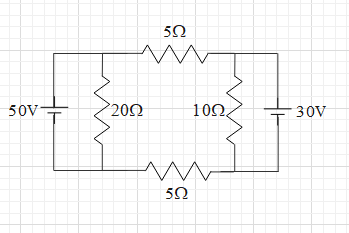
A. 3.5 and 2
B. 3 and 2.5
C. 2.5 and 3
D. 4.5 and 1
Answer
 Verified
588.6k+ views
Hint: Find the currents through the resistances of 20$\Omega $ and 10$\Omega $ by using Ohm’s law. Then use junction law at points C and A and find the currents through both the 5$\Omega $ resistances in terms of current through battery 50V. Then find the value of the current through battery 50V by applying KVL for the outer loop. Use junction law at point D and then find the relation between the currents through both the batteries. Then find the value of the current in the other battery.
Formula used:
V=iR
Complete answer:
Let us first show the current in all the branches of the given circuit. Let the currents through the batteries of 50 V and 30 V be ${{i}_{1}}$ and ${{i}_{2}}$ respectively and shown in the figure below.
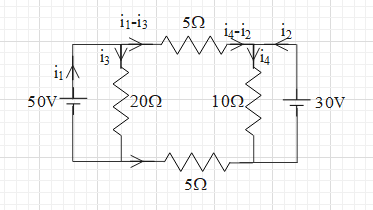
Let the currents through the resistances of 20$\Omega $ and 10$\Omega $ be ${{i}_{3}}$ and ${{i}_{4}}$ respectively.
The potential difference across the 20$\Omega $ resistance is 50V. Therefore, by applying Ohm’s law we get that $50=20{{i}_{3}}$.
$\Rightarrow {{i}_{3}}=\dfrac{20}{50}=2.5A$.
The potential difference across the 10$\Omega $ resistance is 30V. With the same law we get that $30=10{{i}_{4}}$
$\Rightarrow {{i}_{4}}=\dfrac{30}{10}=3A$.
From the junction law at point C, we get the current through the upsides resistance of 5$\Omega $ is ${{i}_{1}}-{{i}_{3}}={{i}_{1}}-2.5$.
Therefore, the potential difference across this resistance is $5\left( {{i}_{1}}-2.5 \right)$.
From the same law at point H, the current through the resistance of 5$\Omega $ down is ${{i}_{3}}-{{i}_{1}}=2.5-{{i}_{1}}$.
Therefore, the potential difference across this resistance is $5\left( 2.5-{{i}_{1}} \right)$.
Now, let us apply Kirchhoff’s loop law for the outer loop ABEFA.
Hence, we get
$50-5\left( {{i}_{1}}-2.5 \right)-30+5\left( 2.5-{{i}_{1}} \right)=0$
$\Rightarrow 20-5{{i}_{1}}+2.5(5)+2.5(5)-5{{i}_{1}}=0$
$\Rightarrow 20-10{{i}_{1}}+25=0$
$\Rightarrow {{i}_{1}}=\dfrac{45}{10}=4.5A$.
Therefore, the current through the battery of 50V is 4.5A.
Similarly, from the junction law at point D, we get the current through the upsides resistance of 5$\Omega $ is ${{i}_{3}}-{{i}_{2}}=3-{{i}_{2}}$.
But we already found the current equal to ${{i}_{1}}-2.5$.
This means that ${{i}_{1}}-2.5=3-{{i}_{2}}$
$\Rightarrow {{i}_{2}}=5.5-{{i}_{1}}$
Substitute the value of ${{i}_{1}}$.
$\Rightarrow {{i}_{2}}=5.5-4.5=1A$.
Therefore, the current through the battery of 30V is 1A.
Hence, the correct option is D.
Note: We can also find ${{i}_{2}}$ by applying junction law points D and G and writing the current in both the resistance of 5$\Omega $ in terms of ${{i}_{2}}$. Then apply Kirchhoff’s loop law for the same loop ABEFA. With this we will find the value of ${{i}_{2}}$.
Formula used:
V=iR
Complete answer:
Let us first show the current in all the branches of the given circuit. Let the currents through the batteries of 50 V and 30 V be ${{i}_{1}}$ and ${{i}_{2}}$ respectively and shown in the figure below.
Let the currents through the resistances of 20$\Omega $ and 10$\Omega $ be ${{i}_{3}}$ and ${{i}_{4}}$ respectively.
The potential difference across the 20$\Omega $ resistance is 50V. Therefore, by applying Ohm’s law we get that $50=20{{i}_{3}}$.
$\Rightarrow {{i}_{3}}=\dfrac{20}{50}=2.5A$.
The potential difference across the 10$\Omega $ resistance is 30V. With the same law we get that $30=10{{i}_{4}}$
$\Rightarrow {{i}_{4}}=\dfrac{30}{10}=3A$.
From the junction law at point C, we get the current through the upsides resistance of 5$\Omega $ is ${{i}_{1}}-{{i}_{3}}={{i}_{1}}-2.5$.
Therefore, the potential difference across this resistance is $5\left( {{i}_{1}}-2.5 \right)$.
From the same law at point H, the current through the resistance of 5$\Omega $ down is ${{i}_{3}}-{{i}_{1}}=2.5-{{i}_{1}}$.
Therefore, the potential difference across this resistance is $5\left( 2.5-{{i}_{1}} \right)$.
Now, let us apply Kirchhoff’s loop law for the outer loop ABEFA.
Hence, we get
$50-5\left( {{i}_{1}}-2.5 \right)-30+5\left( 2.5-{{i}_{1}} \right)=0$
$\Rightarrow 20-5{{i}_{1}}+2.5(5)+2.5(5)-5{{i}_{1}}=0$
$\Rightarrow 20-10{{i}_{1}}+25=0$
$\Rightarrow {{i}_{1}}=\dfrac{45}{10}=4.5A$.
Therefore, the current through the battery of 50V is 4.5A.
Similarly, from the junction law at point D, we get the current through the upsides resistance of 5$\Omega $ is ${{i}_{3}}-{{i}_{2}}=3-{{i}_{2}}$.
But we already found the current equal to ${{i}_{1}}-2.5$.
This means that ${{i}_{1}}-2.5=3-{{i}_{2}}$
$\Rightarrow {{i}_{2}}=5.5-{{i}_{1}}$
Substitute the value of ${{i}_{1}}$.
$\Rightarrow {{i}_{2}}=5.5-4.5=1A$.
Therefore, the current through the battery of 30V is 1A.
Hence, the correct option is D.
Note: We can also find ${{i}_{2}}$ by applying junction law points D and G and writing the current in both the resistance of 5$\Omega $ in terms of ${{i}_{2}}$. Then apply Kirchhoff’s loop law for the same loop ABEFA. With this we will find the value of ${{i}_{2}}$.
Recently Updated Pages
Master Class 12 Economics: Engaging Questions & Answers for Success

Master Class 12 Physics: Engaging Questions & Answers for Success
Master Class 12 English: Engaging Questions & Answers for Success
Master Class 12 Social Science: Engaging Questions & Answers for Success
Master Class 12 Maths: Engaging Questions & Answers for Success
Master Class 12 Business Studies: Engaging Questions & Answers for Success
Trending doubts
Which are the Top 10 Largest Countries of the World?
What are the major means of transport Explain each class 12 social science CBSE
Draw a labelled sketch of the human eye class 12 physics CBSE
Why cannot DNA pass through cell membranes class 12 biology CBSE
Differentiate between insitu conservation and exsitu class 12 biology CBSE
Draw a neat and well labeled diagram of TS of ovary class 12 biology CBSE