




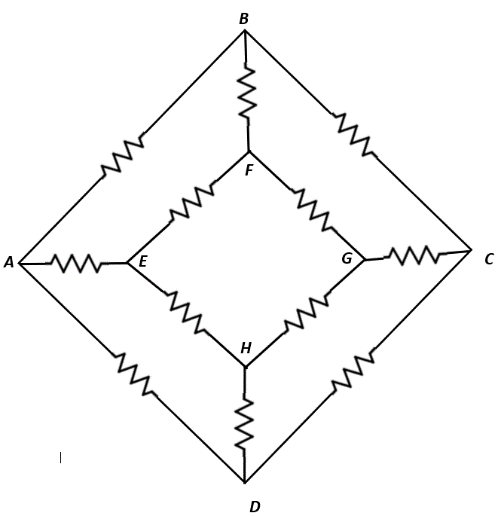
In the network shown in figure, each resistance is$\; R$. The equivalent resistance between A and B is:
A. $\dfrac{3R}{4}$
B. $\dfrac{5R}{6}$
C. $\dfrac{7R}{12}$
D. $\dfrac{4R}{3}$
Answer
 Verified
542.4k+ views
Hint: Begin by construing that a battery is connected across the terminals A and B. Then determine the points that possess the same voltage. The resistors across these points will be parallel to each other. Remember that resistances connected in series are additive whereas those in parallel have an equivalent resistance less than their individual resistances. Use this to calculate the effective resistance of the inner and outer loops, following which you can arrange the resultant equivalent circuit across the terminals A and B and calculate the equivalent resistance.
Formula used:
Effective resistance of two resistors in series: $R_{eff} = R_1 +R_2$
Effective resistance of two resistors in parallel: $\dfrac{1}{R_{eff}} = \dfrac{1}{R_1}+\dfrac{1}{R_2}$
Complete step-by-step answer:
To find the equivalent resistance between A and B, let us assume a battery is connected across A and B.
When this is done, same voltage flows through branches BF and BC, which means that $R_{BF} || R_{BC}$, therefore, the equivalent resistance between B, F and C will be:
$R_{B\leftrightarrow F,C} = \dfrac{R_{BF}R_{BC}}{R_{BF}+R_{BC}} = \dfrac{R \times R}{R+R} = \dfrac{R}{2}$
Similarly, same voltage flows through branches AE and AD, which means that $R_{AD} || R_{AE}$, therefore, the equivalent resistance between A, E and D will be:
$R_{A\leftrightarrow E,D} = \dfrac{R_{AE}R_{AD}}{R_{AE}+R_{AD}} = \dfrac{R \times R}{R+R} = \dfrac{R}{2}$
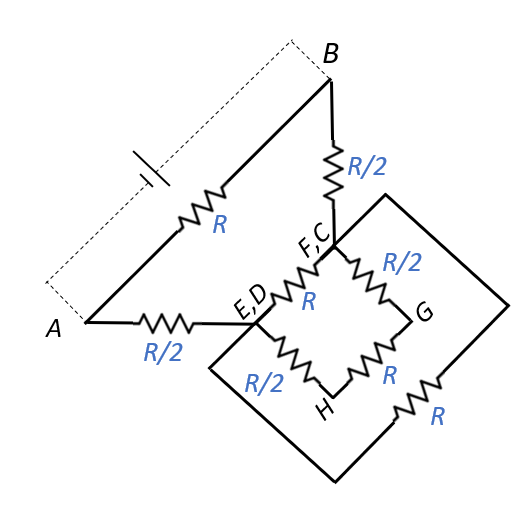
Now, at G, $R_{GF}|| R_{GC}$, therefore, the equivalent resistance between G, F and C will be:
$R_{G\leftrightarrow F,C} = \dfrac{R_{GF}R_{GC}}{R_{GF}+R_{GC}} = \dfrac{R \times R}{R+R} = \dfrac{R}{2}$
Similarly, at H, $R_{HE} || R_{HD}$, therefore, the equivalent resistance between H, E and D will be:
$R_{H\leftrightarrow E,D} = \dfrac{R_{HE}R_{HD}}{R_{HE}+R_{HD}} = \dfrac{R \times R}{R+R} = \dfrac{R}{2}$
If $R_{EF} = R = R_{GH}$, then the equivalent resistance on the inner loop EFGH will be:
$R_{EFGH} = R_{EF} || (R_{G\leftrightarrow F,C} + R_{GH} + R_{H\leftrightarrow E,D}) = R || \left(\dfrac{R}{2} + R + \dfrac{R}{2}\right) = R||2R$
$\Rightarrow R_{EFGH} = \dfrac{R \times 2R}{R+2R} = \dfrac{2R}{3}$
Now, $R_{EFGH}$ is in parallel with $R_{CD} = R$, therefore, the equivalent resistance will be:
$R^{\prime} = \dfrac{R_{EFGH}R_{CD}}{R_{EFGH}+R_{CD}} = \dfrac{\left(\dfrac{2R}{3} \times R\right)}{\left(\dfrac{2R}{3}+R\right)} = \dfrac{\left(\dfrac{2R^2}{3}\right)}{\left(\dfrac{5R}{3}\right)} = \dfrac{2R}{5}$
Now we can find the equivalent resistance across terminals A and B as follows:
$R_{eq} = R_{AB} || \left(R_{B\leftrightarrow F,C} + R^{\prime} + R_{A\leftrightarrow E,D}\right)$
$\Rightarrow R_{eq} = R || \left(\dfrac{R}{2} + \dfrac{2R}{5} + \dfrac{R}{2}\right)$
$\Rightarrow R_{eq} = R|| \left(\dfrac{5R + 4R + 5R}{10}\right) = R||\dfrac{14R}{10} = R||\dfrac{7R}{5}$
Therefore, $R_{eq} = \dfrac{\left(R \times \dfrac{7R}{5}\right)}{\left(R+\dfrac{7R}{5}\right)} = \dfrac{7R^2}{5} \times \dfrac{5}{12R} = \dfrac{7R}{12}$
So, the correct answer is “Option C”.
Note: Remember that a series circuit is a voltage divider whereas a parallel circuit is a current divider. We add up all the resistances in a series circuit because the resistances are arranged in such a way that the current has only one path to take. However, when resistances are connected in parallel, there are multiple paths for the current to pass through but have the same potential difference across them. This results in a net resistance that is lower than any of the individual resistances.
Formula used:
Effective resistance of two resistors in series: $R_{eff} = R_1 +R_2$
Effective resistance of two resistors in parallel: $\dfrac{1}{R_{eff}} = \dfrac{1}{R_1}+\dfrac{1}{R_2}$
Complete step-by-step answer:
To find the equivalent resistance between A and B, let us assume a battery is connected across A and B.
When this is done, same voltage flows through branches BF and BC, which means that $R_{BF} || R_{BC}$, therefore, the equivalent resistance between B, F and C will be:
$R_{B\leftrightarrow F,C} = \dfrac{R_{BF}R_{BC}}{R_{BF}+R_{BC}} = \dfrac{R \times R}{R+R} = \dfrac{R}{2}$
Similarly, same voltage flows through branches AE and AD, which means that $R_{AD} || R_{AE}$, therefore, the equivalent resistance between A, E and D will be:
$R_{A\leftrightarrow E,D} = \dfrac{R_{AE}R_{AD}}{R_{AE}+R_{AD}} = \dfrac{R \times R}{R+R} = \dfrac{R}{2}$
Now, at G, $R_{GF}|| R_{GC}$, therefore, the equivalent resistance between G, F and C will be:
$R_{G\leftrightarrow F,C} = \dfrac{R_{GF}R_{GC}}{R_{GF}+R_{GC}} = \dfrac{R \times R}{R+R} = \dfrac{R}{2}$
Similarly, at H, $R_{HE} || R_{HD}$, therefore, the equivalent resistance between H, E and D will be:
$R_{H\leftrightarrow E,D} = \dfrac{R_{HE}R_{HD}}{R_{HE}+R_{HD}} = \dfrac{R \times R}{R+R} = \dfrac{R}{2}$
If $R_{EF} = R = R_{GH}$, then the equivalent resistance on the inner loop EFGH will be:
$R_{EFGH} = R_{EF} || (R_{G\leftrightarrow F,C} + R_{GH} + R_{H\leftrightarrow E,D}) = R || \left(\dfrac{R}{2} + R + \dfrac{R}{2}\right) = R||2R$
$\Rightarrow R_{EFGH} = \dfrac{R \times 2R}{R+2R} = \dfrac{2R}{3}$
Now, $R_{EFGH}$ is in parallel with $R_{CD} = R$, therefore, the equivalent resistance will be:
$R^{\prime} = \dfrac{R_{EFGH}R_{CD}}{R_{EFGH}+R_{CD}} = \dfrac{\left(\dfrac{2R}{3} \times R\right)}{\left(\dfrac{2R}{3}+R\right)} = \dfrac{\left(\dfrac{2R^2}{3}\right)}{\left(\dfrac{5R}{3}\right)} = \dfrac{2R}{5}$
Now we can find the equivalent resistance across terminals A and B as follows:
$R_{eq} = R_{AB} || \left(R_{B\leftrightarrow F,C} + R^{\prime} + R_{A\leftrightarrow E,D}\right)$
$\Rightarrow R_{eq} = R || \left(\dfrac{R}{2} + \dfrac{2R}{5} + \dfrac{R}{2}\right)$
$\Rightarrow R_{eq} = R|| \left(\dfrac{5R + 4R + 5R}{10}\right) = R||\dfrac{14R}{10} = R||\dfrac{7R}{5}$
Therefore, $R_{eq} = \dfrac{\left(R \times \dfrac{7R}{5}\right)}{\left(R+\dfrac{7R}{5}\right)} = \dfrac{7R^2}{5} \times \dfrac{5}{12R} = \dfrac{7R}{12}$
So, the correct answer is “Option C”.
Note: Remember that a series circuit is a voltage divider whereas a parallel circuit is a current divider. We add up all the resistances in a series circuit because the resistances are arranged in such a way that the current has only one path to take. However, when resistances are connected in parallel, there are multiple paths for the current to pass through but have the same potential difference across them. This results in a net resistance that is lower than any of the individual resistances.
Recently Updated Pages
Master Class 12 Economics: Engaging Questions & Answers for Success

Master Class 12 Physics: Engaging Questions & Answers for Success
Master Class 12 English: Engaging Questions & Answers for Success
Master Class 12 Social Science: Engaging Questions & Answers for Success
Master Class 12 Maths: Engaging Questions & Answers for Success
Master Class 12 Business Studies: Engaging Questions & Answers for Success
Trending doubts
Why cannot DNA pass through cell membranes class 12 biology CBSE
Draw a neat and well labeled diagram of TS of ovary class 12 biology CBSE
In a human foetus the limbs and digits develop after class 12 biology CBSE
AABbCc genotype forms how many types of gametes a 4 class 12 biology CBSE
Differentiate between homogeneous and heterogeneous class 12 chemistry CBSE
The correct structure of ethylenediaminetetraacetic class 12 chemistry CBSE