




In the Reimer Tiemann reaction dichlorocarbene acts as:
A. Nucleophile
B. Electrophile
C. Free radical
D. All of these
Answer
 Verified
568.8k+ views
Hint: To solve this question one should know the complete Reimer Tiemann reaction. One should know the reactants used in the reaction and the products formed under the favorable conditions used in the reactions. We should know the proper mechanism of the reaction otherwise we will not be able to conclude about the dichlorocarbene. First, we will understand the conceptual meaning of the Reimer Tiemann reaction with the proper mechanism, and with the help of the reaction mechanism, we will be able to conclude about dichlorocarbene.
Reimer Tiemann reaction is a type of electrophilic substitution reaction. Reimer Tiemann reaction converts phenol to ortho-hydroxybenzaldehyde.
Complete step by step answer:
A simple reimer Tiemann reaction with reactants, reagents, and products can be written as given below.

The reaction mechanism is given below which involves the formation of dichlorocarbene which is represented as \[:CC{l_2}\].
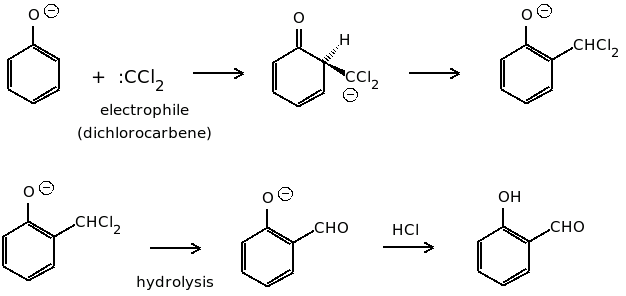
From the above reaction mechanism, we can conclude that the Reimer Tiemann reaction is an electrophilic substitution reaction in which dichlorocarbene acts as an electrophile and is substituted at the ortho position.
So, the correct answer is Option B.
Note: Electrophilic substitution reaction is the type of chemical reaction in which an electrophile displaces any functional group present at any position to form a product.
There is one more type of substitution reaction called nucleophilic substitution reaction in which the leaving group is replaced by the electron-rich compound.
The condition of the Reimer Tiemann reaction is that it requires \[1\] a mole of \[CHC{l_3}\] chloroform and \[3\]moles of potassium hydroxide \[KOH\].
Some of the examples of electrophiles are \[NO_2^ +,S{O_3}\].
Reimer Tiemann reaction is a type of electrophilic substitution reaction. Reimer Tiemann reaction converts phenol to ortho-hydroxybenzaldehyde.
Complete step by step answer:
A simple reimer Tiemann reaction with reactants, reagents, and products can be written as given below.
The reaction mechanism is given below which involves the formation of dichlorocarbene which is represented as \[:CC{l_2}\].
From the above reaction mechanism, we can conclude that the Reimer Tiemann reaction is an electrophilic substitution reaction in which dichlorocarbene acts as an electrophile and is substituted at the ortho position.
So, the correct answer is Option B.
Note: Electrophilic substitution reaction is the type of chemical reaction in which an electrophile displaces any functional group present at any position to form a product.
There is one more type of substitution reaction called nucleophilic substitution reaction in which the leaving group is replaced by the electron-rich compound.
The condition of the Reimer Tiemann reaction is that it requires \[1\] a mole of \[CHC{l_3}\] chloroform and \[3\]moles of potassium hydroxide \[KOH\].
Some of the examples of electrophiles are \[NO_2^ +,S{O_3}\].
Recently Updated Pages
Master Class 12 Economics: Engaging Questions & Answers for Success

Master Class 12 Physics: Engaging Questions & Answers for Success
Master Class 12 English: Engaging Questions & Answers for Success
Master Class 12 Social Science: Engaging Questions & Answers for Success
Master Class 12 Maths: Engaging Questions & Answers for Success
Master Class 12 Business Studies: Engaging Questions & Answers for Success
Trending doubts
Which are the Top 10 Largest Countries of the World?
What are the major means of transport Explain each class 12 social science CBSE
Draw a labelled sketch of the human eye class 12 physics CBSE
Why cannot DNA pass through cell membranes class 12 biology CBSE
Differentiate between insitu conservation and exsitu class 12 biology CBSE
Draw a neat and well labeled diagram of TS of ovary class 12 biology CBSE