




In which stage of complete metamorphosis, does a creature eat a lot in order to store food?
A) Egg
B) Larva
C) Adult
D) Both B and C
Answer
 Verified
507.6k+ views
Hint: Metamorphosis is the series of changes an organism undergoes to convert itself from egg to an adult. In case of complete metamorphosis, there are four stages of development- egg, larva, pupa and adult stage. All these stages vary in terms of morphology. Example- ant, moths, wasps, butterflies etc.
Complete answer:
Metamorphosis is a series of gradual changes which an organism undergoes after the birth to become an adult. The change includes several cell differentiation and division. This cycle is controlled by the hormone thyroxine secreted thyroid glands. In case of complete metamorphosis, the growth and differentiation take place in four steps.
Let us discuss the complete metamorphosis in insects.
Egg- The first step of complete metamorphosis starts from the egg. The insects hatch from the egg and mature into a larva.
Larva- The larva is the small worm which feeds continuously so that they can grow and also store food for further developmental stages.
Pupa- At the end of the larval stage the insects will make hard shell-like outer covering and develop as pupa. At this stage they do not eat or move but undergo several developmental processes.
Adult- The pupa breaks the hard shell and emerges as an adult moth after complete development. The exoskeleton is completely developed and is ready for the reproductive phase.
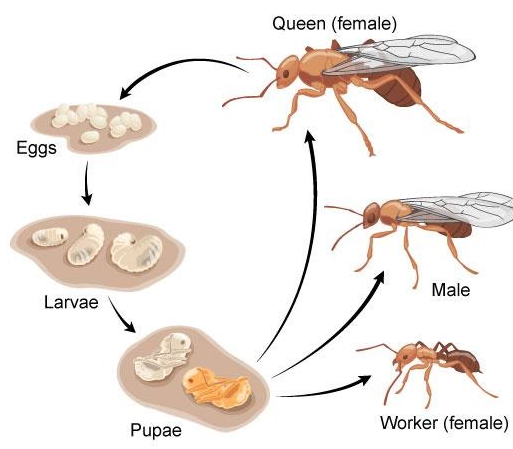
Therefore the correct answer is option ‘B’.
Note: Another type of metamorphosis is the incomplete metamorphosis where the egg hatches to a nymphal stage which develops into an adult. The nymph resembles the adults but are smaller in size and the wings are absent. Example- cockroach, grasshoppers.
Complete answer:
Metamorphosis is a series of gradual changes which an organism undergoes after the birth to become an adult. The change includes several cell differentiation and division. This cycle is controlled by the hormone thyroxine secreted thyroid glands. In case of complete metamorphosis, the growth and differentiation take place in four steps.
Let us discuss the complete metamorphosis in insects.
Egg- The first step of complete metamorphosis starts from the egg. The insects hatch from the egg and mature into a larva.
Larva- The larva is the small worm which feeds continuously so that they can grow and also store food for further developmental stages.
Pupa- At the end of the larval stage the insects will make hard shell-like outer covering and develop as pupa. At this stage they do not eat or move but undergo several developmental processes.
Adult- The pupa breaks the hard shell and emerges as an adult moth after complete development. The exoskeleton is completely developed and is ready for the reproductive phase.
Therefore the correct answer is option ‘B’.
Note: Another type of metamorphosis is the incomplete metamorphosis where the egg hatches to a nymphal stage which develops into an adult. The nymph resembles the adults but are smaller in size and the wings are absent. Example- cockroach, grasshoppers.
Recently Updated Pages
Master Class 12 Economics: Engaging Questions & Answers for Success

Master Class 12 Physics: Engaging Questions & Answers for Success
Master Class 12 English: Engaging Questions & Answers for Success
Master Class 12 Social Science: Engaging Questions & Answers for Success
Master Class 12 Maths: Engaging Questions & Answers for Success
Master Class 12 Business Studies: Engaging Questions & Answers for Success
Trending doubts
Which are the Top 10 Largest Countries of the World?
What are the major means of transport Explain each class 12 social science CBSE
Draw a labelled sketch of the human eye class 12 physics CBSE
Why cannot DNA pass through cell membranes class 12 biology CBSE
Differentiate between insitu conservation and exsitu class 12 biology CBSE
Draw a neat and well labeled diagram of TS of ovary class 12 biology CBSE